I'll get straight to the questions almost every beginner has when first getting into this sport.
This article explains how a beginner paragliding course really works, so you can judge any school you are considering. If you are ready to start and want the dates, fees and what is included in our one-to-one P1–P2 course at Khau Pha, see learn to paraglide in Vietnam.
✦ 1. Beginners often don't know where to start
This is a very common situation. A simple online search for "paragliding courses" will yield a variety of promotional info, such as: ✦ Learn to fly in 3 days ✦ Become a pilot in 7 days ✦ Training available in Hanoi, Saigon, Da Nang... ✦ Earn an international certificate ✦ Fly independently immediately after completion While these sound highly attractive, to be completely honest, the majority of basic courses on the market share a similar training curriculum. The core issue doesn't lie in their marketing. The real question is: what you are taught, who your instructors are, and whether the training is thorough enough. This is the most crucial aspect.
✦ 2. What actually happens in a basic paragliding course?
If properly trained, a basic paragliding course for beginners usually follows these 4 main steps: 🟦 Step 1 – Ground Handling (Kiting): This is the absolute most important part, yet it's the one many beginners tend to underestimate the most. In this phase, you’ll practice basic skills like: ✔️ Inflating the wing ✔️ Controlling the canopy ✔️ Running while managing the wing ✔️ Feeling how the glider reacts to the wind ✔️ Learning to "read" the wing through your hands and body This part is 100% practical, and how fast you "pass" this stage depends heavily on: Your intuition and feel Your physical stamina Your focus How much effort you put into practicing I’ll be completely honest: The more thoroughly you practice ground handling, the safer you will be when you actually fly. Many new students are eager to "just fly already," but in paragliding: Ground handling isn’t a side quest — it’s the very foundation of safety. 🟩 Step 2 – P1 Level: Intro to Low-Level Flights Once you have a solid foundation from Step 1, are mentally calm, and—most importantly—respond well to radio commands, you’ll move to the next phase: low flights. Usually, you'll practice flying at an altitude of about 3 to 5 meters. The goal here is to get you used to: ✔️ The feeling of your feet leaving the ground ✔️ Initial control reflexes ✔️ Proper launch techniques ✔️ Proper landing techniques ✔️ Executing the instructor's commands This phase can be done in a few ways, like winch towing or launching from a small training hill. This is the moment you finally think: ✨ "Wow, I’m actually flying." But let's be clear: Flying low doesn’t mean you fully know how to fly yet. It’s just the transition between technical drills and developing real flying skills. 🟨 Step 3 – Theory and Safety Skills Beginners often brush this off, but in my opinion, it largely dictates whether or not you become a safe pilot. In this phase, you’ll learn: ✔️ Basic flight theory ✔️ Basic meteorology and wind ✔️ How to read flying conditions ✔️ The reserve parachute system and how to deploy it ✔️ What to do if you lose radio contact ✔️ How to handle abnormal in-flight situations ✔️ Basic flight planning There’s usually a review or theory test so that you aren't just "listening for fun," but actually grasp what you're doing.
I always tell my students: A safe pilot isn't the bravest one, but the one who knows when to fly and when to stay on the ground.
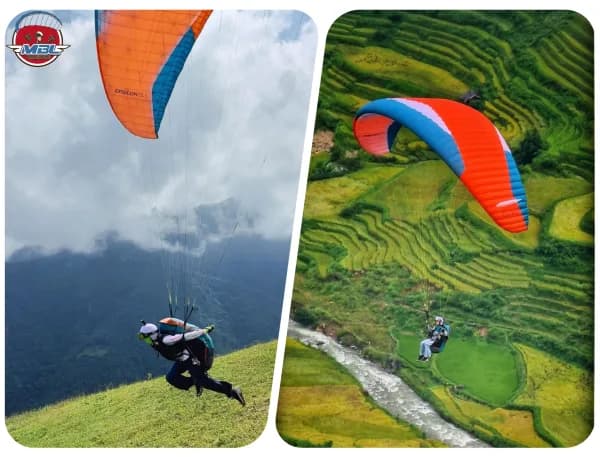
🟥 Step 4 – P2 Level: High Altitude – The First Flight This is the milestone almost every student looks forward to the most. Once you’ve built a solid foundation in the previous steps, you’ll head up to a high-altitude launch site (typically around 400 – 600 meters, depending on the location) for your very first high flight. Of course, at this stage, you will always have at least two instructors directly assisting you. They will be handling: ✔️ Assessing wind conditions ✔️ Inspecting the equipment ✔️ Double-checking your harness and carabiner connections ✔️ Testing radio communications ✔️ Guiding your launch with clear commands ✔️ Monitoring your entire flight path ✔️ Assisting you with landing commands To be completely honest, on your first high flight, you don't really need to "show off" any complex skills. The absolute most important thing at that moment is simply: 🎯 Listen to your instructor – follow directions exactly – and stay calm. That’s all it takes.
✦ 3. Is 3 days of training truly enough?
This is the question almost everyone asks me. And the honest answer is: ❌ NO – not if your goal is to learn properly and build a solid foundation. Unless you're that "rare talent" with great fitness, excellent intuition, fast reflexes, and the ability to breeze through every drill in half a session. But for the average person, each of the phases mentioned above typically takes 2 to 4 days to: Get familiar with the movements; Repetitively practice them; Correct mistakes; And build muscle memory. This means that if you want to learn correctly and comprehensively, a reasonable timeframe for a basic course is: ⏳ A minimum of 7 continuous days or more. ❗So what happens if you only train for 3 days? Something has to give: CONTENT GETS CUT. And skipping content means that while you might still "get to fly," you probably haven't learned enough to truly understand the glider. You might not understand the wind, you may not have developed adequate reflexes, and you may not have the solid foundation needed to progress safely in the long run. Don't cut corners to save a day or two in the beginning, only to pay the price with unnecessary risks later on. Based on my years of experience, here are my key takeaways:
"The more thoroughly you learn in the beginning, the faster and safer you will progress later on."
✦ 4. Before you start, you need to clearly define your goals
In my opinion, paragliding students usually fall into two categories: 🎈 Type 1 – Learning just to experience the feeling of flight (but not pursuing it long-term). If you are learning just to: ✔️ try the feeling of a solo flight ✔️ know what it feels like to take off and fly alone ✔️ tick off the "I've flown" box Then honestly, a short course of about 3 to 4 days is enough for you to touch that experience. But let's be real: 😄 Flying like that... is pretty boring. You only hover for a few seconds, barely having time to feel anything—not high enough, not far enough, and just not satisfying enough. As I jokingly like to put it: "That's not flying, that's just 'a little hop' 😄" 🦅 Type 2 – Learning to become a real pilot If you are learning because you want to: ✔️ fly safely ✔️ pursue paragliding long-term ✔️ make genuine progress ✔️ one day fly completely free Then my advice is: Learn it properly right from the start. The reason is very simple: - the more methodical the training → the safer you are - the stronger the foundation → the further you will go - the more thorough the learning → the faster you will level up later And I'll be perfectly blunt: 💬 DO NOT SKIMP ON MONEY in the early stages. If you are serious about this sport, invest in: - time for basic training - a good instructor - the right training roadmap - a serious learning environment Don't just choose a place because it's a bit cheaper while ignoring who is actually teaching you, because the difference between instructors is massive. For example: - An instructor who has never experienced a wing collapse will find it hard to teach you how to truly handle one. - An instructor who has never flown aerobatics cannot teach you how to deal with complex glider states. - An instructor who has never flown high or flown long distances... will struggle to get you to that level later on. It sounds a bit blunt, but it's the truth.
✦ 5. What are the P1 – P2 – P3 – P4 – P5 levels?
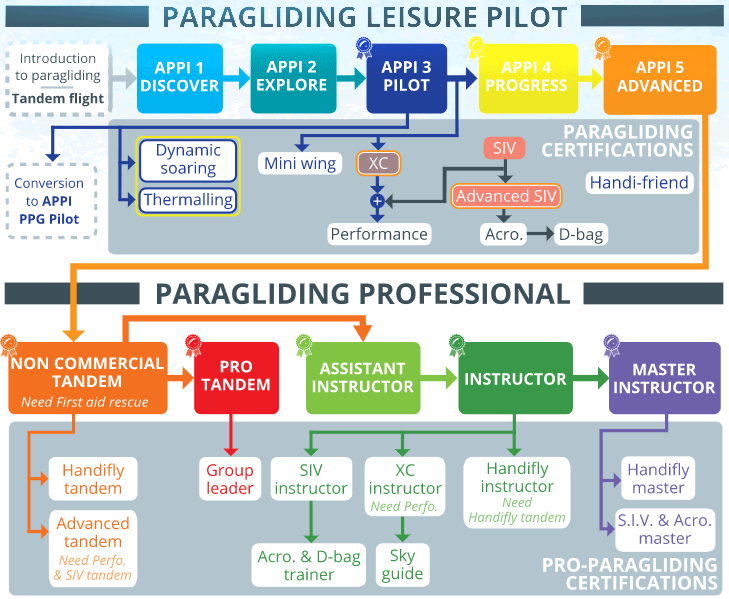
These are the paragliding pilot levels according to general global standards. I will explain them in the easiest way to understand: 🟢 P1 – Introductory Level You start to know how to: ✔️ Pack the glider ✔️ Inflate the wing ✔️ Control the glider on the ground (ground handling) ✔️ May or may not be able to do low flights Jokingly speaking, P1 is like having a "crush on paragliding"—meaning you are just getting familiar with the sport, but cannot be called a real pilot yet. 🔵 P2 – Trainee Pilot This is the level for someone who has the basic foundation to enter the actual flying phase. Usually, at this level, you will have: ✔️ A minimum of 30 hours of ground handling ✔️ Basic knowledge of wind ✔️ Basic glider control skills ✔️ The ability to take off / land under an instructor's guidance ✔️ The ability to fly solo, but not yet completely independently P2 can be simply understood as: 🎓 "Trainee Pilot" - Meaning you are on the path to becoming a pilot, but still need direct supervision from an instructor. 🟣 P3 – Junior Pilot - Beginning independent flight Once you have accumulated enough experience and are confirmed by your instructor to have sufficient skills & knowledge to: ✔️ Prepare by yourself ✔️ Make basic flying decisions on your own ✔️ Control the flight at a safe level by yourself then congratulations, you have started to reach the P3 level. At this level, you can begin to: - fly at more locations - fly without an instructor constantly "hovering" over you - gradually enter the phase of being a true pilot Usually, to reach P3, students will need: - about 50 – 100 flights or 15-30 flight hours. - along with some skills such as: - 360° turns - pitching - big ears - and sufficiently good theoretical knowledge 🟠 P4 – Intermediate Pilot This is a very important level if you want to truly fly free. At this level, you need additional skills such as: ✔️ Thermal flying ✔️ Ridge soaring ✔️ Rapid descent techniques ✔️ Handling basic wing collapses ✔️ A deeper understanding of meteorology and flying techniques ✔️ Accumulating enough flight hours (usually over 100 hours) If P3 is starting to be able to fly independently, then P4 is when you begin to: 🌤️ truly "live" in this sport. 🔴 P5 – Advanced Pilot If P4 is like a general practitioner, then P5 is like: 🏅 A specialist. Meaning you can not only fly, but you are also very deep into a specific branch, for example: ✔️ P5 Cross-Country (XC) ✔️ P5 Accuracy (Spot landing) ✔️ P5 Aerobatics (Acro) This is the level for pilots who have trained for a long time, usually requiring a minimum of: - about 200 flight hours - and at least 2 years of serious training But note that P5 is not a professional license. If you want to become an instructor or engage in commercial flying operations, you will need other corresponding certifications.
✦ 6. Do you need to get a pilot license right from the start?
This is a question many students ask me. The honest answer is: ❌ No need to rush. At the P1 – P2 level, you are not yet a completely independent pilot. You are still a student. And the reality is: Nowhere in the world recognizes P1 – P2 to allow you to fly freely everywhere without an instructor's supervision. Therefore, trying to get a P1 – P2 license too early usually: lacks much practical meaning and also costs extra for: examination fees license issuance fees membership fees 🎯 The thing you need to focus on in the early stages is not a certificate. It is: REAL SKILLS You need to prioritize: ✔️ Takeoff skills ✔️ Landing skills ✔️ Wing control skills ✔️ Safety mindset ✔️ Reflexes for handling situations ✔️ The ability to make the right decisions When you reach a level equivalent to P3, then you should consider: 🪪 taking the exam and getting your license - That is a much more reasonable timeframe. ❓ If you don't have a P1 – P2 license yet, can you be issued a P3? ✅ YES. You can absolutely take the exam once and be issued: P1 + P2 + P3 at the same time. This is the approach that many pilots choose, because it: saves time saves money is much more practical Some people even get their P1 + P2 + P3 + P4 all at once. 💡 My honest advice In your initial basic course, don't worry too much about certificates. Instead, pay attention to the more important questions: ✔️ Who is your instructor? ✔️ What are you actually learning? ✔️ Is the program methodical enough? ✔️ Is safety the top priority? Those are the things that will truly determine your flying future.
✦ 7. Will I receive support after the course? And where will I be able to fly?
This is a very practical question, and in my opinion, students should clarify this right from the start. Typically, a basic course has: - A specific roadmap - A specific cost - Specific goals Technically, when the course ends, the official training also concludes. This means: ⚠️ Not every school continues to support students after the course. To be honest, many places will not provide further support once you finish, and that isn't necessarily "wrong"—but you should be aware of it before signing up. 🤝 Some places will continue to support you—but with conditions. There are schools where instructors are willing to keep supporting students after the course, provided: ✔️ You are serious about paragliding ✔️ You have your own equipment ✔️ You continue to practice regularly In such cases, an instructor can support you during the early stages by: - Guiding your first flights after the course - Fine-tuning your takeoff and landing reflexes - Continuing to correct your ground handling skills - Assessing suitable flight conditions - Guiding you at flight sites that are safe for your level 📍 Where can I fly after the course? The answer is: You will fly at sites that your instructor deems safe enough for your current skill level. This is extremely important. It’s not as if you finish the course and can immediately "grab your glider and fly anywhere." A new student should only fly at sites that are: ✔️ Safe in terms of conditions ✔️ Easy to control with low risk ✔️ Appropriate for your current level Flying at the right spot, in the right conditions, and within your capabilities—that is the only way to progress safely.
✦ 8. Can I use the school's equipment after the course?
To be honest: ❌ Usually, NO. And this is completely reasonable. Paragliding gear is the type of equipment that is: - Very expensive - Easily damaged if used incorrectly - Subject to rapid depreciation - Extremely prone to quality degradation if not used and maintained properly by students Therefore, most schools or instructors cannot continue to provide free equipment after the course ends. 💸 What if I don't have my own glider yet? You can rent equipment, but you should know beforehand that: 💰 Rental prices are usually around 500,000 – 700,000 VND per day per set. If you are serious about this sport and plan to keep practicing after the course, then in the long run: ✅ The most optimal solution is to buy your own set. 🪂 Should I buy new or used gear? The answer is: it depends on your budget. ⚠️ You can certainly buy used gear to save costs, but the mandatory condition is: You must have your instructor or a professional inspect it before purchasing. 📌 Reference Price Ranges: Used gear: Approximately 30 – 60 million VND per set. New gear: Approximately 60 – 120 million VND per set. For beginners, buying high-quality used gear is often the more sensible option. But there is one thing I want to make very clear: 🚫 DON'T GET GREEDY FOR CHEAP DEALS. There are gliders on the market priced at only 10 – 20 million VND, but usually: - The fabric has degraded - The porosity (air permeability) is poor - Safety is no longer guaranteed - Or the equipment is truly "worn out"
Keep this in mind: Nothing is more precious than your own safety. Saving a few million VND by compromising on unreliable equipment is absolutely not worth the risk.
✦ 9. If you are a beginner, how do I recommend you learn?
If you ask for my most honest advice, here is what I would say: ✅ If you are learning to pursue this sport long-term, follow this path: ✔️ Choose an instructor with real combat experience ✔️ Choose a school that is methodical, one that doesn't cut content ✔️ Dedicate enough time to the basics ✔️ Don't obsess over "how many days until I fly" ✔️ Don't rush after certificates ✔️ Prioritize safety, real skills, and reflexes
🧭 In paragliding, the person who goes the furthest is not the one who learns the fastest, but the one with the strongest foundation.
✦ 10. So, if I want to learn, where should I register?
If you’ve read this far, you’ve probably realized one thing: The most important thing isn't finding where is the cheapest to learn, but finding who is the right person to learn from. A good course should be a place where you receive: ✔️ A clear training roadmap ✔️ Instructors with real-world experience ✔️ Comprehensive training content ✔️ Serious post-course support ✔️ And most importantly: A safety-first flying mindset right from the start If you are a beginner and want to learn properly, with a focus on: - safety - the right foundation - a long-term direction - not just learning "to say you tried" then you should choose a place where the instructors truly know their craft and genuinely care about their students.
🪂 Closing Words
If you are truly serious about entering the world of paragliding, my most sincere advice is this: Learn a bit slower, but learn solidly. In paragliding, the person who goes the furthest is not the most rushed. It is the one who builds the best foundation from day one. If you learn the right way, you won’t just fly. You will fly safely, fly beautifully, and be able to fly for a very long time to come.
📩 Ask about the P1 – P2 course
Wishing you will soon find your joy with a paraglider in the sky — Pilot Dang Van My
📩 Register for P1 – P2 Course Consultation If you would like to learn more about: ✔️ A training roadmap tailored to you ✔️ Realistic training duration ✔️ Training locations ✔️ Course fees ✔️ Whether to learn for the experience or for long-term pursuit 👉 Contact the Mebayluon hotline +84 385 907 789 directly for a clear consultation before registering.
🤔 13 common myths about paragliding
Want it faster, or one to one?
If group scheduling does not suit you, or you want the pace set by your own progress, our one-to-one course may fit better — just you and your instructor each session.