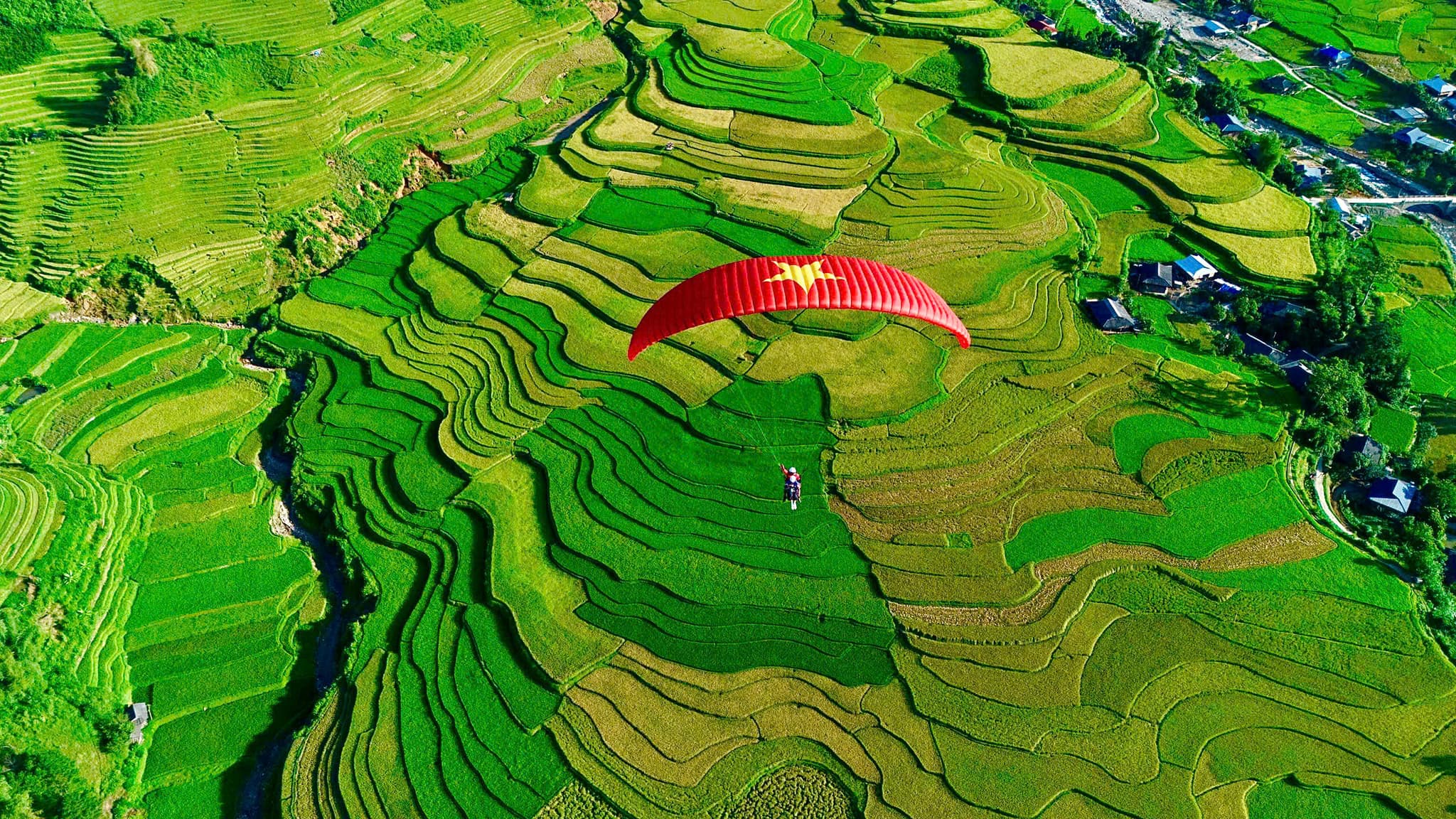
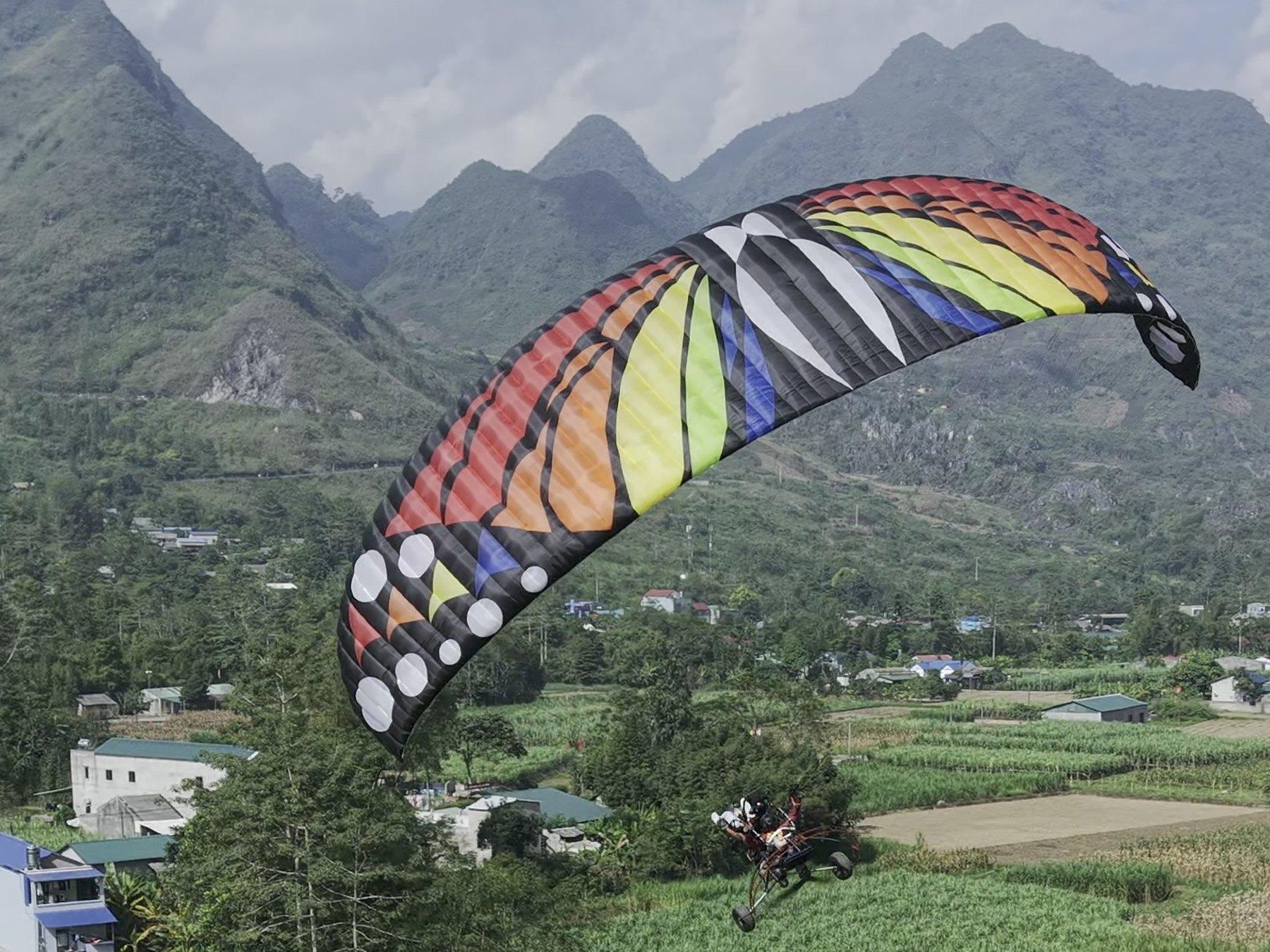
This article comes from the PPG and paratrike training manual Mebayluon wrote in October 2026, the paratrike part: a powered paraglider that takes off from a three-wheeled frame instead of a foot-launch run. At our Khau Pha and Quan Ba (Ha Giang) sites Mebayluon flies PPG mostly on trikes, so this is the part we teach in the most detail. General equipment, throttle and pitch, and the basic landing circuit are covered in PPG Fundamentals; this article only deals with what is specific to the trike: balancing the trike, takeoff, landing and how to keep it from rolling over.
Every figure in this article about engines, torque settings and weight ranges is an example taken from manufacturers' manuals (Vittorazi, Fly Products, Advance, Dudek). Always check your own trike and wing against the manuals that came with them. Reading an article never replaces flight training with an instructor and a radio.
1. How a paratrike differs from a foot-launched PPG
| Paraglider (PG) | Foot-launched PPG | Paratrike (three-wheeled) | |
|---|---|---|---|
| Thrust | None; flies on rising air | Engine worn on the back | Engine mounted on the trike |
| Takeoff | Running launch on a slope | Running launch on flat ground | Rolling takeoff on flat ground |
| Advantages | Light, quiet | Takes off from almost any open field | No running, can carry 2 people, easy takeoff in nil wind and at high sites |
| Specific risks | Weather and terrain dependent | Propeller at engine start, leg injuries | Rollover, lines sucked into the propeller |
Overall, flying a trike carries about the same risk as foot-launching, but the risk of propeller injuries is much lower because you sit inside the frame instead of wearing the engine on your back. In return the trike is heavy: the whole unit flies at a much higher load, so it flies faster, climbs worse and burns more fuel than a foot-launched PPG. Serious trike accidents usually happen when a pilot believes the trike will climb over trees, power lines or a hillside when in fact it cannot.
2. How a paratrike is built
- Frame and wheels: a wide wheel track, a low centre of gravity and the mass kept in the middle of the trike make it hard to roll over. Big, soft tyres keep the trike smooth on bumpy grass.
- Hang arms and hang points: high hang points make the trike swing less in flight; low hang points make it harder to roll on the ground but it swings more in the air. Trikes usually have several attachment holes so you can adjust for the pilot's weight.
- The thrust line sits close to or below the pivot (the hang points) and points slightly upward, so the propeller wash does not disturb the wing.
- Line support: the trike must have line supports under or behind the seat so the lines cannot fall into the propeller or catch on the rear wheels during inflation. Many trikes also have an A-assist bar to help pull the A-lines.
- Nose-wheel steering pedals: they steer like a sled: push right and the trike turns left. People used to motorbikes and cars often get this the wrong way round during their first taxi runs.
- Throttle, kill switch, wheel brake: you must be able to press the kill switch while holding the brake toggles.
- The reserve is mounted on the frame, with the handle within reach once you are seated and strapped in.
- Two-seat trikes have an extra structure in front of the front passenger's legs, so that in a hard landing the frame takes the impact instead of the passenger's legs.
Engine: a trike engine is bigger than a backpack engine because it has to push the whole trike. Trikes, especially two-seaters, mostly use twin-cylinder engines. Some trikes use a large single-cylinder engine such as the Vittorazi Cosmos 300 or the Simonini Victor 1 (about 400 cc). Mebayluon's manual uses the Moster 185 as the example for a single-seat trike and the Cosmos 300 for a two-seater. For fuel mixing, warm-up and maintenance, see Paramotor 2-stroke engines.
3. Choosing the wing and the load for a trike
Wing loading = total takeoff weight ÷ flat area of the wing (kg/m²). On a trike the total weight includes the pilot, the fuelled trike, the wing and the reserve, so it is far higher than with a foot-launched PPG. Worked examples from the manual:
- Foot-launched PPG: pilot 75 kg + fuelled paramotor 30 kg + wing and reserve 7 kg + flying kit 3 kg ≈ 115 kg.
- Single-seat trike: pilot 80 kg + fuelled trike 70 kg + wing 7 kg ≈ 157 kg: above the 155 kg top of the powered range of an Advance Alpha 8 Classic size 26, so you have to go up to size 31 (powered range 100–210 kg).
- Two-seat trike: weigh the trike, weigh both people, add the fuel, and only then choose the tandem wing size (the Dudek Cabrio, for example, comes in sizes from about 110 to 400 kg).
Always weigh for real and fly within the weight range on the wing's label, the range certified for powered flight. A heavily loaded wing flies faster, is more responsive, needs a longer takeoff run (here a longer roll) and reacts harder when it collapses. Wings for two-seat trikes are usually reflex wings: trimmers closed for takeoff and landing, opened gradually once high enough; with the trimmers open, do not pull the main brakes, steer with the tip steering. For the full picture see Reflex wings explained.
4. Trike hang check: nose up 5–15°
The hang check is the most important job on a trike, and it has to be done with the pilot who will actually fly it. Hang the whole trike from its hang points (on a rig, or by pulling up on the A and B lines), have the pilot sit in, then look at the angle of the trike:
- Ideal: the rear wheels lower than the nose wheel, nose up 5–15°.
- Nose wheel lower than the rear wheels means the trike is nose-heavy and will wheelbarrow: when rolling with the wing pulling from above, the nose wheel digs in and the trike rolls over very easily.
- Set the attachment holes for each pilot's weight. A heavy pilot climbing in makes the trike nose-heavy, which is the worst case. On a trike shared by several pilots, make a pilot weight – attachment hole chart and stick it on the trike.
- As fuel burns off, the nose drops further. At landing the nose wheel sits lower than at takeoff, so a hang check with a full tank must still leave some nose-up margin.
- Once the wing is lifting, the trike behaves as if its centre of gravity were higher, so it is easier to roll than when standing still. That is why you always steer slightly toward the side the wing is pulling while rolling.
How to build a hang rig, measure the angle and adjust riser spacing for PPG in general is covered in Paramotor hang check.
5. Assembling and checking the trike before flight
Assembly and inspection order for a paratrike from the manual, each step detailed in the Fly Products and Vittorazi manuals:
- 1. Fit the frame, axle and wheels; check tyres, bearings and safety pins.
- 2. Seat, seat belts, line supports; leg-protection structure for the front passenger (two-seaters).
- 3. Mount the engine, cage, netting and propeller; tighten to the manufacturer's torque settings.
- 4. Hang arms, line supports, A-assist bar; choose the attachment holes for the pilot's weight.
- 5. Reserve mounted on the frame; handle within reach when seated.
- 6. Nose-wheel steering pedals (push right to turn left), wheel brake, throttle, kill switch.
- 7. Fuel-injected (EFI) engines: battery, control unit (ECU), display, electrical connectors. On water-cooled engines also check the coolant and the radiator.
- 8. Hang check: 5–15° nose up with the pilot who will fly.
Just before takeoff, on top of the 7-point pre-flight check (wind, wing, helmet, harness, brake lines, clear airspace, direction of turn), a trike has its own items:
- Throttle back to idle, kill switch working.
- Nothing loose near the propeller: spare straps, bags, camera poles, headset cables.
- Enough fuel for the flight plus a reserve.
- Lines lightly tensioned, resting on the line supports, clear of the rear wheels.
- Radio: right channel, charged, radio check done.
- Everyone around at least 6 m from the propeller.
6. Trike takeoff
A trike inflates the wing forward-style (forward inflation): the wing is laid out behind the trike and the pilot faces the direction of flight. The sequence from the manual:
- Lay the wing out as for a forward. Wing and trike in line, into the wind. Lines over the line supports, clear of the rear wheels.
- Before starting the engine, push the trike forward until the lines are just slightly taut. Slack lines lying near the trike are easily sucked into the propeller the moment you add power.
- Sit in, buckle up, then take hold in this order: throttle, brake toggles, A-lines (or the A-assist bar). Read the checklist, look around, feet on the pedals.
- Power up smoothly. The propeller wash blows straight over the wing on the ground, so the trike starts rolling before the wing comes up.
- Wing at the top: let go of the A-lines and brake to stop the wing overshooting, but keep the power on for a few more seconds. Cutting power too early makes the wing surge forward, and it can fall into the propeller.
- Steer the wing first, the trike follows: use the pedals to keep the trike running straight under the wing.
- Only add power to lift off once the wing is overhead, stable and moving with the trike.
When to abort: the wing is more than about 20° off the trike's heading, comes up unevenly, or is oscillating. Never leave the ground with the wing still swinging. To abort, close the throttle, press and hold the kill switch, let the trike stop, and only then deal with the wing.
Torque at liftoff: the propeller turns one way, so pilot and trike are twisted the opposite way. Prevent it by powering up smoothly and keeping the wing slightly offset to one side at liftoff to compensate (slightly right with a gear reduction drive, slightly left with a belt drive; confirm your engine's drive type in the manufacturer's manual). If the wing starts to twist as you lift off: reduce power and abort the takeoff.
The practical wind limit for most trike pilots is 13–16 km/h (about 3.6–4.5 m/s). A trike takes off most easily in completely nil wind, a big advantage over foot-launching. At high sites, in thinner air, holding a lot of brake at liftoff can leave the trike unable to climb: release the brakes so the wing gains speed, then climb.
7. In the air: power, torque and wake turbulence
- Add and reduce power gradually. The hang points are the pitch pivot. With the thrust line above the hang points, adding power pitches the trike forward; a sudden burst of power throws the trike forward, the wing overshoots and then oscillates. If the trike swings under power, bring the throttle back to idle and the oscillation will stop.
- Torque twist after liftoff: reduce power, reduce brake, then steer. Using the opposite brake to stop the rotation easily spins the wing; the only cure is less power. Overreacting is the most common mistake: go back to half power, do not cut the engine completely at low height.
- Reflex wing with trimmers open: hands off the brakes, steer with the tip steering. The more turbulent the air, the more you should open the trimmers and stay off the brakes; reduce power if the wing oscillates.
- Wake turbulence behind a trike: trikes, especially two-seaters, leave strong wake turbulence behind and below them. Following another trike, stay above its flight path and avoid flying through the air it has just passed through for at least 2 minutes.
Safe height: always keep enough height to glide to a landing field if the engine stops. Climbing, level flight and fuel planning are the same as for foot-launched PPG; see PPG technique for paraglider pilots.
8. Trike landing
The landing circuit is the same as with a foot-launched PPG: a downwind leg at about 90 m, parallel to the field; when the landing point is 45° behind you, reduce power and turn onto base; turn onto a straight final into the wind with the wing level; never turn your back completely on the landing point. A heavily loaded trike sinks faster, so every checkpoint has to be higher. What is specific to the trike:
| Situation | What to do on a trike |
|---|---|
| Power-on landing | Normal circuit, add a little power over the last 15 m and hold it until the wheels touch. This gives the trike a soft touchdown and makes it easy to hold a straight line. |
| Engine-off landing | The trike glides faster and steeper than an unpowered wing. Switch off (press and hold the switch) at about 15 m at the latest. |
| Touchdown direction | Always into the wind, trike in line with the wing. Touching down sideways or while the trike is sliding sideways makes a rollover very likely. |
| Wing oscillating on final | Let both brakes up evenly, do not try to correct. Below about 15 m do not correct oscillations; below 6 m stop steering and just keep the wing level. |
| Near water | Do not skim over water: a trike that drops into water can flip over and sink because of its heavy frame. |
| Once the trike has stopped | Switch off and bring the wing down at once. A wing still flying overhead that falls straight back can pull the trike over backwards. |
Remember that with less fuel the trike is more nose-heavy at landing than at takeoff. If the nose wheel keeps touching first and digging in, redo the hang check and move the attachment holes before your next flight. Approach technique and flaring in general are covered in PPG Fundamentals.
9. When a trike starts to roll over: 4 steps
Trikes usually roll over during the takeoff roll (wing off to one side, trike not following the wing, nose wheel digging in) or when touching down sideways. When you feel the trike start to tip:
- 1. Steer toward the wing: push the pedal so the trike runs toward the side the wing is pulling; do not try to steer away from it.
- 2. Throttle back to idle.
- 3. Release the brakes.
- 4. Press and hold the kill switch.
Never put a hand out to the ground. Keep your arms and legs inside the frame with your seat belt done up: the frame is built to take the impact, your limbs are not. The propeller keeps spinning for a few seconds after the engine stops, so do not climb out the moment the trike tips over.
10. Emergencies when flying a trike
| Situation | What to do |
|---|---|
| Engine stops below 6 m | Brake to check the forward pitch, keep the trike straight, prepare to touch down. |
| Engine stops above 30 m | Enough time to turn into the wind and pick a field. |
| Engine stops at about 60 m | Set up a landing circuit first, then try to restart. |
| Choosing an emergency field | Land rather than water; into the wind; avoid rotor behind obstacles; scan for power lines (if you see a pole, assume there are wires). |
| Throwing the reserve | In a spiral or about to lose control: switch off and hold the switch; look at the handle; let go of the brakes, pull; choose a direction clear of the lines and the propeller; throw it down and out, away from the rotation. |
| Caught in power lines | Never touch the equipment and the ground at the same time; stay seated on the trike until the power company cuts the power. Paraglider lines can conduct electricity from about 4,000 V. |
Every emergency reflex must be practised in a ground simulator until it is automatic. For packing and fitting a PPG reserve, see Reserve parachutes for PG and PPG.
11. Two-seat trikes
- Safer than a foot-launched tandem: the passenger does not have to run, and there is no risk of the passenger sitting down too early while the pilot is still running and falling face first.
- Balance for the front passenger: a heavier front passenger means using the forward attachment holes. Make a passenger weight – attachment hole chart, or weigh the load on the nose wheel.
- It handles differently: heavier steering, slower response, a longer pendulum; every input has to come earlier and more gently.
- Strong wake turbulence: a two-seat trike leaves strong wake turbulence; other pilots should avoid the air it has just flown through for at least 2 minutes.
- Requirements: only pilots who are proficient at flying a trike solo may carry passengers. The total weight must be within the range of the tandem wing size and of the reserve.
Before every flight the pilot explains three things to the passenger: keep your arms and legs inside the frame, never reach toward the propeller, and if the trike tips while rolling, sit still and do not put a hand out.
12. Wind limits for new trike pilots
| Criterion | Recommendation for paratrikes |
|---|---|
| Good wind | Nil to light; open field, steady wind. |
| Maximum wind for takeoff | 13–16 km/h for most trike pilots. |
| Gusts | Set your own limit (for example, no flying with gusts above 21 km/h). If the wind changes by more than 8 km/h within 5 seconds, do not take off. |
| Wind aloft | Wind aloft above 24 km/h often means wind shear on the way down. |
An easy rule among power pilots: if the branches are moving, stay on the ground. For gradient wind, valley wind and rotor, see Understanding wind for paragliding.
Learn and fly paratrikes with Mebayluon
To fly a paratrike on your own, a new pilot usually needs at least 8 days of training and about 25 flights with an instructor and radio, starting with ground handling, then taxiing, then low flights over the field. Khau Pha (Mu Cang Chai) and Quan Ba (Ha Giang) are Mebayluon's two sites offering paragliding, PPG trike flights and training. If you would like to try a two-seat trike flight to get a feel for the trike before learning, or ask about our PPG training path, get in touch with Mebayluon.