Every paramotor pilot hears it sooner or later: "reflex wings are fast and almost collapse-proof". That is half true. A reflex wing (a wing with a reflex profile) really does hold its shape at speeds where a classic paraglider is already getting nervous. But it only does so when the pilot flies it the right way: which controls go with which trim setting, when the speedbar is allowed, and when the main brakes must not be touched at all. Flown the wrong way, that same "collapse-proof" wing gives you a high-speed collapse that is far more violent than on a classic wing.
This article pulls together what the Powered Paragliding Bible (Jeff Goin, 7th edition), manufacturer material from Dudek, Ozone and Apco, and a French accident investigation report say about reflex wings, in plain language. Where the sources disagree, the article says so. It is background knowledge and does not replace an instructor or the manual of the wing you actually fly.
1. What a reflex profile is
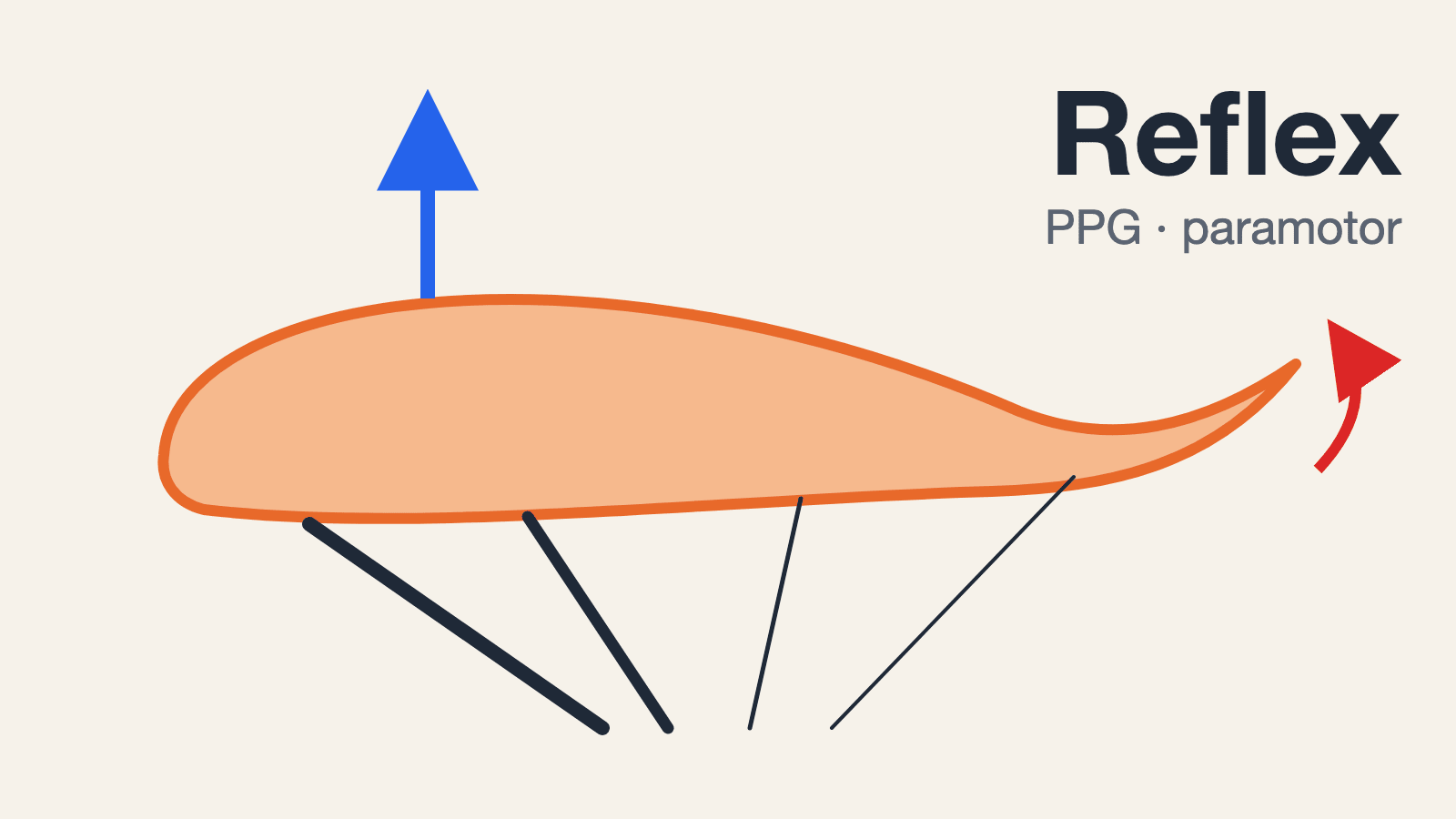
Slice through a classic paraglider and you see an evenly curved profile: a cambered top and a trailing edge that points slightly down. A reflex profile differs at the back: the aft portion near the trailing edge curves upward. The idea is not new. Tailless aircraft have used it for decades to stay stable in pitch, because they have no tailplane to do the job.
The upturned tail does two things. First, it shifts the centre of pressure (where the lift acts) towards the leading edge. Second, it creates a moment that always tries to raise the nose of the wing: when the angle of attack drops, meaning the wing is about to dive forward, the profile pushes it back. Dudek puts it simply: a reflex profile is one that automatically tends to increase its angle of attack again whenever it decreases.
For a soft wing, what matters most is where the load goes. On a classic wing, the faster you go the less load the A and B rows carry, and the easier it is for a gust to fold the leading edge under. On a reflex wing it is the other way round: let the trimmers out and the load moves forward. Dudek gives the example of one of its reflex wings with trimmers fully released: the A row carries about 60%, B about 30%, and C and D about 5% each. A leading edge held that tight is very hard to collapse.
"Reflexed airfoils are more collapse resistant mostly because the center of lift moves forward, loading the A lines more."
— Jeff Goin, Powered Paragliding Bible 7, p. 226
2. Is reflex for free flight or for paramotoring?
The short answer: a full reflex wing is paramotor equipment. According to Jeff Goin, standard paragliders have minimal reflex, if any, while many motor wings have a lot, sometimes only at their faster trim settings. Cross Country magazine gives the historical reason: in the early days of paragliding pilots just wanted to stay up, and reflex means more sink, so nobody chose it. Only once there was an engine on the pilot's back to win the height back, around the early 2000s, did the benefits become obvious. The person usually credited with bringing the profile to paramotor wings is Mike Campbell-Jones of Paramania.
Why free-flight wings rarely use full reflex:
- More sink, worse glide. The upturned tail makes no lift and actually pushes down. Goin says it plainly: the more reflex is employed, the less efficient the airfoil. With an engine you add a little power; in free flight it is height you never get back.
- Heavy brakes. Dudek itself lists the big steering forces as a drawback of reflex wings. Thermalling means working the brakes constantly, and a heavy wing is a tiring wing.
- Launch behaviour. Here the sources differ. Goin notes that reflex wings tend to inflate sluggishly at their slowest trim settings; Dudek says a modern reflex wing comes up smoothly and sits overhead. In practice it depends on the model and on the trim setting used for launch.
- Wing loading. Motor wings are built to carry the engine as well and to fly at higher wing loadings; see wing loading and choosing a wing size.
That does not make free-flight wings and reflex two separate worlds. Three things are easily confused. One is the shark nose: a way of shaping the leading edge (patented by Ozone in 2011) so that internal pressure stays steady over a wide range of angles of attack; it is not reflex, and it is found on a great many free-flight wings today. Two is the hybrid wing: Apco, for example, describes its Hybrid as behaving like a reflex profile without the cost in glide. Three is the dual-use reflex wing: Dudek presents its Solo 2 as a fully reflex paramotor wing that is also EN-B certified in free-flight weight ranges with trimmers closed. Note those last words: the certification only applies at slow trim.
3. What characterises a reflex wing
- Long trimmer travel. Trimmers are adjustable buckles on the rear risers: let them out and the rear riser gets longer, the trailing edge rises, the wing flies faster, and it stays there until you pull them back in. According to Goin, trimmers add roughly 10–35% airspeed, with the biggest gain on reflex models. On many models letting the trimmers out changes not only the wing's angle but the profile itself, adding reflex.
- Speedbar. Push with your feet and the A and B risers are pulled down, lowering the leading edge; release and the effect is gone at once. Goin's rough figures are about 15% more speed from trimmers and about 25% from speedbar. Each maker mixes the two differently, which is why the limitations differ too.
- A wide speed range. Size for size, highly reflexed wings are generally about 20% faster (Goin). This is why essentially all pylon-racing and cross-country motor wings are reflex.
- Collapse resistance at speed, not at slow trim. The anti-collapse advantage of reflex lives in the fast-trim configuration. At slow trim a reflex wing behaves much like a classic wing and needs to be flown actively like one.
- More fuel per hour, not necessarily per kilometre. Flying faster needs more thrust, so the hourly burn goes up. But because you cover ground faster, fuel per kilometre is only slightly higher, and into a headwind it can even be lower. The flip side: if the engine quits while you are trimmed fast, the sink rate is much higher; the first job is to bring the trim back for the best glide.
- Certified at slow trim only. Goin notes that reflex gliders are usually only flight-tested with trimmers closed; the fast settings do not usually pass, and unlocking the full trimmer range takes the wing out of certification. Ozone states that its Speedster is EN-B with the trimmers in the slow position. The Speedster 3 manual (2020) puts it differently: in-house testing showed behaviour in line with EN C with trimmers slow, and the wing has had no independent flight certification. Each generation differs, so check the manual for the one you fly. As for the French DGAC label, Goin describes it as a manufacturer's self-certification with no independent testing of recovery behaviour. On strength, Ozone explains that the DGAC accepts a 5.25 G load factor, whereas the EN 926-1 load test requires 8 G.
4. How to fly a reflex wing
Which trim for which phase
| Phase | Trimmers | Steer with | Notes |
|---|---|---|---|
| Launch | The maker's launch setting, usually neutral (the 0 mark) | Main brakes | Check both trimmers are even before inflating; uneven trim makes the wing turn. Too slow and the wing comes up sluggishly. |
| Climb-out | Leave as set | Main brakes | Slow trim climbs better. Leave the trimmers alone while low. |
| Cruise, smooth air, enough height | Let out gradually, a little each side | Main brakes released; tip steering or weightshift | Use your non-throttle hand so you cannot kill the engine by accident. |
| Air getting rough | As your wing's manual says (see section 7) | As the manual says | Come off the speedbar first, slow down, look for a landing. |
| Landing pattern | Back to slow or neutral, done while still high | Main brakes | Tip steering does almost nothing for pitch, so it is no good for landing. |
Main brakes or tip steering
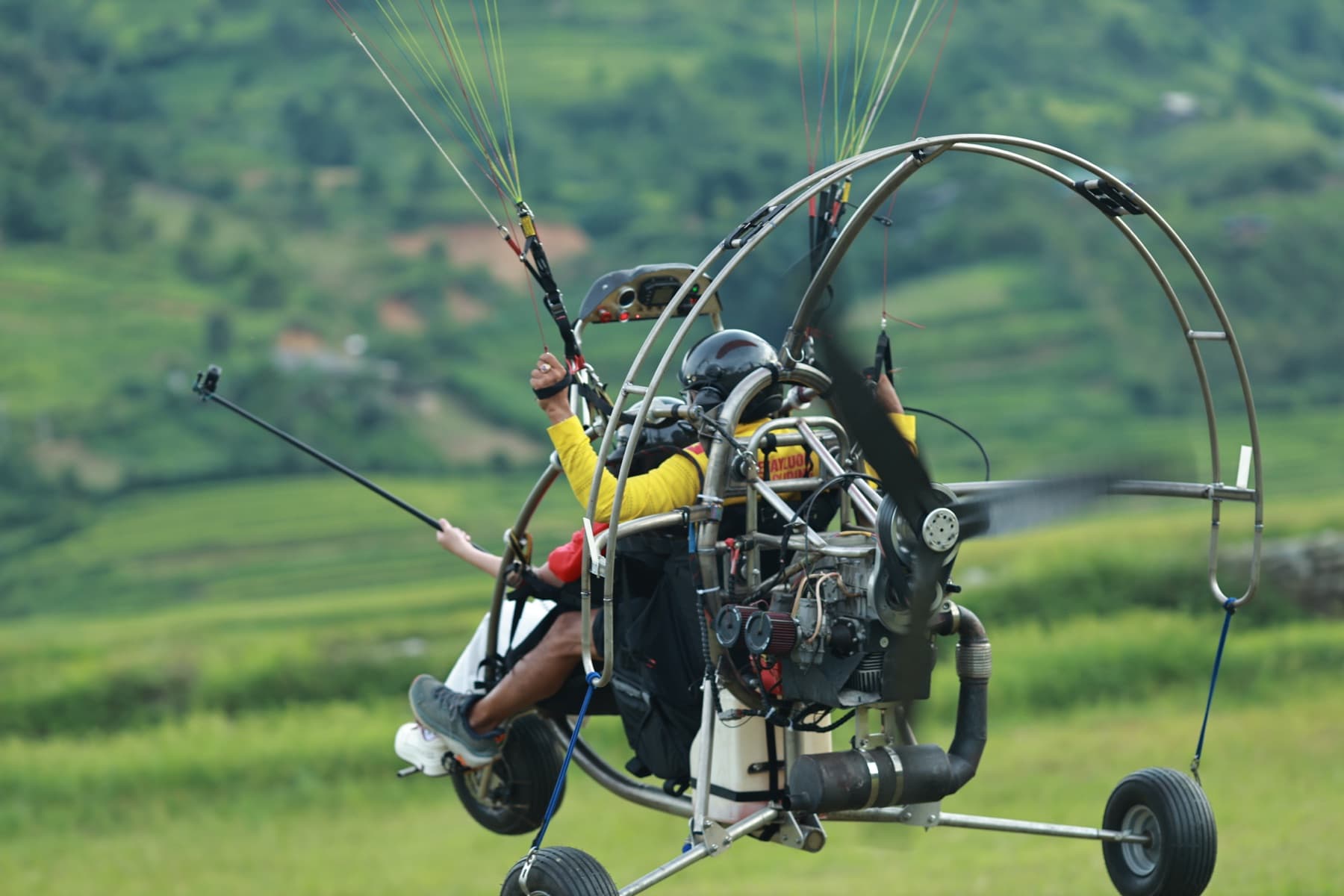
The main brakes pull most of the trailing edge down. At slow trim that is simply how you steer. At fast trim, pulling the main brakes means pulling down the upturned tail itself, erasing the very thing that keeps the wing stable. So reflex wings have a separate control that acts only on the wing tips (tip steering; Dudek calls it TST, some makers call it stabilo steering). According to Goin, stabilo steering affects the reflex profile least, tip steering has some effect on the outer part, and the brakes have a lot. Some makers connect the tips to the main brake handle, known as 2D steering: depending on the direction of your pull you get the tips first or the whole trailing edge.
- Learn tip steering before you learn trimmers. Goin advises at least a dozen flights before touching the trimmers, and getting used to the tip steering first. Once comfortable: take the tip toggles, stow the main brakes if necessary, and only then let the trimmers up a little at a time, about an inch.
- Hands up, no resting on the brakes. In straight flight at fast trim the main brakes must be fully released. The Dudek manual, as quoted by the French investigators, says even the slightest brake input in this configuration is enough to upset the balance of aerodynamic forces.
The order of trimmers and speedbar
- Trimmers first, speedbar second. Goin describes the sequence: ease the trimmers out, let the wing surge, then add speedbar as it comes back. On many reflex wings this is a rule, not just a tip (see section 7 for where makers differ).
- Never push the bar while the wing is surging forward. Apply it slowly, ideally while adding power or as your body swings forward. Keep your hands up, but be ready to use the brakes again as soon as you come off the bar.
- To slow down, reverse the order: come off the speedbar first, then pull the trimmers in. Only once you are back at slow trim do the main brakes work as normal again.
Landing: trimmers in
Before joining the landing pattern, while still high, bring the trimmers back to slow or neutral and take the main brakes again. There are two reasons. Touchdown speed is lower, and you need the main brakes for the flare: tip steering has almost no pitch control, so you cannot land on it. Goin lists "landing with the trimmers still out" among the causes of fast, hard landings. Experienced pilots sometimes deliberately land trimmed fast in strong wind, but that is not for beginners. Powered landings in general are covered in PPG fundamentals.
5. Things to watch
- Read the manual for your exact model and version. Two reflex wings from two makers can forbid opposite things. There is no single "reflex technique" that fits every wing.
- Trimmers are a pre-flight item. Even on both sides, at the launch mark, buckles not slipping. Worn trimmer buckles can creep; Goin even suggests taping the trimmers in place for the first flights.
- Do not shorten the brake lines yourself. Brake lines that are too short mean the trailing edge is always slightly pulled, even when you think your hands are fully up. The Ozone Speedster 3 manual forbids shortening the factory brake lengths, because the trailing edge would be engaged once the trimmers are released. The BGD Cyclone manual says the brakes must not engage when the trimmers are released, as this could deform the profile and cause a collapse. The Dudek Solo 2 manual requires that the trailing edge is not deformed in any speed configuration.
- No dynamic manoeuvres with the trimmers out. Dudek has a specific warning: spirals and dynamic wingovers with open trimmers are dangerous, because nearly all the load sits on the two front rows and approaches the structural limits of the wing. Close the trimmers before any high-G manoeuvre.
- Redo your glide and fuel planning. Fast trim means more sink if the engine stops and less endurance per tank. Always keep a landing field within glide.
6. When a reflex wing is dangerous
Main brakes while trimmed fast and on speedbar
"Pulling brakes while trimmed fast moves the center of pressure aft and makes the wing more susceptible to front tuck. That's why tip steering is preferred."
— Jeff Goin, Powered Paragliding Bible 7, p. 228
This is the most dangerous combination and also the easiest mistake to make, because pulling brake is every paraglider pilot's reflex. Main brake at fast trim pulls the trailing edge down: the reflex disappears, the centre of pressure moves aft, the nose pitches down and a leading edge already flying at a very low angle of attack can tuck. Goin lists "using main brakes while accelerated in reflex mode" as one of three causes of a front tuck, and notes that on most reflex wings getting this wrong can cause a nearly immediate collapse. If you really have to brake, come off the speedbar first.
Collapses at speed
"Collapses at higher speed will be more dramatic."
— Jeff Goin, Powered Paragliding Bible 7, p. 262
Hard to collapse does not mean impossible to collapse. When a reflex wing does collapse at fast trim, it does so at high speed and high wing loading, and reacts accordingly: fast rotation, fast height loss. Dudek's French importer told the BEA investigators that once a reflex wing has closed it is harder to reopen, that the reopening can be sudden and may cause a spin, unlike a classic wing, which reopens more gently. On top of that, the fast trim settings are usually outside the certified envelope, so nobody has measured for you how the wing recovers.
That report (BEA, accident of 7 February 2022 at Duvy, France) is worth reading for its caution. An experienced paramotor pilot flying a reflex wing on a trike lost control at about 250 m in lightly turbulent air; a witness saw the wing fold and the aircraft fall in a spin. The trimmers were found open afterwards. The investigators could not determine the cause, and mention both a possible medical event and a possible inappropriate control input. The lesson is not that "reflex wings cause accidents", but that at fast trim the safety margin depends entirely on the pilot doing the right thing.
Five more situations
- False confidence in turbulence. "It's a reflex, so rough air is fine" is the most dangerous thought of all. Reflex widens the safety margin at speed; it does not turn an unflyable day into a flyable one. Dudek's own importer says it: if the conditions are not suitable for flying, stay on the ground.
- High speed at low altitude. Any collapse is worse when accelerated, and down low there is no height for the wing to recover or for a reserve to open. Goin advises avoiding the speed system below about 60 m (200 ft) above the ground, unless you are competing or the manual says otherwise.
- Thermic midday air. Strong thermals bring sudden up- and downdraughts, exactly what tucks a leading edge. Fast trim plus speedbar in that kind of air is a combination Ozone allows only "in extremely calm conditions" and Apco flatly calls dangerous.
- Beginners. A beginner does not yet have the reflex "hands up, off the bar"; their reflex is to pull brake. Putting that pilot at fast trim is setting up the most dangerous combination in advance.
- Uneven or creeping trimmers. One side fast and one side slow makes the wing turn all the time; at speed the pilot tends to fight it with main brake, which is mistake number one again.
"A reflex glider may make it safer in some ways, but not if you're wearing it."
— Jeff Goin, Powered Paragliding Bible 7, p. 169
7. Where the sources disagree
Makers design their risers and profiles differently, so some questions have no single answer. Having compared the manuals of 18 Dudek, Ozone and BGD wings, we found the differences run not only between makers but between two generations from the same maker. The four points below are where pilots most easily carry one wing's rule over to another:
| Question | One source says | Another says |
|---|---|---|
| May you use speedbar with the trimmers slow? | No, or only conditionally. Apco Lift EZ manual: the speed system should only be used with trimmers fully open. Dudek Report'air manual: release a minimum length of trimmer before using the speed system. Dudek Universal 1.1 manual: full bar on closed trimmers gives light steering but less stability than with trimmers open. Dudek's importer (per the BEA): always untrim before accelerating. Goin: on some reflex models speedbar at slow trim is dangerous. | Yes. The Ozone Speedster 3, Sirocco 3, Roadster 3, Spyder 3 and Freeride manuals all say that using the full accelerator range with the trimmers slow is safe, and Ozone itself notes that this differs from some other PPG wings. The Dudek Nucleon 4, Hadron 3, Hadron 4 and Solo 2 manuals allow the speed system at any trimmer position, but on the condition of calm air. |
| In turbulence, trim fast or slow? | Fast, hands off. Dudek Nucleon 4 manual (2024), and likewise Solo and Universal 1.1: “The more turbulent is the air encountered, the more trims should be released and use of regular brakes avoided.” Apco Lift EZ manual: if you unexpectedly meet strong turbulence, fly with trimmers open and no brakes, use only the tip steering and land as soon as possible. | Slow, flown actively. Dudek Solo 2 manual (2026): “In turbulent conditions, use a slow configuration and apply active piloting.” Hadron 4 (2026) says much the same. Ozone Roadster 3, Spyder 3, Kona 2 and MagMax 2: in thermic or turbulent air pull the trimmers back to slow; Speedster 3 and Sirocco 3 call the fully slow position the safest in very turbulent air. BGD Cyclone: open trimmers make the wing more solid but its reaction to a collapse more dynamic, so it recommends trimmers closed. Goin: for most gliders, no speedbar, trimmers neutral and light brake pressure. |
| From which trim setting do you stop using the main brakes? | Early: from half trimmer travel. Dudek Solo 2 and Hadron 4 manuals: no main brakes with the trimmers released beyond half or with the speed system engaged. BGD Cyclone: beyond halfway steer with the tip steering handles, and with trimmers fully released do not use the brakes. Dudek Nucleon 4: with trimmers released or bar applied, TST steering is strongly advised, and at maximum speed TST only. Apco: with trimmers opened, secondary steering only is highly recommended. | Later, and at a different mark on each model. Ozone Roadster 3: with trimmers fully released the brakes may still be used for steering; only when accelerating further with the bar do you move to tip steering. Speedster 3 and Sirocco 3: the limit is a red stitched line on the trimmer, and faster than that line the brakes are out. Roadster 3 and Spyder 3 also say the reverse for turbulent air: steer with the brakes, not the tip steering. Goin: if letting the trimmers out only changes the wing's angle of incidence and not its profile, the maker may not prohibit brakes. |
| Inflation and take-off: where do the trimmers go? | Fully closed. BGD Cyclone: launch behaviour is best with trimmers fully closed, partly released only when the wind on launch is fairly strong. Dudek Universal 1.1: in nil wind fully closed is easiest, the stronger the wind the more you can open, and launching at fast trim is hard or impossible. Ozone Kona 2: slow position recommended, released a little if you want a faster inflation. Goin: at the slowest setting reflex wings tend to come up sluggishly. | Slightly open. Ozone Speedster 3 and Sirocco 3: set the trimmers between the two green stitched lines marked on the trimmer. Roadster 3 and Spyder 3: the wing inflates well fully slow, but the red line gives a faster inflation, useful in light wind or at high-altitude launches. Dudek Nucleon 4: closed or slightly released, faster in strong conditions; the manual says the wing practically does not overshoot. |
What the manuals of wings commonly flown in Vietnam say
We read the makers' English manuals for 18 Dudek, Ozone and BGD wings and summarised eight of them below in our own words. This is a summary for comparison, not a substitute for the manual: open the edition for the generation of wing you actually fly, because two generations of the same model name can say different things.
| Wing (manual) | Trimmers and speedbar | Main brakes vs tip steering at fast trim | In turbulence | Certification and the trim range it covers |
|---|---|---|---|---|
| Dudek Nucleon 4 (2024) | First flights: trimmers closed or slightly released. Speed system usable at any trimmer position in calm air; with wind and turbulence the pilot must judge. | Trimmers closed: steer with the main brakes. Trimmers released or bar applied: TST strongly advised. Maximum speed: TST only. | The more turbulent, the more trim released and the less main brake; brakes fully released in straight flight. | The manual only says generically: meets EN 926-1 and 926-2 or holds a manufacturer's airworthiness certificate. EN class and trim range: not stated. |
| Dudek Universal 1.1 (2024) | Delivered as a free-flight wing; the user activates the trimmers (half or full travel) to turn it into a PPG wing. Full bar on closed trimmers: light steering but less stable than with trimmers open. | Full bar plus fully open trimmers: steering with TST or the TEA line strongly recommended. Main brakes work better at slow settings, the ALC line at fast ones. | Free-flight section: fly with a little brake. Powered section: in strong turbulence partly open the trimmers; the more turbulent, the more trim released, avoiding the main brakes. | EN-B and LTF-B as a free-flight wing; DGAC standard for PPG. Which trim settings the EN certificate covers: not stated. |
| Dudek Solo 2 (2026) | First flights: trimmers closed or slightly released. Speed system usable at any trimmer position in calm air. | No main brakes with trimmers released beyond half their range or with the speed system engaged; steer with TST or weight shift. | Use a slow configuration and fly actively; land at once if conditions are unsafe. In the landing section, however, the manual says the wing copes with turbulence better on partly open trimmers. | EN-B for the free-flight weight ranges, trimmers closed; the certification is not valid with trimmers released. Which sizes: see the data table. |
| Ozone Speedster 3 (2020) | Full bar with trimmers fully slow is safe. Trimmers fully released plus full bar: only in calm conditions with sufficient altitude. Do not shorten the factory brake lengths. | Up to the red line on the trimmer the brakes may be used for steering. Faster than that line, whether by more trim or by bar: no brakes, steer with the TST. | The fully slow position is the safest in very turbulent air: easiest to manage, with the most benign behaviour after a collapse. | Load tested to EN 926-1 and acknowledged by the DGAC. In-house testing showed behaviour in line with EN C with trimmers slow; no independent flight certification. |
| Ozone Roadster 3 (2020) | Full bar with trimmers slow is safe. The risers come with trimmer locks that prevent release in flight. Trimmers released plus full bar: only in calm conditions. | With trimmers fully released the brakes may still be used for steering; accelerating further with the bar, steer with the TST. | In thermic or turbulent air: trimmers back to slow, or at least to the red line. Steer with the brakes, not the tip steering. | Some sizes independently flight tested EN B with trimmers slow. Releasing the trimmers, using the accelerator or flying outside the weight range invalidates the EN flight certification. EN 926-1 load test, DGAC. |
| Ozone Spyder 3 (2018) | Full bar with trimmers slow is safe. Trimmers released plus full bar: only in calm conditions with sufficient altitude. | In accelerated flight: steer with the TST, never with the brakes alone. | In thermic or turbulent air: trimmers back to slow, or at least to the red line; in very strong turbulence fully slow and flown actively. Steer with the brakes, not the tip steering. | Passed the DGAC criteria and the EN 926-1 load test; the manual says it has no other independent flight certification. |
| Ozone Kona 2 (2020) | Standard (slow) position for take-off, landing, climbing and free flying. Release the trimmers only in calm conditions. The foot accelerator is within the flight-tested envelope. | At full speed: steer with the TST, never with the brakes alone. Braking faster than the trimmers-released speed weakens the profile. | Trimmers back to the standard (slow) position and fly actively, whether free flying or under power. | Independently flight tested to EN 926-2 with the accelerator, but with trimmers slow only. EN 926-1 load test, DGAC. |
| BGD Cyclone (2023), solo or tandem PPG wing | Trimmers closed is the standard setting: best launch, best glide, best fuel consumption. Speedbar: not stated. | Trimmers more than halfway open: steer with the tip steering handles. Fully released: do not use the brakes. The brake lines must not engage when the trimmers are released. | Trimmers closed. The manual explains: with trimmers open the wing is more stable but reacts more dynamically to any collapse. | DGAC. Trim range covered: not stated. |
8. In Vietnam: where a PPG learner should start
- Your first wing is an EN-A, left exactly as delivered. You do not need high reflex to learn PPG. If the school wing has trimmers, leave them at the launch setting and do not touch them on your first flights.
- Learn with an instructor. The foundations of wing control (inflation, active flying, landing) are best learned on a classic paraglider, following a recognised syllabus such as IPPI; see what a P1–P2 course looks like. The motor-specific part is covered in PPG technique for paraglider pilots.
- Slow trim until correct brake use is second nature. A sensible path: at least a dozen flights at launch trim (Goin's figure; more is better), then tip steering practised at slow trim, and only then the trimmers let out one step at a time, at a safe height, on a smooth morning. The speedbar comes last.
- Choose your time of day. This is general advice from our own flying, not taken from any manual: in the mountains the air is usually smoothest early in the morning and late in the afternoon, and thermals are strongest around the middle of the day. In the hot season, check the thunderstorm forecast before flying. What does come from the manuals is this: the Ozone manuals allow the trimmers past their mark only in calm conditions. So the smooth hours are also the only times to try fast trim.
- The manual still has to be read, even in English. All 19 Dudek, Ozone and BGD manuals we read for this article were English editions. If your wing does not come with a Vietnamese one, ask your instructor or dealer to explain three sections properly: trimmer setting for launch, brake limitations, and speedbar limitations.
Mebayluon operates tandem PPG flights at Quan Ba (Ha Giang); the air at that site is described in flying technique at Quan Ba. For tandem passengers, everything above is the pilot's job. For anyone who wants to fly themselves, it is the reason to train properly before thinking about flying fast.
9. Verdict: who should and who should not fly a reflex wing
This section is Mebayluon's own judgment, drawn from the manuals and sources cited above. It is not any maker's rule, and it does not hold for every wing.
Free flight (PG)
- Do not choose a reflex wing as your main glider if you only free fly. At slow trim it behaves like a classic wing (the Dudek manuals say so of the Nucleon 4, Solo 2 and Universal 1.1), but it sinks more and handles more heavily. The benefit of reflex lies at fast trim, exactly where the EN certification no longer applies (Dudek Solo 2, Ozone Roadster 3, Ozone Kona 2).
- You can free fly a reflex wing if its manual gives a free-flight weight range and a certification for that range, as the Dudek Solo 2, Dudek Universal 1.1 and Ozone Kona 2 do. Then: trimmers closed, weight inside the PG range, and flown like a classic wing, that is, actively on the brakes.
- Do not open the trimmers “to be safe” when thermalling. The Ozone Kona 2, Ozone Roadster 3 and BGD Cyclone manuals all say to bring the trimmers back to slow in thermic or turbulent air.
Paramotoring (PPG)
- Do fly a reflex wing if you fly cross-country, often push into wind, need speed, and your hands already have the right reflexes. That is the job reflex was made for.
- A beginner can fly a reflex wing, but at slow trim. Ozone presents the Roadster 3 and Spyder 3 for beginner and intermediate pilots; Dudek says the Solo 2 suits beginners and is used by schools. The Dudek manuals recommend first flights with trimmers closed or barely released, and the Roadster 3 has trimmer locks so they cannot be released in flight. A wing suited to beginners does not mean fast trim is suited to beginners.
- Do not yet fly fast trim if your hands still hold tension on the brakes as on a classic wing, if you have not practised tip steering, or if you have not read the brake limitations in your own wing's manual. The Dudek Nucleon 4 manual says plainly that the wing is for intermediate pilots who have already mastered reflex flying.
- Nobody should use the fastest combination (trimmers fully released plus full speedbar) in turbulent air or close to the ground. Ozone writes this for the Speedster 3, Sirocco 3, Roadster 3, Spyder 3 and Kona 2: only in calm conditions and with sufficient altitude.
One wing for both
- Choose a wing the maker designed and certified for both, then read both weight ranges. Ozone advises anyone who also intends to free fly a Speedster 3 or Kona 2 to pick a size that puts their free-flying weight near the top of the PG range.
- Treat it as two configurations of the same wing. The Dudek Solo 2 and Universal 1.1 manuals require moving the brake pulley and the brake handle position when switching to free flight; they also give separate harness requirements for free flight.
- Free flying: trimmers closed, forget fast trim. Under power: fast trim is a separate skill, learned later, at a safe height.
- Do not carry habits across. Holding brake tension is right when free flying at slow trim and wrong at fast trim. Hands fully off is right at fast trim on some wings and wrong when thermalling at slow trim.
The conservative default
Follow the manual of the wing you actually fly, for the right model and generation. Where the manual is silent, or you do not have it yet: fly at slow or neutral trim, no speedbar, no main brakes while at fast trim, and stay right out of strong midday turbulence. This default is not the optimal way to fly every reflex wing; some earlier Dudek manuals even advise the opposite about trimmers in turbulence. But slow trim is the configuration that the certification, if your wing has one, was issued for.
10. Frequently asked questions about reflex wings
Can a reflex wing be flown in free flight?
Technically yes, at slow trim, if the wing is certified for your free-flight weight range. But it sinks more and handles more heavily than a free-flight wing of the same class, and the certification usually only holds with trimmers closed. If you want to do both, look at wings the maker has designed for both uses.
Can a reflex wing collapse?
Yes. It is harder to collapse at fast trim with the brakes released, but it can still collapse in strong turbulence or when the pilot pulls main brake while accelerated. And when it does collapse at speed, the reaction is more violent than on a classic wing.
Should a PPG beginner buy a reflex wing?
A beginner needs a wing that inflates easily, lands easily and forgives mistakes, chosen by the instructor. That wing may well be a reflex wing: Ozone presents the Roadster 3 and Spyder 3 for beginner and intermediate pilots, and Dudek says the Solo 2 suits beginners and paramotor schools. The condition is to fly it at slow trim like a classic wing; the Dudek manuals recommend exactly that for first flights. Reflex wings aimed at experienced pilots, 2D steering and every fast trim setting belong to a later stage.
What is the difference between tip steering and 2D steering?
Tip steering is a separate line with its own toggle that pulls only the wing tip. 2D steering connects the tip line to the main brake handle: pull one way and the tip comes down first, pull another way and the whole trailing edge comes down. 2D steering was developed for pylon racing and demands that the pilot knows exactly what each hand is pulling.
Trimmers or speedbar: which first?
On most reflex wings: trimmers first, speedbar second, and the reverse when slowing down. But some wings allow speedbar at slow trim and some forbid it outright. This is a question to answer from the manual, not from habit.
Sources: Jeff Goin, Powered Paragliding Bible, 7th edition (2022), pages 13, 16–17, 50, 63, 65, 169, 183, 188, 208, 225–228, 262–268; Dudek Paragliders, Reflex Profile and the safety note on spirals with open trimmers; Ozone, Speedster product page and the notice on load testing for PPG wings; Apco Aviation, Lift EZ manual and Hybrid page; the English user manuals of the Dudek Nucleon 4, Nucleon XX, Universal 1.1, Solo, Solo 2, Report'air, Hadron 3, Hadron 4, Orca 5 and Orca 6, the Ozone Speedster 3, Roadster 3, Spyder 3, Sirocco 3, Freeride, Kona 2 and MagMax 2, and the BGD Cyclone; BEA (France), investigation report BEA2022-0040 on the accident of 7 February 2022 at Duvy; Cross Country Magazine, Design Insight: Flying on reflex and Shark attack: understanding the sharknose. This article does not replace training; where your wing's manual says otherwise, follow the manual.