Paramotor (PPG) Fundamentals: Equipment, Pre-flight, Launch, Landing and Emergencies
October 1, 2026 • 3 views
Share this post:
A PPG fundamentals guide: what a paramotor system is made of, high vs low hang points, pre-flight checks, safe engine starts, throttle control, power-off landings, emergencies, weather limits and the training path.
Powered paragliding (PPG), or paramotoring, looks simple: a paraglider wing, a motor unit on the back and a throttle. But that motor brings three things free flyers never deal with: a propeller spinning thousands of times a minute right behind you, a thrust force that can twist pilot and wing against each other, and a fuel tank that can run dry. Almost every PPG safety rule comes back to those three.
This article covers the fundamentals: what a paramotor system is made of, inspection and starting, launching, flying, landing, emergencies, weather limits and a proper training path. If you are a paraglider pilot wondering which skills carry over and which must be relearned, see also PPG Technique for Paraglider Pilots: What Changes When You Add a Motor.
The main source is Powered Paragliding Bible (Jeff Goin, 7th edition), the most complete PPG manual available, plus the aviation decision-making and weather material Mebayluon uses in training. Figures have been converted to metres, m/s and kilograms and rounded. This is background knowledge and does not replace a course with an instructor; the book's own author says it is not meant for teaching yourself to fly.
1. What a PPG system is made of
A foot-launched PPG has two parts: the wing (with its risers and lines) and the paramotor, meaning the motor unit, frame, propeller cage and harness. The two connect through two carabiners. Knowing what each part does is the first step to knowing what to check and why.
The PPG wing
A PPG wing is still a paraglider, but usually has a : a slightly raised trailing edge that makes it harder to collapse at speed. It comes with (they stay where you set them) and a (it stops working when you release it). On reflex wings trimmed fast, many manufacturers forbid the main brakes and allow only tip steering. That is covered in the PG–PPG comparison article; here are just three fundamentals:
Students fly an EN-A wing, left as it came from the factory and flown inside the certified weight range. That range includes motor and fuel, not just body weight.
Wing certification does not test with a motor, and reflex wings are usually tested only trimmed slow. Unlocking the full trimmer range, or fitting different risers, can take a wing outside its certification.
Brake line length is life-or-death in PPG. Too short and the wing stalls and spins easily. Too long and the brake handle can be drawn into the propeller, and you lose flare authority. With hands up, the brake lines must still have slack, even when trimmed fast.
The motor unit: engine, drive, propeller, cage
Checking the motor unit before flight: the pilot points at the carburettor and air filter, with the frame and a propeller blade behind. Photo: Mebayluon
Engine. Most paramotors use an air-cooled 2-stroke, commonly around 80–280 cc; bigger engines are for heavier pilots, tandem, trikes or high sites.
Drive. A reduction drive (belt or gear) turns the prop about 2.5–3 times slower than the engine. The drive type decides which way you get twisted. Small engines often have a centrifugal clutch: at idle the prop must stand still.
Propeller. A big prop turning slowly is quieter and stronger than a small one turning fast. The tips travel faster than 500 km/h, so a small crack or loose bolt matters. Good props are deliberately frangible.
Cage. Cage and netting keep the lines out of the prop. The cage protects lines, not people. Never start an engine without a cage.
Frame, harness, hang bars. A thrust spreader stops the motor squeezing you into the front webbing. If the carabiner hooks to a metal bar, a backup strap to the harness is required.
The throttle carries the kill switch. A throttle lock (cruise control) is a major cause of prop accidents and must be off when starting.
Type
Strengths
Weaknesses
Operating notes
2-stroke
Light for its power; simple; by far the most common
Runs hot; louder; needs oil mixed into the fuel
Mix fuel and oil at the right ratio; watch temperatures; overheating or no oil means a seized engine
4-stroke
Quieter, cleaner, about 10–15% less fuel; no mixing
About 15–25% heavier; more complex
Better suited to trikes than to backpacks
Electric
Quiet, almost maintenance-free, instant throttle response
Short endurance; heavy batteries (about 0.5 kg per minute of flight); thermal-runaway fire risk
Charge and store batteries exactly as the maker says; heat is the battery's enemy
Table 1. Three kinds of paramotor engine (summarised from Powered Paragliding Bible)
High and low hang points
The simplest classification: in flight, if the bottom of the carabiner sits above the collarbone it is a high hang point, below it is a low hang point. According to Powered Paragliding Bible, there is no clear safety difference between the two; they differ mainly in handling feel and in how torque is managed.
Diagram: high hang point (carabiner above the collarbone) and low hang point (below it). Mebayluon diagram based on Powered Paragliding Bible
High hang point
Low hang point
Typical bars
Over-shoulder J-bars, underarm bars
Pivoting S-arms (gooseneck)
In-flight feel
Transmits less wing movement to the pilot, feels smoother in turbulence (actual collapse resistance is the same)
More wing feedback, closer to a free-flight harness
Weight shift
Little or none
Good, especially with pivoting arms
For students
Some instructors find it slightly easier to learn on
Asks for better wing feel
Never
Bars must not swing inward
Arms must never swing inward: risers close together cause violent twisting under power
Table 2. High versus low hang points
Two harness numbers worth remembering: riser separation should be around 42 cm (narrower makes riser twist more likely), and hang angle about 5–15°. More tilt-back is more comfortable but increases torque and makes launch and landing harder. All of this must be adjusted while actually hanging from the carabiners, with someone who knows that harness.
Thrust line and torque
Thrust acts on the pilot, not on the wing. That is why more power makes you climb, not go faster. If the thrust line sits above the system's pivot point, adding power also tips the pilot forward; if it is off-centre, it feels like being pushed on one shoulder.
Torque is the propeller's reaction: the prop spins one way, so motor and pilot tend to rotate the other way, most strongly at high power and when the pilot leans far back. Manufacturers reduce it by adjusting hang angle, offsetting the thrust line slightly, fitting airflow vanes on the cage netting or setting the carabiners at different heights. A gear drive only reverses torque; it does not reduce it.
2. Pre-flight: from carabiner to propeller
You’re not a paramotor pilot, you’re a mechanic who gets to test your work.
— Opening line of the Setup & Maintenance chapter (Wesley Woo), Powered Paragliding Bible, 7th edition (Jeff Goin, 2022)
A backpack two-stroke aircraft does not forgive forgetfulness. Good habits start with fuel:
Mix fuel and oil at the manufacturer's ratio, typically 50:1 (about 20 ml of oil per litre of petrol). A two-stroke run without oil seizes.
Use synthetic two-stroke oil for air-cooled engines, a coloured one. The colour of the fuel tells you it has been mixed and avoids the "I thought I'd mixed it" mistake.
Mixed fuel left open goes stale (the book says around two weeks). Use fresh fuel, no water, clean cans.
Do the pre-flight after refuelling, so the fuel cap and tank vent are checked last. A blocked vent leans the mixture until the engine quits in the air.
Know your fuel burn per hour at cruise power, and have a way to see the fuel level in flight.
Then comes the equipment walk-around. The book recommends a fixed order that always starts at the carabiners, and if you are interrupted, start over: interruptions are when things get missed.
Item
What to check
Why
Carabiners, harness, hang bars
Cracks, wear, gates locked; backup strap on the hang bars
This is the entire load path between you and the wing
Throttle lock and start protection
Throttle lock off; anti-runaway start protection (if fitted) on
Unexpected thrust at start-up is the most common cause of serious injury
Throttle cable
Squeeze and release the throttle, watch the carburettor arm return to idle
The book calls this the single most important item: a stuck throttle at start-up means a prop at full power
Walk around the motor
Bolts and torque-marker paint; exhaust (cracks are common); safety wire; belt; spark plug; frame feet
Constant vibration loosens fasteners hour by hour
Fuel cap, vent, fuel line
Cap closed, vent clear, no cracked lines, no air bubbles
A blocked vent or leaking line stops the engine
Propeller
No cracks or chips; bolts evenly tight; not mounted backwards
A reversed prop gives about half the thrust; damage near the hub is worse than at the tip
Cage and netting
Nothing broken, netting tight; on clutched engines spin the prop by hand to check clearance
The cage is the only thing keeping lines out of the prop
Reserve
Pins correct; bridle routed clear of the throttle cable
A badly installed reserve is worse than none
Wing
Inflate it: lines, fabric, trimmers even on both sides, brake pulleys turning freely
A seized pulley can saw through a brake line
Table 3. PPG pre-flight check (suggested order)
Checking harness buckles and carabiners on the trike before starting: the first item of every pre-flight check. Photo: Mebayluon
Two PPG-specific checks that newcomers often skip:
Hang check. Hang motor and harness from a simulator or anything that gets your feet off the ground, to make sure you get into the seat easily, reach every control and sit at the right angle. Hanging from the leg straps for a few minutes numbs the legs and can cause blackout.
Run-up. With the motor secured or on your back, confirm three things: it reaches climb power, responds properly to the throttle, and stops with the kill switch. No full revs, no launch.
Line, brake and cage clearance. During the hang check, pull the brakes fully and see whether the handles come near the propeller disc. Tie off every loose strap end: a dangling strap will find the prop sooner or later.
3. Starting and handling the motor on the ground
According to Powered Paragliding Bible, the propeller is the number one source of serious PPG injuries, and most happen on the ground, during start-up, not in the air. A hard-starting engine is a dangerous one, because frustrated pilots get sloppy, for example holding the throttle open while pulling.
Treat every start like it will go to high power—cages only protect lines from the prop, not people.
— Jeff Goin, Powered Paragliding Bible, 7th edition (2022)
Diagram: the danger zone around the propeller during start-up, seen from above. Mebayluon diagram, figures from Powered Paragliding Bible
Shout "clear prop" and look around before every start. Spectators stand out of the propeller plane, at least 6 m away; cage fragments have been thrown more than 15 m.
Secure the motor before starting: on a stand, on your back, or braced against something that can hold it at full thrust. Worst of all is starting an unsecured motor while standing in front of it.
If possible, start on choke to limit thrust, warm up, then shut down; restart only once it is on your back, just before launch.
Pull-start motors: someone else pulls while you hold throttle and kill switch. Never lift an idling motor off its secure spot until the throttle is in your hand.
Clear loose objects; wear no scarves or camera straps around the neck. Never point the prop blast at people or laid-out wings.
Long idling loads up the engine; after a few minutes, run about half power for around 10 seconds to clear it.
4. Launching under power
Step-by-step forward and reverse inflations for PPG (the order for throttle, brake and A-risers, how to turn around) are described in the PG–PPG comparison article. This section focuses on the general rules that decide whether a launch is safe.
Choose the inflation by wind. The book suggests reverse in steady winds of about 1.8–5.8 m/s and forward from calm to about 2.2 m/s. Never launch with a tailwind.
Only add power when the wing is stable directly overhead. Power with the wing off-centre, swinging or still behind you lets thrust pull you over or twist you against the wing.
At throttle-up, stand tall and push the hips forward. Leaning over like a free-flight launch run drives you into a face-plant, prop into the ground.
Don't jump, don't sit early. Run until your feet pedal air; only get into the seat above about 15 m, and stow the brake before reaching for the seat.
Limit turns after lift-off: below 9 m no more than about 30°, above 18 m up to 90°, 180° only above 30 m.
A long enough field: a beginner needs about 150 × 150 m of flat ground inside a bigger open area. On hot days, at high sites or in calm air, the run can be three times longer.
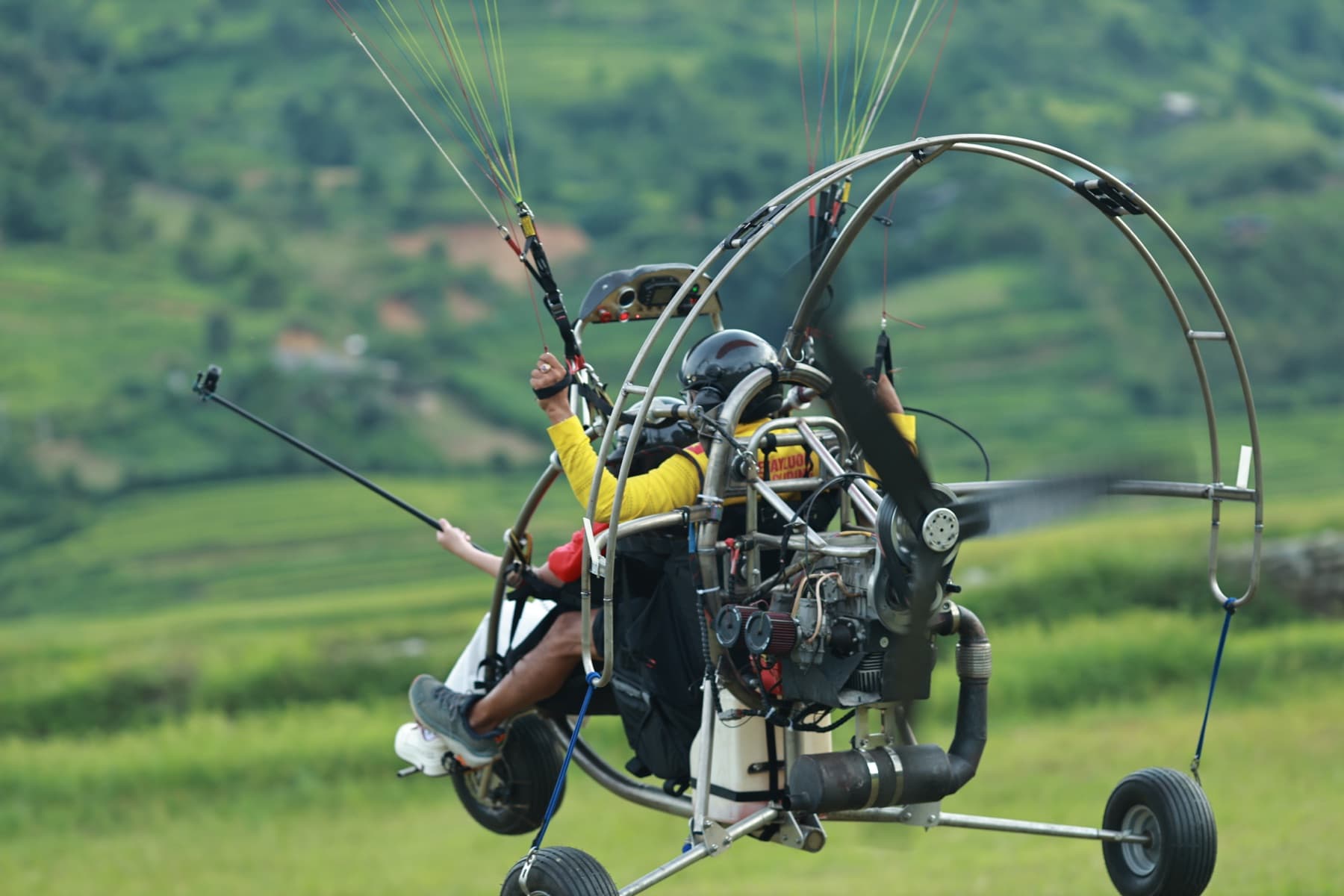
A PPG trike just off the field and climbing straight out, with no steep turns while still low. Photo: Mebayluon
Common launch errors: running slowly or hesitantly; releasing the A-risers too early; over-braking the wing; adding power before the wing is overhead; leaning back at throttle-up; forgetting the leg straps. For a student the right reflex when anything is wrong is to abort, not to try to save it. The abort sequence: release the throttle, press and hold the kill switch until the prop stops, stop running, turn to face the wing and kill it. If you realise you forgot a leg strap, abort as well.
5. In the air: throttle, pitch, turns and fuel
A PPG trike in flight seen from below: wing, lines, propeller cage and wheels. Photo: Mebayluon
Throttle and pitch go together
The pilot hangs under the wing like a pendulum. Add power and the pilot swings forward, the wing tilts back and the system starts climbing. Reduce power and the opposite happens: the pilot swings back and the wing surges forward. The sharper the throttle change, the bigger the surge; a strong surge is followed by a dive. Close to the ground, that dive can become a hard impact.
So change the throttle in two stages: about half power, wait roughly 2 seconds for the swing to settle, then full. Same when reducing. The brakes act almost instantly, while the throttle takes a few seconds to show its effect. In level flight, cruise power is often around 30%, with the brakes held at light feel pressure.
Diagram: adding power makes the system climb; chopping the power makes the wing surge forward, then dive. Mebayluon diagram
Turning with torque
At high power, the motor always wants to turn you one way. Accept that turn while climbing rather than fighting it with heavy opposite brake: uneven heavy braking, especially against the torque, is the shortest road to a spin. To turn against the torque, reduce power first, then turn gently. Turn sequence: look, lean, brake, then add power if needed; hold the brake steady for a few seconds and let the turn develop instead of yanking.
Trimmers, speed bar and posture
Adjust trimmers with the non-throttle hand, a little at a time on each side; reaching across with the throttle hand can hit the kill switch.
Push the speed bar slowly, preferably under power. On a reflex wing at speed, steer exactly as its manual says (usually tip steering or rear risers).
In turbulence: off the bar, neutral trim (unless your reflex wing's manual says otherwise), light brakes around 25%, enough power for level flight. Newer pilots should not fly actively in the free-flight sense yet: over-reacting easily creates oscillation.
Return trimmers to normal before entering the landing pattern.
Safe altitudes and glide
Always ask yourself: if the engine quits right now, where do I land? Power off, a PPG glides only about 6:1, far worse than the same wing on a free-flight harness, because the cage, frame and prop add a lot of drag. A headwind of half your airspeed halves your glide over the ground, and the area you can reach shifts downwind.
Diagram: how far you can glide after an engine failure at 150 m, in calm air and in wind. Mebayluon diagram, figures from Powered Paragliding Bible
Always have an out; the engine will eventually quit.
— Jeff Goin, Powered Paragliding Bible, 7th edition (2022)
Cruise at about 60–150 m above ground. According to the book, getting above 60 m removes most of PPG's risk.
Keep around 150 m so you have a way out if the engine stops; enter the landing pattern at about 60–90 m.
Power lines are almost invisible from above, and most wire accidents happen in familiar areas. Cross at the poles, at least twice the wire height.
Look where you want to fly, not at the obstacle: many accidents start with target fixation.
Fuel planning
Go upwind first, so the return is a quick downwind leg. With wind: use at most half your endurance outbound, then turn. In calm air: only about a third.
Know your motor's endurance and note your launch time, but still check the actual fuel level: a leak can shorten a flight dramatically.
Speed costs a lot of fuel; only into a strong headwind is it worth flying faster to cover the most ground per litre.
Don't let dusk catch you: in failing light, power lines are even harder to see.
6. Landing: power off or power on
Students, and paraglider pilots new to PPG, should land power-off for the first flights (the book suggests about 10). With the engine off the system becomes a paraglider again: no torque, and no spinning prop when your feet touch down.
A PPG trike in the last metres before the wheels touch the grass: keep straight, no sharp steering near the ground. Photo: Mebayluon
Approach with a pattern: downwind leg at about 90 m, base leg, final into wind from about 30 m.
When to kill the engine: go to idle, then press and hold the kill switch until the prop has fully stopped, before descending below about 15 m.
Below about 15 m, don't correct swings; below about 6 m, stop steering and keep straight. Have your hands nearly all the way up by about 15 m, as a near-ground wind gradient can drop you quickly.
Two-stage flare from hands up: at about 1.5–3 m pull partly so you swing forward, then fully at about 0.3–0.6 m. One foot forward, ready to run it out.
Once down, kill the wing straight away and keep it away from the propeller.
Power-on landing is a skill for experienced pilots: a little power in the last 9 m or so can halve the sink rate, giving a softer touchdown and the option to go around if the approach is wrong. The trade-off is a prop still spinning when your feet touch, and a stumble backwards at that moment wrecks the prop or cage. The safe go-around sequence and the engine-out-by-altitude table are in the PG–PPG comparison article.
7. Emergencies
Not sure what’s happening? Reduce power, reduce brake, then steer.
— Jeff Goin, Powered Paragliding Bible, 7th edition (2022)
This is the root reflex for any unusual situation under power. Cut to about half power rather than chopping it, ease the brakes to light pressure, then deal with the problem. The priority is always: keep control of the wing → keep a safe heading and altitude → only then solve the problem. The most common beginner error is not reacting too slowly but over-reacting. Make smooth inputs, hold them 2–3 seconds and watch the result.
Engine failure. If you always stayed within glide of a field, a dead engine just makes you a paraglider pilot. The real danger is losing power in a steep climb close to the ground: the wing surges forward and a strong surge is followed by a dive; check it with brake. Below about 60 m, just land; don't try to restart.
Strange noise, vibration, something hitting the prop. Reduce power and, if safe, shut down and land. If lines have touched the prop, have the wing inspected even if it looks fine.
Torque-induced riser twist. Common when power goes on before the wing is stable, on a motor too strong for the pilot's weight, or with risers too close together. Reduce power to remove the twisting force, ease off the brakes, then steer; pulling brake against it invites a spin. Twist as the wing leaves the ground: kill the engine and abort.
Stuck throttle. Full power just means you climb; don't panic. Get some height, then stop the engine with whatever is closest: secondary kill switch, carburettor throttle arm, choke, pinching the fuel line, pulling the plug cap.
Deep stall. More likely with old, porous or wet wings, over-braking, and when high thrust holds a wing in a stall it would otherwise leave. Cut power, release the brakes fully, and be ready to check the surge as it flies again.
Wake turbulence. Vortices sink and drift downwind, strongest behind trikes and tandem wings. Fly above the path of the aircraft ahead and stay out of its track for at least about 2 minutes.
Low turns. A wing does not lose airspeed by turning downwind; what is real is the illusion of fast-moving ground that makes pilots over-brake, plus the wind gradient. Climb into wind to about 60 m before turning, and don't pull more than about 25% brake while climbing.
Water. Before motor-mounted auto-inflating flotation, drowning was PPG's leading cause of death. Carry flotation near water; if you must ditch, unbuckle first, don't jump, get out as your feet touch and swim away from the motor.
Throwing the reserve with a motor
A paramotor reserve has its own trap: by reflex, pilots reach toward the hip. So the throttle hand must not be the reserve hand, and the bridle must be routed well clear of the throttle cable and propeller. The book's sequence, done within about 3 seconds:
Kill the engine and hold the switch. A prop still turning when the reserve opens can take in the reserve lines.
Look at the reserve handle. Pilots have hit the ground while still groping on the wrong side.
Pull decisively, letting go of the brake first.
Clear: find open air, away from the main wing and from people.
Throw hard, down and to the outside of any rotation.
Once the reserve is open, if the main wing is downplaning and pulling you off line, disable it (the book suggests pulling the B-lines). Prepare a parachute landing fall (PLF): feet together, knees soft. Don't lift your legs to land on the frame; that is how backs get broken.
8. Weather and PPG-specific limits
The motor lets a PPG fly when there is no lift, but it does not let it fly in strong wind or turbulence. A PPG cruises at only about 30–45 km/h; wing loading is higher than on a paraglider, but thrust and torque add workload when the air is rough.
Wind. The best learning wind is about 2.7–5.4 m/s, steady. The Japan Hang & Paragliding Federation (JHF) syllabus limits powered training to 4 m/s mean, 6 m/s gusts. Strong mean wind (over 6 m/s in the launch layer) is outside basic PPG flying.
Gusts and changes.Don't launch if the wind changes by more than about 2.2 m/s within 5 seconds. Set a numeric gust limit and keep to it, even when others are flying.
Time of day. Smoothest about 30 minutes after sunrise and late afternoon. Thermals peak from midday to mid-afternoon and can stay dangerous until about 2 hours before sunset. Gusts on the ground mean turbulence aloft. Watch for at least 20 minutes before deciding.
Turbulence behind obstacles. In about 4.5 m/s of wind, turbulence behind trees and buildings extends roughly 4–10 times the obstacle height, sometimes 20. Mebayluon's quick estimate: safe downwind distance ≈ obstacle height × 0.6 × wind speed (km/h); a 10 m tree line in 18 km/h of wind needs about 108 m.
Mountains and valleys. A calm field may just be in a wind shadow with rotor above; check the forecast wind at summit height. Cold air draining down the mountains can flow strongly even before dawn, stronger in passes and narrow gaps.
Density altitude. High, hot, humid air is thin: weaker engine, longer run, poorer climb. The book's example: 45 kgf of thrust at sea level becomes about 36 kgf at a density altitude of 1,520 m. Fly in the cool morning, carry less, and check full revs at the site.
Carburettor. Above about 900 m the engine usually needs leaning; take it back to low ground without re-richening and it overheats. Follow the manufacturer's instructions.
Thunderstorms. The gust front can arrive well ahead of a storm, sometimes 30 km; wait at least 2 hours after it passes. Rain is always bad for PPG: a wet wing deep-stalls more easily.
Fog and cloud seas. Fog hides ground reference and power lines; if it is forming, land while you can still see the ground. Over a sea of cloud, treat glide range to a cloud-free area as a hard limit.
If the branches are swayin’, on the ground I’m a stayin’.
— A self-made weather rule given as an example in Jeff Goin, Powered Paragliding Bible, 7th edition (2022). Look at the branches, not just the leaves
9. Safety culture and the PPG training path
Powered Paragliding Bible lists PPG's four leading fatal risks as the learning phase, steep manoeuvres at low altitude, water and bad weather, while the propeller causes the most serious injuries, mostly at start-up. The book stresses that risk comes from pilot behaviour more than from equipment. A few habits keep it in check:
Check yourself before every session with aviation's IMSAFE model: illness, medication, stress, alcohol, fatigue, emotion. One "yes" is reason enough to stay on the ground.
Write your personal limits down as numbers while on the ground (maximum wind, gusts, days since last flight) and keep to them. "Legal" does not mean "wise".
Beware of cameras and crowds: many serious accidents happen when a pilot wants to show off.
Powered gives way to unpowered. Avoid motoring around paragliding launches; launch and leave, and throttle back near homes.
Maintain like a mechanic: plugs, fuel lines, wing inspections and reserve repacks on the manufacturer's schedule.
The best pilots use their superior judgment to avoid needing their superior skills.
— Well-worn aviation motto quoted in Jeff Goin, Powered Paragliding Bible, 7th edition (2022)
The training path in the book usually runs: ground-handle the wing until really proficient (the book suggests about 15–25 hours before adding power) → practise with a dummy throttle → wear the frame without an engine → simulator work, following radio commands and rehearsing emergency reactions → get used to flying (tandem, tow or a small hill) → solo flights with an instructor on the radio. The first solo can come after a few days, but the book reckons about 25 flights before flying on your own under supervision and about 50 before you are truly independent. Aeroplane or skydiving experience does not replace PPG training; paraglider pilots learn faster but still have to learn the motor.
On qualifications: the IPPI framework (FAI/CIVL SafePro Para) is a proficiency scale for paragliding and has no separate PPG levels. Paramotors fall under a different FAI branch for competition (Section 10, class R), while PPG training and ratings are handled by each country's association or federation in its own way: in the US there are the USPPA's PPG ratings; in Japan, the JHF has a separate powered paraglider licence. In Vietnam, a powered paraglider is a "powered other flying vehicle" and every flight needs a flight permit; see How flying vehicles are classified: where paragliders and paramotors fit. Wherever you are, learn with a certified PPG instructor on student equipment.
10. PPG at Mebayluon's sites
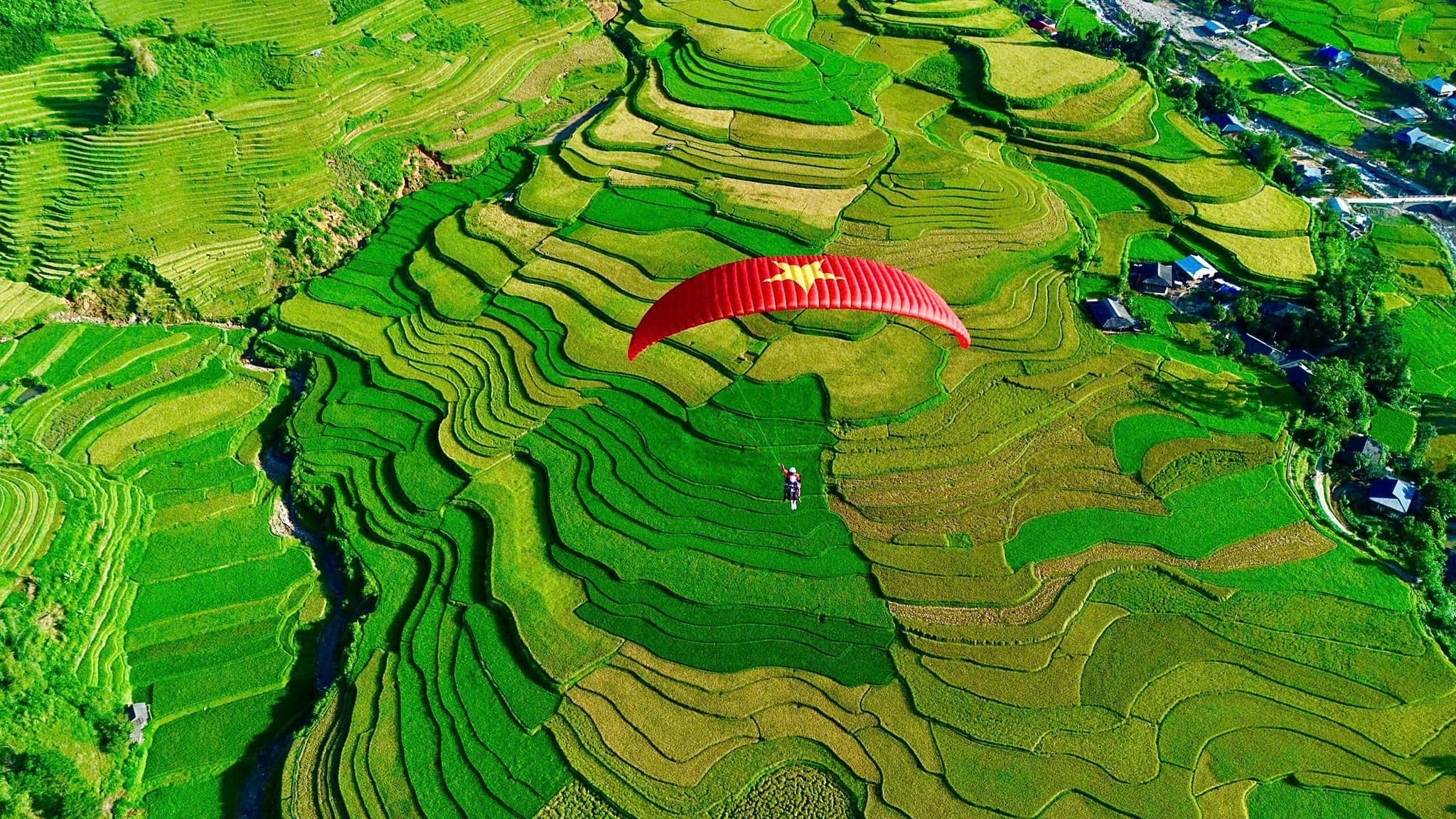
A PPG wing flying past the Mebayluon homestay, next to the PPG launch field at the foot of Khau Pha pass. Photo: Mebayluon
Mebayluon flies tandem PPG at two mountain sites, and both show how the principles above work in practice:
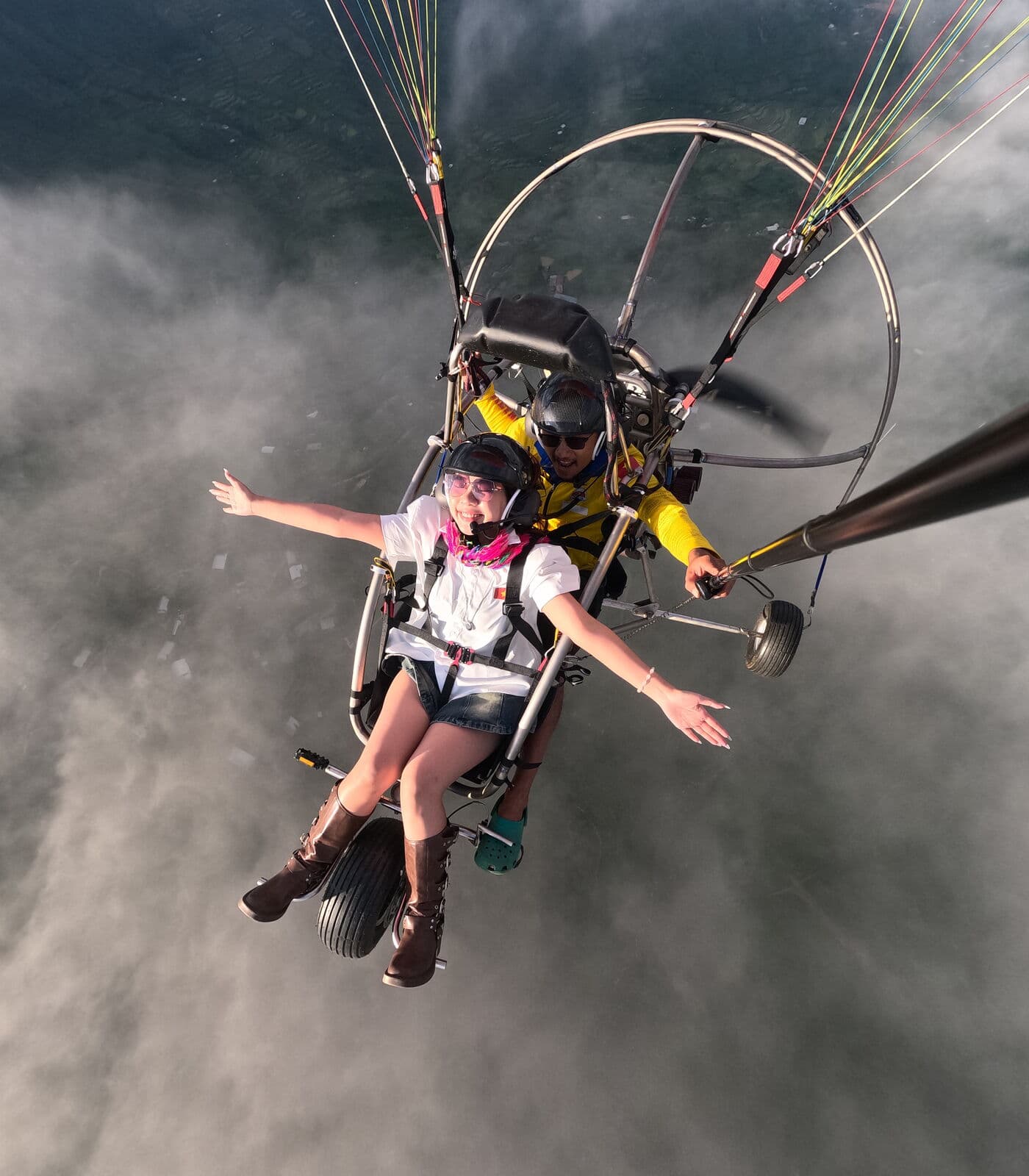
Khau Pha – Mu Cang Chai (Yen Bai): PPG launches from the flat field at the foot of the pass, also the paragliders' landing field; ceiling up to 2,000 m. Sharing the field with paragliders makes powered gives way to unpowered and wake avoidance a daily matter. Cloud, sunrise and sunset flights here tie in with morning cloud seas and cold air draining down the pass.
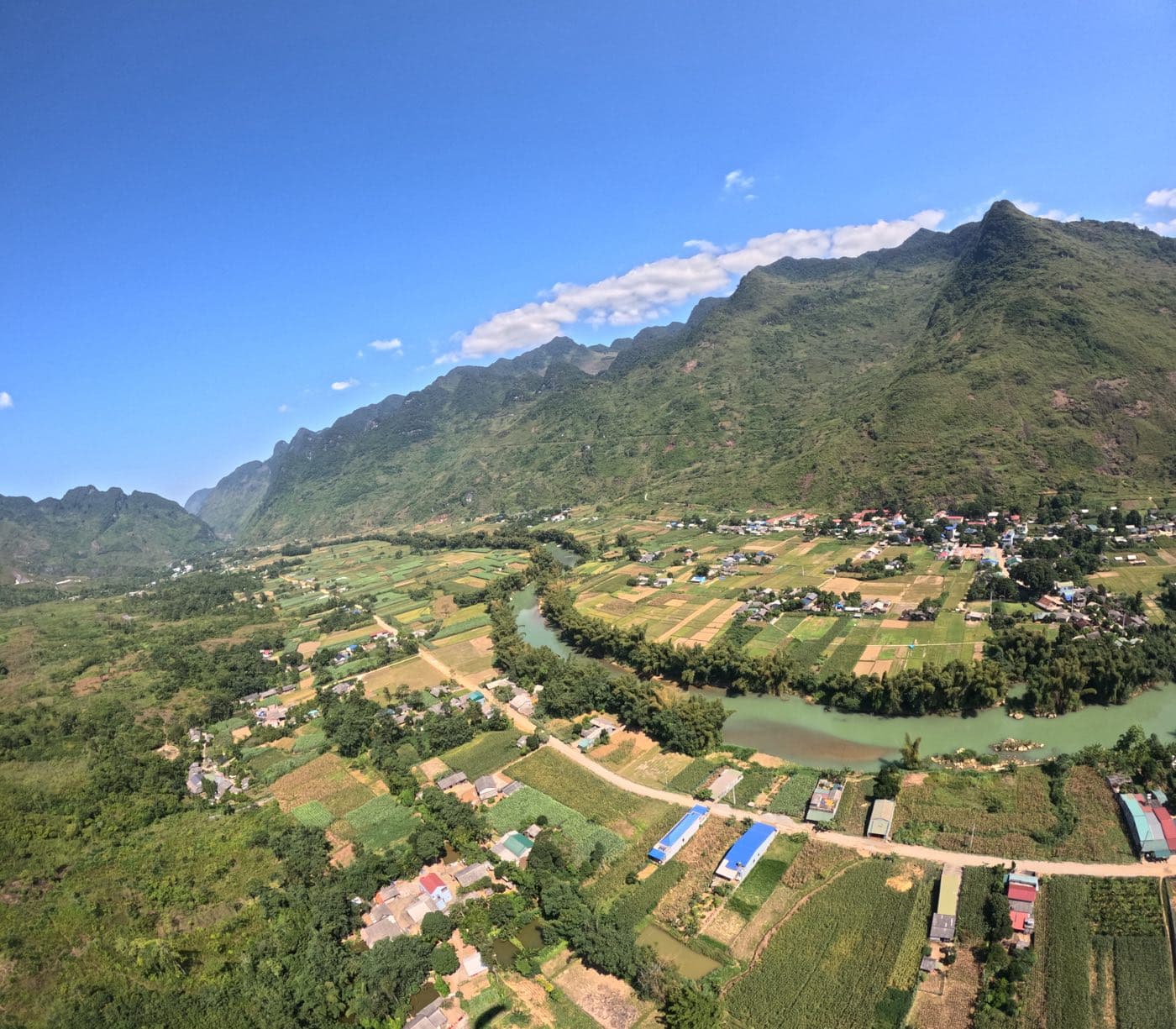
Quan Ba (Ha Giang): PPG launches right in the Quan Ba valley, also the paragliders' landing field. Limestone karst offers few emergency fields and many places where the wind is squeezed, so glide range back to the field matters even more.
At both sites, tandem flights use a trike: the passenger sits in a seat and takes off and lands on wheels, with no running. According to Powered Paragliding Bible, wheeled tandem is much easier and safer than foot-launched tandem.
Mountain valleys ask more than flat country: density altitude, rotor behind ridges, valley winds that shift through the day. That is why flight times and the go/no-go call are set by the chief pilot according to each session's actual conditions.
If you want to see how a tandem PPG flight at Khau Pha unfolds from the passenger's side, the article paramotor at Khau Pha, Mu Cang Chai walks through it step by step. And if you are thinking of learning PPG, start with section 9 above: lots of ground handling, an instructor, and no hurry to add power.
Sources: Jeff Goin, Powered Paragliding Bible, 7th edition (2022); US Federal Aviation Administration (FAA), Pilot's Handbook of Aeronautical Knowledge, aeronautical decision-making chapter; Japan Hang & Paragliding Federation (JHF) syllabus; SafePro Para framework (FAI/CIVL). Figures converted and rounded; where your equipment has its own manual, the manufacturer's manual always comes first.