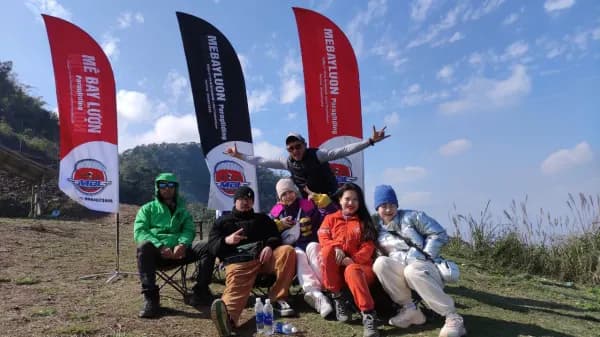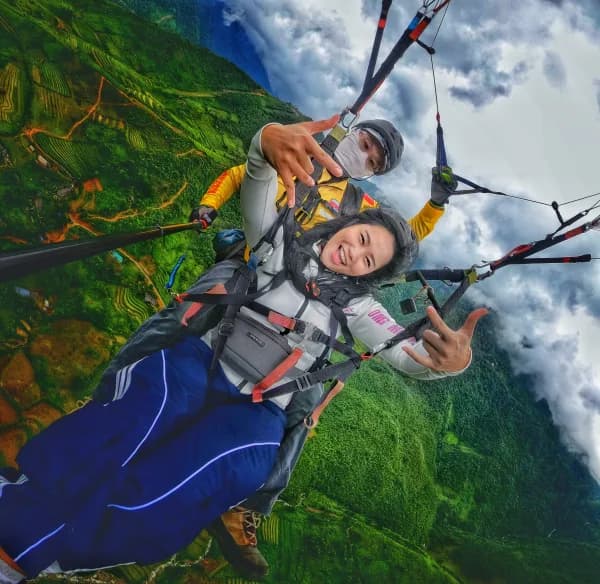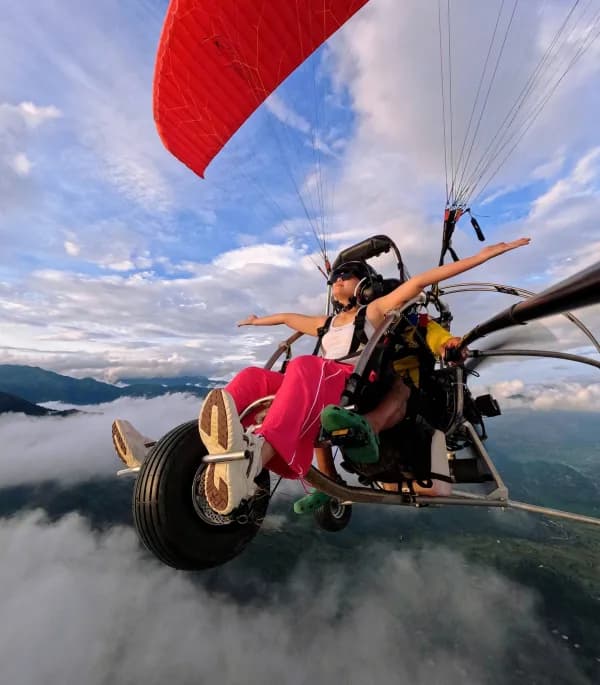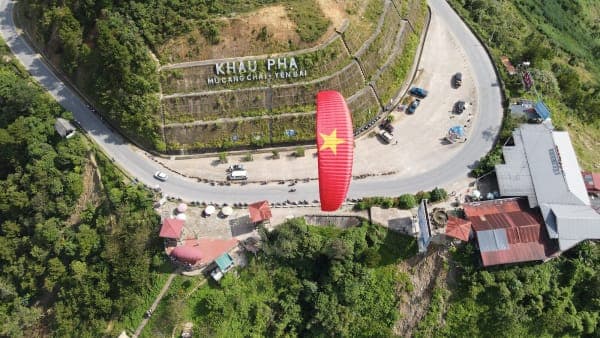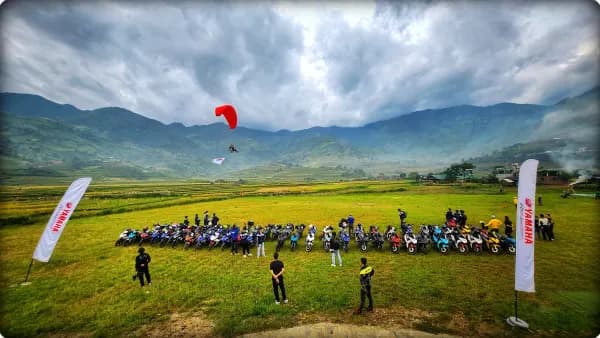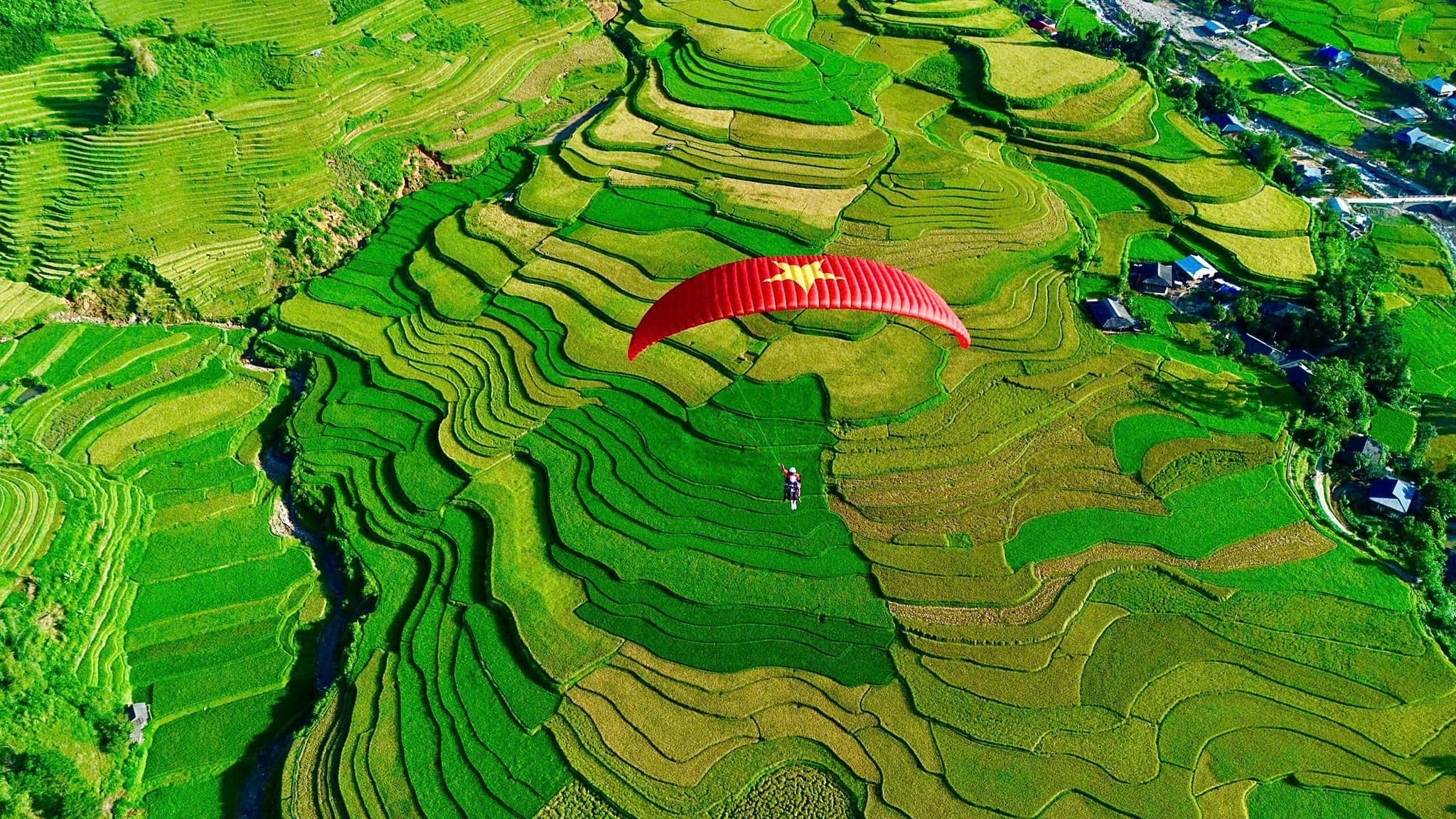
Powered paragliding — internationally called a paramotor, abbreviated PPG — at Khau Pha Pass, Mu Cang Chai is a tandem flight in which the pilot carries an engine and propeller on his back, giving him the ability to climb, hold altitude and choose a heading at will. The 2026 price is 2,390,000 VND per passenger (list price 2,690,000 VND), a standard flight lasts 15 minutes (the special flight or a long flight: 20 – 25 minutes, +700,000 VND per passenger), and the ceiling is 2,000m. The whole difference comes down to one word: control. An unpowered wing depends on two things nobody controls — the wind and the sun. A paramotor does not. And that one difference opens up the two flights an unpowered wing can barely deliver here: climbing above the cloud sea, and catching the sunset.
How is a paramotor different from a normal paraglider?
Same wing, same pilot, same harness — the difference is an engine on the pilot's back. That small difference changes almost everything about the experience. A normal tandem launches from a high slope, trades altitude for distance and looks for lift to stay up. At Khau Pha you launch at 1,268m and fly in a band between 1,268m and 2,000m. It is a beautiful, smooth glide with a clear beginning and end. A paramotor needs no slope. The engine gives thrust, the wing gives lift, and the pilot decides to go up or down at any moment. No waiting for the sun to build thermals. No waiting for the wind to come from the right direction. No ceiling imposed by the height of the launch. Three practical consequences: — It flies in the slots a normal wing cannot. Calm early morning and late afternoon are the two best hours of the day for light, and the two worst for thermal lift. — The sky does not set the duration. On an unpowered wing the sky decides how long you fly. A paramotor flight is a standard 15 minutes, or 20 – 25 minutes if you book the special flight or a long flight. — It goes further and higher. The pilot takes you out beyond the flying site, around the far terraces, and up on top of the cloud layer. If you want the technical side, we have written it up separately: paragliding vs powered paragliding and who powered paragliding suits.
Why Khau Pha is the paramotor flight worth taking in Vietnam
In principle a paramotor flies from any open field. That is both its strength and its problem: flying a paramotor over flat farmland is safe, easy and dull. The value of a paramotor flight lies entirely in what is underneath you. Underneath Khau Pha are the Mu Cang Chai rice terraces — a Special National Heritage site, carved into the mountainside by generations of Hmong families. Beyond them is the Lim Mong valley, Lim Thai village, the stream along the valley floor, and in the right season a sheet of gold running from the foot of the pass to the ridge line. No other paramotor site in Vietnam has that beneath it. Two more things only this site has: — The cloud sea. The pass is called "Sky Horn" in Thai — the part of the mountain that rises above the cloud. This is cloud-making terrain, and the cloud appears for months of the year, not on a handful of lucky days. — A permitted ceiling of 2,000m. Flying high is not only a question of engine power. It is a question of airspace. Flight operations at Khau Pha are licensed by the flight authority of the Ministry of National Defence, and the operator holds the full paragliding operating licence from the Ministry of Culture, Sports and Tourism. This is also the only site in Vietnam running all three disciplines at once: mountain-launched paragliding, powered paragliding to thousands of metres, and intensive pilot training. The site itself is documented in the Khau Pha Pass site profile.
Paramotor prices at Khau Pha, 2026
Powered paragliding package — Price: 2,390,000 VND per passenger (list price 2,690,000 VND, currently promoted) — Duration: a standard 15-minute flight; the special flight or a long flight is 20 – 25 minutes — Ceiling: up to 2,000m Included in the price — A professional pilot and certified equipment throughout — Passenger insurance — All GoPro photos and video from the flight — no extra charge, no selling images by the frame — Certificate of participation — Drinks and a souvenir — Free rescheduling or cancellation — please let us know in advance Optional filming add-ons — Drone filming: 400,000 VND — 360° camera: 400,000 VND — Both together: 700,000 VND (saving 100,000 VND) Special flight — +700,000 VND per passenger, 20 – 25 minutes Sunrise (6–7 am, sunny days), sunset (4–5 pm, sunny days) or cloud chasing up to ~2,000m — the pilot flies one of the three depending on the day's conditions (a sunset means no cloud; cloud means no sunset or sunrise). Long flight, 20 – 25 minutes (conditions permitting): +700,000 VND per passenger, free with the special flight. If none of the three special-flight options can be flown, or the wind is too weak for a long flight, the surcharge is refunded after the flight, which becomes a standard flight. For comparison: a standard tandem at Khau Pha is 2,190,000 VND per person for 10 – 15 minutes. The paramotor costs about 200,000 VND more and gives you a far higher ceiling, and much more flexible slots. The full price list is in the paragliding in Mu Cang Chai guide.
15 minutes or 20 – 25 minutes?
This is the question guests ask most when booking a paramotor, and the answer is not "the longer the better". 15 minutes — the standard flight. Every paramotor flight at Khau Pha lasts 15 minutes: time to climb properly, leave the immediate area, work around a few ridges of terraces and come back without rushing. With no special requirement, book this one. 20 – 25 minutes — the special flight or a long flight. The special flight (+700,000 VND per passenger) is a sunrise flight (6–7 am, sunny days), a sunset flight (4–5 pm, sunny days) or cloud chasing up to ~2,000m — the pilot flies one of the three depending on the day's conditions, because a sunset means no cloud and cloud means no sunset or sunrise. Cloud chasing takes time: climbing on top and then flying along the cloud surface. And the sun waits for nobody, so the pilot needs margin to get you to altitude before it touches the ridge. A long flight of 20 – 25 minutes (conditions permitting) is +700,000 VND per passenger, and free when you have booked the special flight. One honest note: if you get motion sick easily, stick with the standard 15 minutes. A paramotor has engine vibration and banked turns an unpowered wing does not. Most guests are completely fine, but 25 minutes while feeling unwell is a very long time.
Cloud chasing by paramotor in Mu Cang Chai
"Cloud chasing" gets used so loosely it has lost its meaning. Here it means something very specific: climbing above the cloud layer and looking down on the top of it. Why can an unpowered wing barely do it? Because it only climbs where there is lift, and the mornings that produce a beautiful cloud sea are usually still, damp and sunless — precisely the conditions with the least lift. You can see the cloud right in front of you with no way to get above it. The paramotor solves exactly that. The pilot opens the throttle, climbs steadily, threads a gap or works up around the edge of the layer, and levels off on top. From there you see what is never visible from the ground: Khau Pha and the ridges around it standing out of the cloud like islands — the "Sky Horn" doing precisely what its name says. When is there cloud? Most often in late autumn and winter, after a cold damp night, between 06:00 and 08:30. Summer produces cloud too, but usually afternoon cumulus, which is a different shape entirely. Nobody can book cloud in advance, but our team watches the forecast and tells you when the odds look good — which is the real reason to book early and stay in touch.
Sunset flights — and the 10% nobody tells you about
Plenty of guests come to Khau Pha with one wish: to be in the air exactly as the sun goes down. We understand why — it is the best frame of the day. But plainly: if you wait for sunset on a standard wing, your odds are about 10%. Three reasons: — A clear sunset is rare to begin with. Not every evening opens up enough to see the sun touch the ridge. — Late afternoon brings low cloud. It rolls in and covers the exact moment you waited all afternoon for. — An unpowered wing is limited in range and altitude. Once the sun is low behind the mountains, there is almost no way to climb above the cloud layer or high enough to catch it. Which means you can drive 300km, stay a night, wait out a whole afternoon — and go home with nothing. A paramotor solves exactly that. With an engine the pilot climbs to thousands of metres, above the low cloud, and meets the sun from above. At that altitude the sun sets later than it does for someone standing in the valley — you get minutes the ground does not have. Watching the sunset stops being luck and becomes a matter of technique, and of booking the right package. Sunset is part of the special flight (+700,000 VND per passenger, 20 – 25 minutes, 4–5 pm on sunny days): the pilot flies sunset, sunrise or cloud chasing depending on the day's conditions. Tell us when you reserve so we can place you in the right slot.
Sunrise flights, 6 – 7 am: every bit as beautiful as sunset
Many guests only think of sunset and overlook the morning. In fact, the 6 – 7 am sunrise window is every bit as beautiful as the 4 – 5 pm sunset window, and on many days it is even easier to get a great flight: — Low, soft, warm morning light. Early sun slants across the valley, lighting up every terrace, the thin mist and the village roofs. The colours are close to sunset, only clearer and brighter. — Morning air is the calmest of the day. The flight is smooth and gentle, ideal for first-time flyers and older guests. — Mornings usually have less low cloud than late afternoons, so the chance of good sunshine is often higher than waiting for sunset. — You still have the whole day ahead to continue to Mu Cang Chai, stop in Tu Le or catch the bus back to Hanoi. 👉 If you only have one session at Khau Pha, consider booking the special flight in the morning slot rather than betting everything on sunset: on a sunny day the pilot flies you at sunrise, on a cloudy one you go cloud chasing.
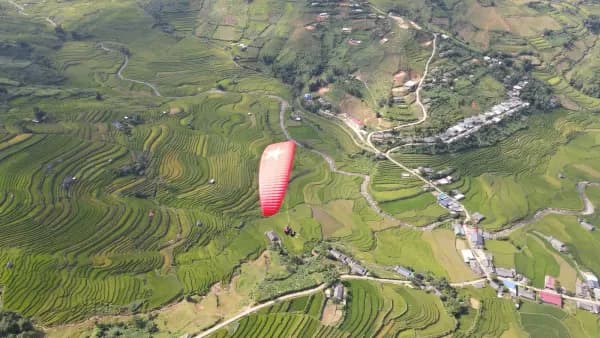
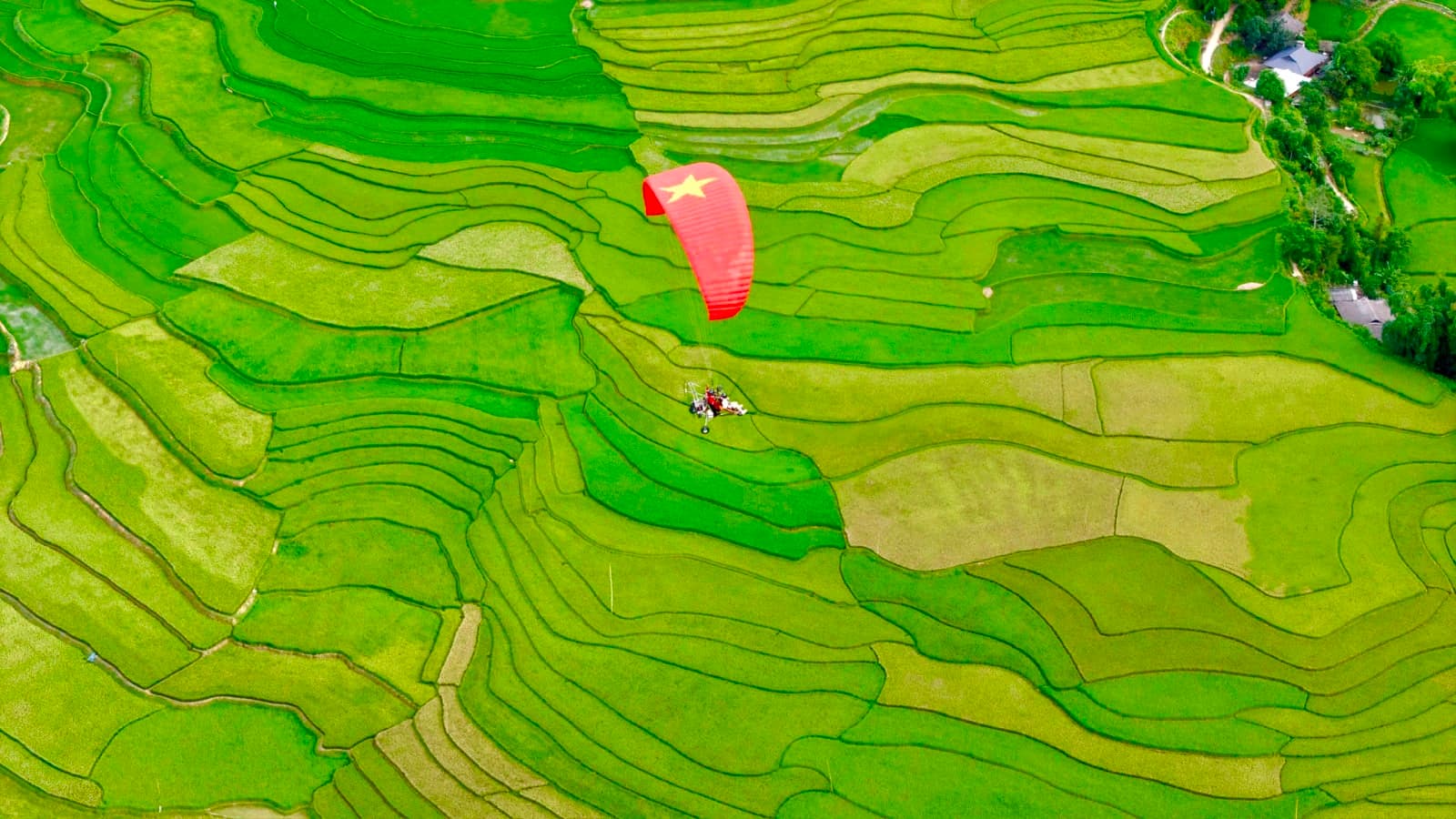
📸 Real photos from a morning paramotor flight in Mu Cang Chai (drone, around 9 am): the low sun picks out every terrace, thin mist still sits in the valley, and the orange wing glows against the green and gold rice.
No sunrise or sunset? Switch to a cloud-chasing flight
In the mountains there are days when thick cloud hides the sun completely, with no sunrise or sunset to watch. On days like that you do not lose your flight: the pilot switches to a cloud-chasing flight. With an engine, the paramotor climbs through the cloud layer and flies above it, where a sea of white cloud stretches beneath you and the peaks rise like islands. The cloudy days that look like "bad weather" often produce the most striking footage. So when booking, simply pick a good time slot (morning or afternoon). Close to the day, the Mebayluon team checks the weather and tells you whether to go for sunrise, sunset or cloud-chasing, so you get the best flight possible. That is how the special flight works: you book the package and the pilot flies one of the three, whichever the day allows. If none of them can be done, the 700,000 VND surcharge is refunded after the flight, which becomes a standard flight.
A 2,000m ceiling: what you actually see from up there
Two thousand metres is an abstract number, so here is what it looks like. — At 1,268m — level with the pass — you see the terraces at the foot of the pass and the Lim Mong valley. This is the view from a standard tandem flight. — At around 1,500m, Highway 32 appears in full, a single ribbon laid across the mountainside, and the ridges behind the first line start to come into view. — At close to 2,000m, the whole region opens: layer after layer of mountains running towards Mu Cang Chai and Van Chan, the Tu Le basin sitting to the south, and on a clear day the far ranges at the edge of the horizon. This is also why paramotor photographs look different from tandem photographs: you get the wide angle of a drone shot with real people in the frame.
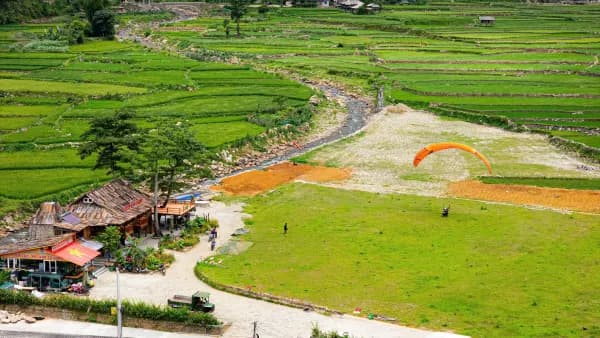
And the other direction: a paramotor is also the only wing that can fly low. Few people think of this. When an unpowered wing goes low, the flight is over — with no engine, going down means landing. A paramotor can drop as low as the pilot wants, run along the surface of the fields, then open the throttle and climb again. So a single flight gives you both ends: the whole region from close to 2,000m, and passes just above the rice terraces — a perspective no other kind of flying in Vietnam offers.
Is a paramotor safe? What happens if the engine stops?
It is the right question, and it has a clear answer rather than a dodge. If the engine stops, you are still sitting under a complete paraglider. That is the point most people miss. A paramotor is not an aeroplane — the engine only buys you climb. Switch it off and the wing goes back to being an ordinary paraglider and continues to glide down at its own glide ratio. The pilot still steers, still picks the field, still lands normally. In practice pilots shut the engine down deliberately during parts of the flight so you can hear the silence. Because of that, the professional rule is that the pilot always keeps enough altitude and position to be within gliding range of a safe landing field. Flying high here is not more dangerous — it is more margin. The other layers are the same as for a standard tandem: the flight permit from the Ministry of National Defence and the operating licence from the Ministry of Culture, Sports and Tourism; pilots with tandem ratings and thousands of hours; internationally certified equipment with a reserve parachute; and the rule that we do not fly when conditions are not right — flights get cancelled rather than pushed. One small difference worth knowing in advance: a paramotor is louder and has engine vibration. You wear a helmet with ear defenders and an intercom — so you can still talk to your pilot throughout — but do not expect the total silence of an unpowered wing.
Who can fly a paramotor, and who should not
Requirements — Age: 3 and above. Under 18 needs a parent or guardian's consent. — Weight: under 120kg. If you are between 90 and 120kg, or under 30kg, tell us when you book so we can prepare the right wing size and assign the right pilot. — No alcohol before flying. Not suitable for — Epilepsy — Serious heart conditions or high blood pressure — Spinal conditions — Pregnancy What about fear of heights? You can still fly, and this surprises people. Fear of heights comes from your brain comparing you to a nearby reference — the edge of a balcony, the rail of a bridge. In the air there is no reference at all, so most guests who are afraid of heights sit down and find themselves completely fine. You are also not controlling anything; the pilot does all of it. No experience needed, and nothing to practise beforehand.
What to prepare for a paramotor flight
Wear — Trainers or hiking shoes with laces — no sandals, no heels — Long trousers and long sleeves. It is noticeably colder at 2,000m, and there is relative wind from the engine — Bright, strong colours — you will stand out against the terraces. Avoid skirts. — Tie long hair back Leave behind — Jewellery, hoop earrings, loose scarves — Phone and keys in your pockets — they will fall. Leave them at the office. — Sunglasses are a good idea, but bring a pair with a retainer strap Do — Eat something light beforehand — neither empty nor full — Use the bathroom before going out to the field — Arrive 15 minutes early for check-in — Bring a phone with free storage if you want your files copied on the spot Can I take my phone up? No. The team's GoPro covers all the photos and video, at no charge, and you get the files right after landing.
Photos, video and drone
Photographs are half the reason people fly, so here are the details. — GoPro: included in the ticket. The pilot films on a pole throughout the flight. You receive all the original files, uncut, no extra charge, no selling individual images. Copied straight to your phone at the office after landing. — 360° camera — 400,000 VND: spherical footage, so you can produce orbiting video and "tiny planet" stills. It is the add-on that suits a paramotor best, because you are high enough for a genuine full-circle panorama. — Drone — 400,000 VND: filmed from outside, giving you the shot of yourself in flight — the one a pole-mounted GoPro can never take. — Both together — 700,000 VND, saving 100,000 VND. An honest recommendation: if you only add one, add the drone. A small wing against a whole hillside of gold terraces is the frame that makes people stop scrolling, and it is the only angle you cannot film yourself.
How a paramotor flight at Khau Pha actually runs
Step 1 — Check in and talk it through. At the registration desk you meet the pilot who will fly with you. This is where you confirm a standard 15-minute flight or the 20 – 25-minute special flight / long flight, give your weight, and say whether you want cloud chasing, a sunset flight, or simply the smoothest ride possible. Ask everything here — it is the easiest moment to ask.
Step 2 — Sign the participation conditions. A short declaration covering your health and the flying rules. Your pilot sits with you and walks through each point rather than handing over a form to sign.
Step 3 — The dedicated helmet. This is where it differs sharply from an unpowered tandem. Paramotor helmets carry noise-cancelling ear defenders and a built-in intercom, so you can talk to your pilot throughout the flight even with the engine running. Want to go higher, circle back over something, or come down a little — just say so.
Step 4 — The pilot fits your harness himself. This is not delegated to ground staff. He checks every buckle and every strap, then checks the whole thing again before starting the engine.
Step 5 — Ready to launch. You sit in front, the pilot behind, the wing laid out behind the trike. The pilot always carries a camera pole — all the airborne photos and video are shot on the team's own equipment, at no extra charge.
Step 6 — Off the ground and climbing. The engine pushes, the trike rolls a few metres and the wheels leave the ground. This is the part that feels most different from an unpowered wing: you clearly feel yourself going up, steadily and continuously, rather than circling in search of lift. The ground drops away and the terraces open out.
Step 7 — Landing. The pilot eases off, approaches the field and touches down gently. The ground crew is waiting to gather the wing. All you do is put your legs out when told.
Step 8 — Files and certificate. Back at the office you copy all the photos and video to your phone and collect your certificate, souvenir and a drink. Total time on site: roughly 45 – 75 minutes, depending on your package and how busy the day is.
Booking: how far ahead, payment, changes and cancellation
How far ahead to book — Outside peak season: 3 – 5 days — Rice harvest season (late August to mid-October): 1 – 2 weeks — Public holidays: 1 – 2 weeks Booking early is not only about holding a slot. It gives the team time to track the forecast for your specific day and warn you before you set off — which matters more for a paramotor, since cloud chasing and sunset flights depend on the day's conditions. Last-minute bookings lose that. Slots are limited. Powered flying requires a pilot with a separate engine rating, so there are far fewer paramotor slots per day than tandem slots. In peak season this is the package that sells out first. How to book — Fastest: take a queue number online at mebayluon.com/booking — about a minute. Package details at mebayluon.com/ppg. — Or call the team directly and say clearly that you want the paramotor, and whether you want the standard 15-minute flight or the 20 – 25-minute special flight. Payment: cash, bank transfer or card. Changes and cancellation: free rescheduling or cancellation — please let us know in advance. That is not a formality — Khau Pha is a mountain site and weather postponements are a normal part of this work.
Khau Pha compared with other paramotor sites in Vietnam
Vietnam has a handful of places where a paramotor can fly, mostly on the plains or along the coast. The difference is not the equipment — it is the ground beneath and the ceiling above. — Coastal and lowland sites: easy to run, steady wind, but what is underneath is sand or flat paddy. Beautiful for the first five minutes. — Khau Pha: underneath are Special National Heritage rice terraces, the Lim Mong valley and the layered ranges of the Northwest; above is the cloud sea; and the permitted ceiling is 2,000m. One thing few people notice: at Khau Pha you can fly both disciplines on the same trip — a mountain tandem in the morning, a paramotor in the afternoon — because one operator runs both. Many guests fly tandem once and come back only for the powered wing. A full comparison of sites is in the best paragliding spots in Vietnam.
Frequently asked questions about the Khau Pha paramotor
How much is powered paragliding in Mu Cang Chai? 2,390,000 VND per passenger (list price 2,690,000 VND) for a standard 15-minute flight. The special flight (sunrise, sunset or cloud chasing) and a long flight of 20 – 25 minutes are +700,000 VND per passenger; the long flight is free with the special flight. That includes the pilot, equipment, insurance, all GoPro photos and video, a certificate, drinks and a souvenir. How long does a paramotor flight last? A standard flight is 15 minutes; the special flight or a long flight is 20 – 25 minutes. A standard tandem is fixed at 10 – 15 minutes and depends on conditions. How high does the paramotor fly? The permitted ceiling at Khau Pha is 2,000m. Do I need experience? No. This is a tandem flight; the pilot does everything. You sit in front and do nothing. What if the engine stops mid-air? You are still under a complete paraglider and it glides down normally. The pilot always stays within gliding range of a safe landing field, and in fact shuts the engine off deliberately for parts of the flight. Which month is best for cloud chasing at Khau Pha? Cloud is most frequent in late autumn and winter, after a cold damp night, between 06:00 and 08:30. Cloud cannot be booked, but the team watches the forecast and updates guests who have reserved. Will I definitely see the sunset on a sunset flight? Nobody can promise weather, but a paramotor improves the odds enormously over an unpowered wing (about 10%) because it climbs above the low cloud. Book the special flight (20 – 25 minutes, +700,000 VND per passenger) and tell us in advance; with no sunset the pilot switches to sunrise or cloud chasing depending on the slot, and if none of the three can be done the surcharge is refunded after the flight. Can children fly a paramotor? From age 3, with a parent or guardian present and consenting. Can I fly if I weigh over 100kg? Yes, the limit is under 120kg. Between 90 and 120kg, tell us in advance so we prepare the right wing size. Does a paramotor make you airsick? A small number of guests feel uncomfortable because of engine vibration and banked turns. If you get motion sick easily, book 10 – 15 minutes and tell your pilot you would rather skip the turns. Is it noisy? Yes, noisier than an unpowered wing. Your helmet has ear defenders and an intercom so you can still talk to your pilot, and the pilot cuts the engine for stretches so you can hear the silence. How far in advance should I book a paramotor? Three to five days outside peak season; one to two weeks for rice season and public holidays. There are fewer paramotor slots per day than tandem slots, so it sells out first. What if the weather stops us flying? Free rescheduling or cancellation — and that applies for any reason, not only weather, and we simply ask that you let us know in advance. Can I fly both a tandem and a paramotor on the same trip? Yes. The same operator runs both disciplines at Khau Pha — just tell us when you book.
Further reading
— Paragliding in Mu Cang Chai: prices, seasons and the complete guide — the most complete write-up of flying at Khau Pha — Khau Pha Pass site profile — terrain, wind, history and international standing — Paragliding vs powered paragliding — Who powered paragliding suits — Launch and landing sites at Khau Pha Pass — Where to stay when you fly at Khau Pha
The paramotor is one reason guests pick Khau Pha over Sapa — see the full comparison of the two sites.