This question is hard to answer honestly, because almost every comparison out there is written by someone who operates only one of the two sites. Whoever sells Sapa concludes Sapa. Whoever sells Mu Cang Chai concludes Mu Cang Chai. We are in a different position: Mebayluon runs both — the Khau Pha site in Mu Cang Chai and the Muong Hoa valley site in Sapa. Wherever you fly, you fly with us. So this is not written to push you one way; it is written so you pick the right one — because a 300km drive to the wrong place is a wasted trip. The short answer first: choose by what you want to look at, not by which name you have heard of. If you want a fully serviced holiday with plenty to do, Sapa suits you better. If what you are after is landscape that is still original — uncommercialised, unconcreted, clean, with people who are exactly who they seem — Mu Cang Chai is your place. And on the quality of the flight itself, Khau Pha is the better site.
The 30-second answer
Choose Sapa if you: — Want plenty to do besides flying: the Fansipan cable car, Cat Cat village, the night market, spas, Western restaurants — Are travelling with several generations and need proper hotels and full services — Have only two days and want everything within walking distance Choose Mu Cang Chai if you: — Want the finest rice terraces in Vietnam — a landscape not yet concreted over, with no tin roofs or apartment blocks in the frame — Want a region that is not yet commercialised, where people are straightforward and nobody is selling at you — Care more about the flight than about ground comforts — Dislike being hassled to buy things, and prefer to travel simply and freely — Want to fly a powered paraglider — Sapa has none; in northern Vietnam Mebayluon flies paramotors at Khau Pha and Quan Ba (Ha Giang) — Have already been to Sapa and found it busier than expected
Where Sapa genuinely wins
We put this section first, because a comparison that will not concede anything is worth nothing. Sapa beats Mu Cang Chai comprehensively on infrastructure and services. That is not up for debate. Sapa is a full town: accommodation from guesthouses to five-star resorts, restaurants of every kind, a cable car to the roof of Indochina, and dozens of activities beyond flying. You can arrive in Sapa with no plan at all and still have a complete holiday. Sapa is far better known internationally. The name has been in guidebooks for decades. Most foreign visitors have never heard of Mu Cang Chai. Sapa is easier to slot into an itinerary. There is a train, an expressway, and limousine vans running from Hanoi all day. Going to Sapa is an easy decision to make. These are real advantages, and for many travellers they matter. But they are advantages of comfort, not of landscape — and landscape is what you actually look at while hanging under a wing.
But what is Sapa trading away?
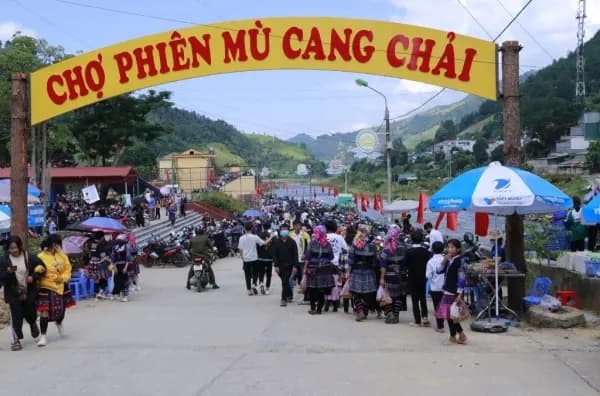
The Sapa of ten years ago and the Sapa of today are two different places. Urbanisation has gone a long way. The town centre is now a proper small city — mid-rise buildings, concrete, traffic. Which raises a question worth asking yourself: you travel to get out of the city, so does moving from one city to another give you what you came for? Almost everything has been commercialised. The photo spots, the costume rentals, the walk into the villages. Everything has a price and everything has become a service. The pressure to buy. Many guests tell us they struggled to relax because they were approached constantly, even while walking or eating. For some people that alone ruins a holiday. None of this makes Sapa a bad place. It is still beautiful, and for a great many travellers that convenience is exactly what they want. But if what you are after is somewhere still largely untouched, Sapa is no longer the answer — and that is where Tu Le, Khau Pha and Mu Cang Chai come in.
What should a Northwest mountain region be?
One thing worth saying plainly: Mu Cang Chai has not lost itself to commercialisation. Sapa has grown loud and hurried — which is the last thing a mountain region in the Northwest should be. This is a place whose value lies in being simple, unspoiled, plain and natural, not in high-rise hotels, five-star restaurants or premium services. What a trip into these mountains actually requires, in the end, is very little: — A place to sleep that is warm enough — A meal that tastes of the mountains — A winding road that belongs to the people who live there — A way of life you cannot find in a city — And a view that is completely clean — nothing in it but plants, earth and water That is the entire list. If you found yourself nodding at those five lines, you already have your answer, and the rest of this article is only detail.
Comparing the flight itself — the part that matters
If you are coming to the Northwest mainly to fly, this section decides it. And this is where Khau Pha wins clearly. Terrain and wind. The valley at Khau Pha is considerably wider and the wind direction is far more consistent. That has two consequences for you: a smoother flight, and more flyable days across the year. A narrow valley makes for turbulent air and more cancellations. Vertical and airtime. The drop from launch to landing at Khau Pha is over 500m. In moderate wind the pilot can extend the flight to 15, even 20 minutes — against an international standard of 10 to 15 minutes for an experience flight. An honest note few operators will make: longer is not automatically better. Most guests find 10 to 15 minutes about right; past that, some people start to feel queasy. The value of being able to fly 20 minutes is not the extra minutes — it is that the pilot has margin: margin to pick a better line, to swing back over something you liked, to approach the landing field without hurrying. Safety. A wide valley means many alternative landing options. And Khau Pha has one detail pilots rate very highly: there are no power lines anywhere in the flying area — the single greatest hazard for paragliding over developed terrain simply does not exist here.
Site infrastructure: an interesting reversal
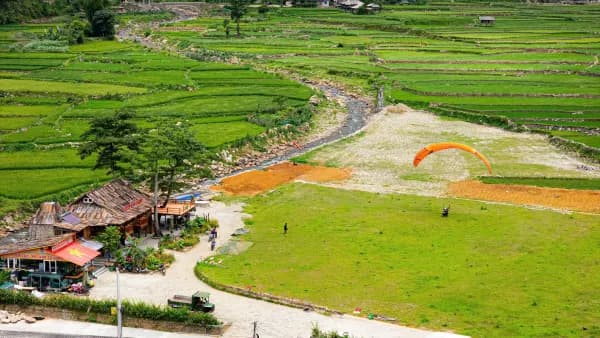
Mu Cang Chai loses to Sapa on tourist infrastructure. But on infrastructure built specifically for paragliding, Khau Pha is the best-equipped site in Vietnam. The road to launch is Highway 32. Fully paved. A 45-seat coach drives up without difficulty. That is rare — most Vietnamese sites involve a dirt track or a motorbike shuttle. The landing field is roughly one hectare, with numerous alternates around it. No power lines, no obstacles. At launch there is a check-in building, a reception desk, and free drinks while you wait your turn. At the landing field there is a clubhouse looking straight down the valley. Guests rest there, and outside peak season you can stay the night at no charge. See the food, rooms and the view on site: Khau Pha homestay by the landing zone. During the harvest season it is simply too busy for free overnight stays, but the clubhouse stays open for guests. And a convenience few people notice: coaches from Hanoi to Mu Cang Chai, and coaches from Sapa, drive straight past the site. You step off the bus and you are there — no onward transfer.
The landscape: there is nothing to compare it to
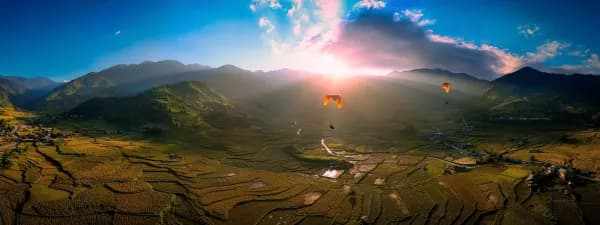
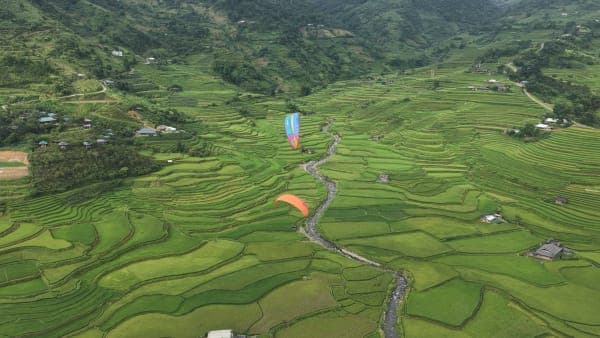
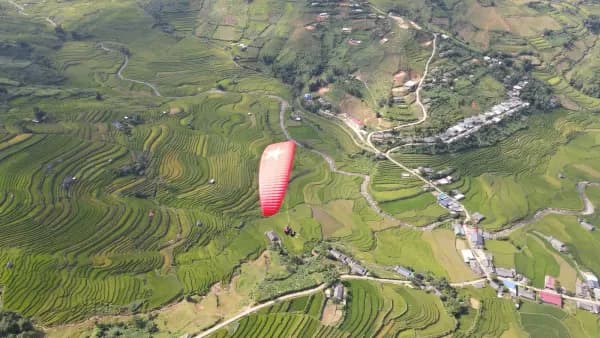
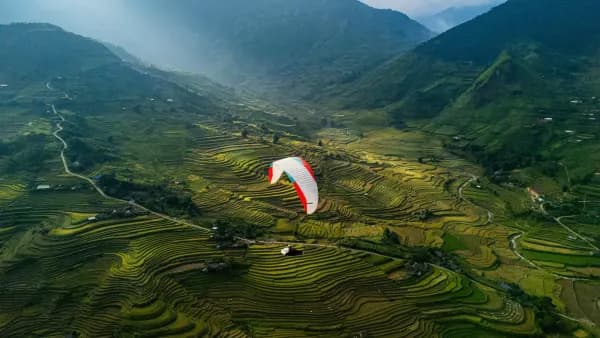
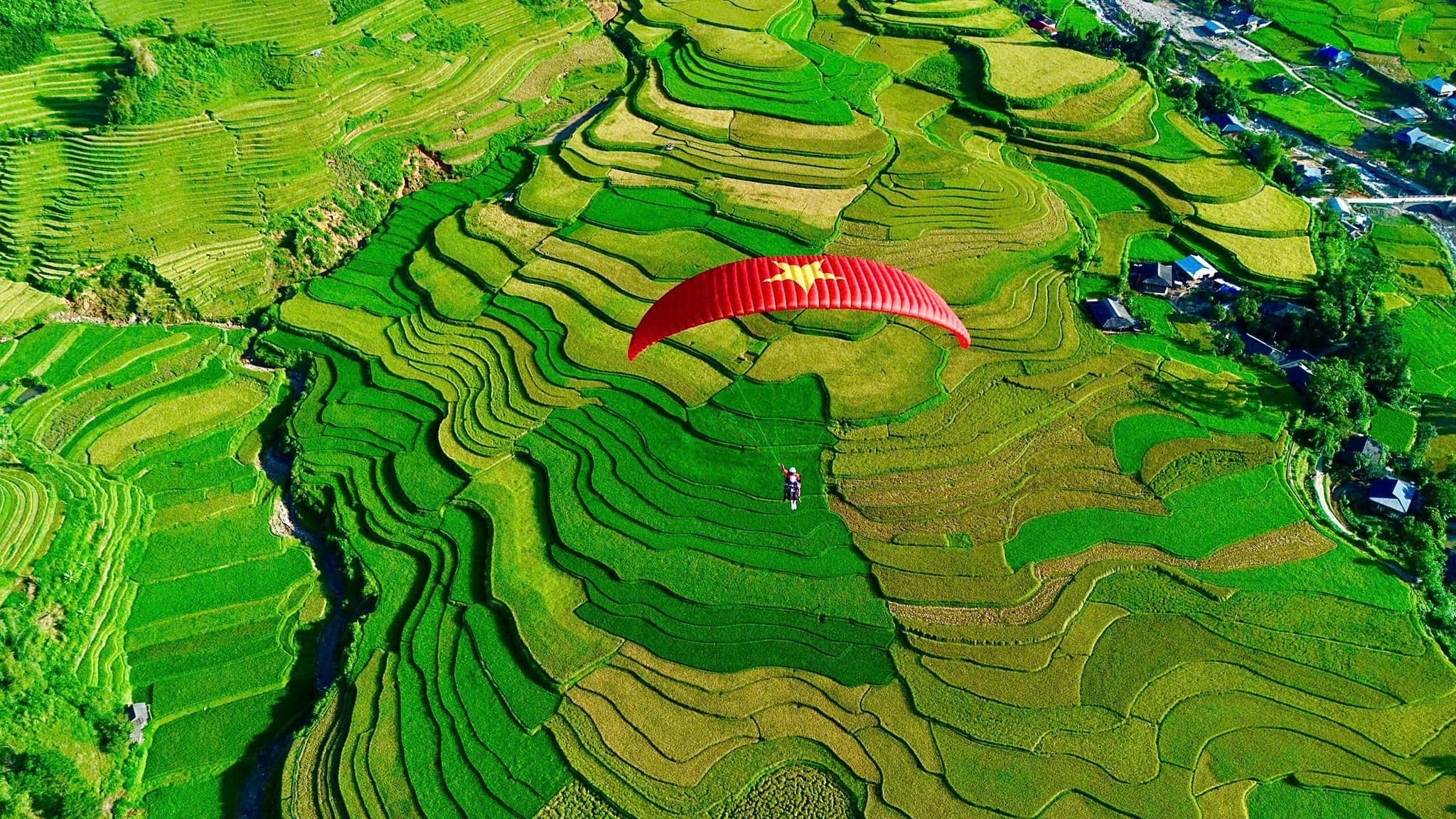
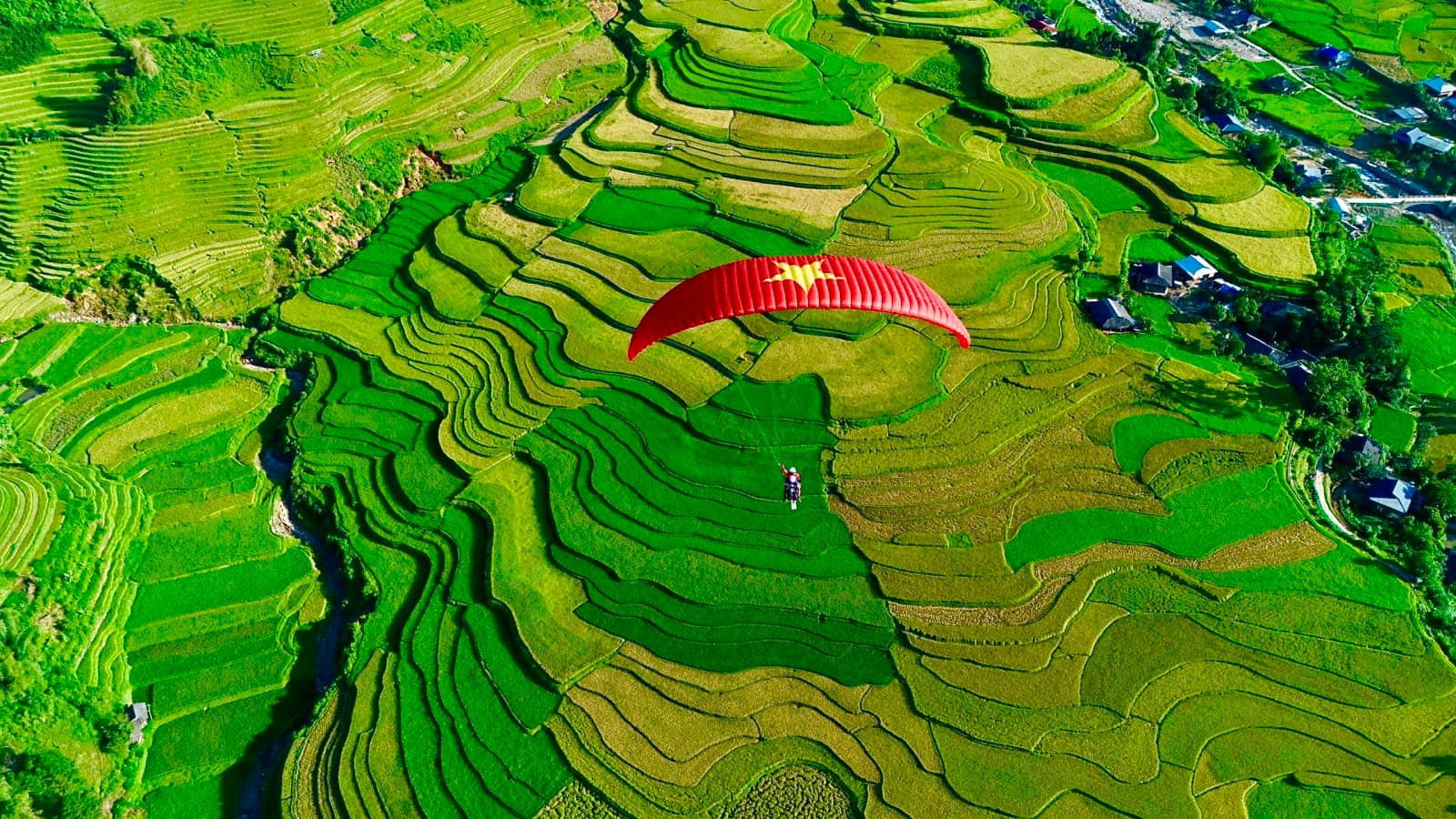
This is the real reason Khau Pha is ranked among the world's ten most beautiful paragliding sites. The Mu Cang Chai rice terraces are a Special National Heritage site — tens of thousands of paddies carved into the mountainside by generations of Hmong families, stacked from the valley floor to the ridge line, and from the air they appear to run on without end. But what sets them apart is not only that they are beautiful — it is that they are clean. There are no tin roofs in your frame, no apartment blocks, no pylons, no concrete. Only terraces and timber houses. This is the kind of landscape that cannot be recovered once it is developed, and at Mu Cang Chai it is still intact. Mam Xoi hill, Mong Ngua hill, the terraces at La Pan Tan — whether you come for the flooded season, the green season or the gold, an early morning here has a purity we have not found anywhere else in Vietnam. The thing we hear most often from guests after landing, almost word for word every time, is simply: "oh, it's so beautiful."
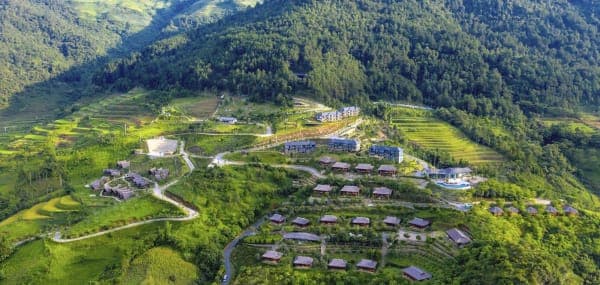
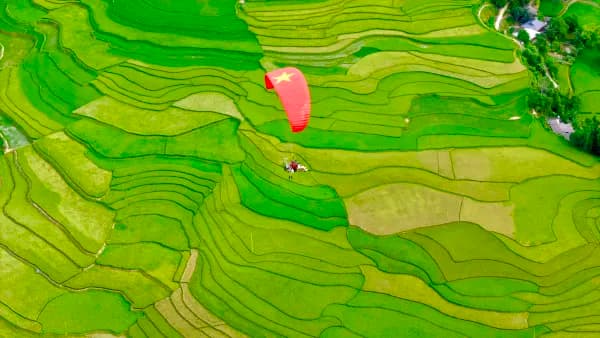
Both sites from the air — shot by the same team, so you can judge for yourself.
Powered paragliding — something Sapa does not have
Here is a difference Sapa cannot match: Khau Pha operates powered paragliding (paramotor) daily — in northern Vietnam, the only other paramotor site is Mebayluon's Quan Ba (Ha Giang). An engine means the pilot controls altitude rather than depending on natural lift. Three things only a paramotor can do: — Fly low over the terraces. An unpowered wing that goes low has to land. A paramotor runs along the surface of the paddies and then climbs out again. — Chase cloud. Climb above the low cloud layer instead of waiting for the cloud to come down to the wing. — Choose your own route. A standard flight is 15 minutes (20 to 25 with the special flight or a long flight), and you tell your pilot where you want to go — the helmets carry an intercom, so you can talk throughout the flight. The full details are in powered paragliding in Mu Cang Chai.
"Mu Cang Chai is only good in harvest season" — not true
This is the most common misconception about the site, and it makes a lot of people miss seasons that are every bit as good. April to May, the flooded season. The paddies fill with water and mirror the sky, thousands of stacked panes of glass. Plenty of photographers argue this is the best season of all. June to August, the green season. The whole valley is vivid green, the crowds are gone, and the air is often clearer. Late August to mid-October, the gold. The famous one, and the busiest. Late autumn and winter, the cloud sea. The pass is called "Sky Horn" in Thai — the part of the mountain that rises above the cloud. After a cold damp night this terrain makes cloud, and flying above a cloud sea is this season's own reward. Khau Pha flies all year, not for one month.
What Mu Cang Chai does worse — honestly
A comparison that only praises one side is not worth trusting. Here is what you should know before deciding. Far fewer services than Sapa. This is the flip side of being unspoiled. Fewer restaurants, fewer places to stay, no cable car, no attractions. If you want a fully serviced holiday, Sapa suits you better. Holidays and harvest season get busy. Book ahead — three to five days outside peak season, one to two weeks for the harvest and public holidays. Booking early also lets our team track the forecast for your specific day and warn you before you set off. Fewer transport options than Sapa. Sapa has a train and limousine vans running all day. Mu Cang Chai has fewer services, so check departure times in advance. Mountain weather. Some days do not fly. That is true of both places, but if you only have one day the risk is real. At both sites you can reschedule or cancel free of charge — we simply ask that you let us know in advance so the team can rework the schedule.
So who is Mu Cang Chai for?
After years of hosting guests at both sites, the picture is fairly clear. Mu Cang Chai is for you if: — You love nature and want to genuinely get away from the city, not swap one city for another — You want landscape as it should be: uncommercialised, unconcreted, clean, not staged — You value people being straightforward over service being polished — You dislike being hassled and dislike feeling rushed — You travel independently, simply and on your own terms — The flight is the point of the trip, not a side activity Sapa is for you if: — You want lots to do and full services — You are travelling with older relatives or small children who need comfort — Time is tight and you want everything close together
Or simply: do both
Few people realise that the two sites sit on the same road. The coach from Sapa to Hanoi drives past Khau Pha, and so does the coach the other way. Which means you do not have to choose. A three or four day trip can be: fly at Muong Hoa in Sapa, stay a night, drive on to Mu Cang Chai the next day and fly at Khau Pha, then head back to Hanoi. We operate both sites, so one booking covers both legs. And if you must pick one, our answer is the same as at the top: choose by what you want to look at. For comfort and plenty to do, Sapa. For a region still original, clean and unpretentious — and a better flight — Khau Pha.
Booking, and one thing worth knowing first Whichever you choose, the policy is the same: free rescheduling or cancellation — please let us know in advance. Reserving early costs you nothing — and it lets our team track the forecast for your specific day and warn you before you set off. In other words: if you are still undecided, reserve for both and decide later.
🪂 Book a flight in Mu Cang Chai (Khau Pha)
🏔️ Book a flight in Sapa (Muong Hoa)
Frequently asked questions
Is paragliding better in Mu Cang Chai or Sapa? For what you see from the air, Mu Cang Chai — Special National Heritage rice terraces with no urban development in the frame. For comforts on the ground, Sapa. Which is safer? Both are licensed and run to the same rules. On natural conditions Khau Pha has the advantage: a wider valley, more consistent wind, many alternate landing fields, and no power lines anywhere in the flying area. Where do you get more airtime? Khau Pha. Over 500m of vertical allows 15 – 20 minutes in favourable wind, against the standard 10 – 15. Do prices differ? Tandem flights start at 2,190,000 VND per person at both sites. Mu Cang Chai also offers powered paragliding at 2,390,000 VND. Can you fly Mu Cang Chai outside harvest season? Yes, all year. Flooded terraces in April – May, green season June – August, gold from late August to mid-October, cloud sea in late autumn and winter. Can I do both in one trip? Yes, the two sites are on the same road. Three to four days is enough. Does Sapa have powered paragliding? Paramotors currently operate daily at Mu Cang Chai. In northern Vietnam, Mebayluon also flies paramotors at Quan Ba (Ha Giang); Sapa has none. What if I book and then change my mind? Free rescheduling or cancellation at both the Mu Cang Chai and Sapa sites — please let us know in advance. So if you are undecided, hold a slot at both. Where do I book? Mu Cang Chai at mebayluon.com/booking; Sapa at paraglidingsapa.com. Both are run by the same team. How long is Sapa to Mu Cang Chai? Three to four hours by road, and the bus passes the Khau Pha site directly.
Further reading
— Paragliding in Mu Cang Chai: prices, seasons and the complete guide — Khau Pha Pass site profile — Powered paragliding in Mu Cang Chai — The Khau Pha pilot team — Muong Hoa – Sapa flying site — Book a flight at Khau Pha Pass