Almost everyone researching a paragliding flight asks the same three questions: where, how much, and which season. Very few ask the one that matters most — who is flying with me? On a tandem flight you control nothing. The person behind you decides everything: whether today is flyable, when to launch, which line to take, where to land, and what to do if the wind shifts. The wing is a piece of fabric. The pilot is the product. This is the published roster of the team operating at Khau Pha Pass, Mu Cang Chai — 16 pilots, with their ratings, hours and real flight numbers. None of it is internal information; every profile is open at mebayluon.com/pilots, and you are entitled to check before you book.
Why "who flies with you" matters more than "where you fly"
A site is terrain. Terrain does not change day to day; weather does. Khau Pha is beautiful and reliable, but it is still a mountain site — the wind swings through the day, cloud rises and falls with temperature, and an afternoon can go from perfect to unflyable in forty minutes. The decision inside those forty minutes is not made by a website, a price list, or the agency that sold you the tour. It is made by the pilot standing on launch, looking at the grass, the cloud and the clock. Three things only a pilot can do, and which pilots do differently: — Call it off. This is the hardest skill in the trade, harder than flying. An experienced pilot will cancel on a guest who has driven 300km and is visibly disappointed, for a reason the guest cannot see. — Read conditions on the spot. Two people read the same forecast and reach different conclusions. Someone who has flown here for years knows which spur works at which hour. — Handle the unexpected. Most flights are uneventful. The value of accumulated hours lies entirely in the rest. Which is why a flying team should publish its roster and its numbers, not just say "experienced pilots".
The Khau Pha team: 16 pilots
Chief pilot and instructors — Dang Van My — Chief pilot, PG & PPG pilot · "Captain My" — Alish Thapa — APPI & SIV instructor, acro pilot, PPG pilot · "Sky Phantom" — Subash Thapa — Acro pilot, SIV instructor, PPG pilot · "Sky Knight" Team pilots — Minh Vo · "Steel Eagle" — Minh Trung · "Space Warrior" — Dinh The Anh · "Cloud Hunter" — Chien Thang — team and PPG pilot · "Thang the Thunderbolt" — Bishal Thapa · "Wind Commando" — Ngo Doi · "Gliding Fighter" — Phan Hung · "Sky Wanderer" Acro and competition pilots — Bishal Skyboy — acro and competition pilot · "Skyboy" — Suman Thapa — acro pilot · "Sky Rider" Local pilots — A Xieng — local pilot · "the hard-working village boy" — A Mac — PG/PPG pilot and flight coordinator at Mu Cang Chai · "the all-rounder" Trainee pilots — A Hung · "the Hmong flute player" — Khang Dung · "sky photographer" Every pilot on the team is trained to the international APPI and IPPI standards. The operator — Vien Nam Tourism and Sports JSC — is licensed to fly by the Operations Department of the General Staff, Ministry of National Defence, and holds the paragliding operating licence from the Ministry of Culture, Sports and Tourism.
Dang Van My — chief pilot
If one person is behind Khau Pha becoming the site it is today, it is My. — Ten years of flying: around 1,500 solo flights for more than 1,000 solo hours, and more than 6,000 tandem flights safely, for several thousand tandem hours — Currently the pilot with the most flight hours in Vietnam — Vietnam's first helico pilot (the paragliding manoeuvre) — The first and only tumbling pilot in Vietnam — one of the hardest acro manoeuvres in the sport — Jumped under a D-Bag deployment at a paragliding event in Mu Cang Chai in 2022 — video below — APPI ParaPro P5 and P5 from the Japan Hang and Paragliding Federation (JHF) — a senior level within the international IPPI framework Born in 1985, he lectured at Hanoi University of Science and Technology before turning to paragliding full time around 2016. In the early years he translated international manuals himself and learned from foreign pilots, with the explicit aim of building a properly structured paragliding community in Vietnam rather than an informal club. More telling than the numbers: most of the local pilots now flying at Khau Pha were trained directly by him. That is not something equipment can buy. Full profile: pilot Dang Van My.
Alish Thapa — APPI and SIV instructor
Alish Thapa is Nepali, and Nepal is to paragliding roughly what Brazil is to football — Himalayan terrain produces a generation of pilots who fly in harder conditions than almost anywhere else. Flying since 2011. His first acro trophy came in 2013, the same year he took second place in a tandem cross-country competition. He flies with the Nepal Acro Team. Ratings and roles — APPI paragliding instructor — AFF-I and TAN-I skydiving instructor to USPA standards — Chief instructor and S&TA (Safety and Training Advisor) at Insky Skydive Nepal, and chief instructor at Skydive Chiang Mai — Currently owns both a paragliding company and a skydiving operation in Pokhara, Nepal — the paragliding capital of the world — Managing director at Insky Skydive and Everest Paragliding, managing director and instructor at Fishtail Nepal Paragliding — BGD team pilot (Bruce Goldsmith Design) — Judge at the Accuracy World Cup and the Acro Pre-World Cup — Performed a skydive from a powered paraglider at the 2023 Mu Cang Chai harvest festival — video below — With Subash Thapa, has run four SIV and acro courses in Vietnam for Mebayluon between 2022 and 2024 — twice at Nui Coc Lake and twice at Ha Long Two of those are worth pausing on. First, S&TA is the role responsible for safety across an entire flight centre — the person who assesses other pilots. That someone at that level flies and teaches regularly at Khau Pha says a great deal about the standard this site is run to. Second, being picked as a manufacturer team pilot is not simply a commercial arrangement. A wing maker attaches its name only to pilots it trusts to fly correctly, because any mistake in the air reflects back on the product. He is also an SIV instructor — the incident-recovery training that is the hardest and most important part of a pilot's education — and is recognised as one of Nepal's first skydiving instructors.
Subash Thapa — 4,000 tandem hours
— More than 4,000 professional tandem hours — Chief pilot and paragliding/skydiving instructor at Pokhara, the paragliding capital of Nepal — Chief pilot at Nepal Acro Paragliding, formerly chief pilot at New Para World Paragliding — SIV instructor — Performed a skydive from several thousand metres at the 2023 harvest paragliding festival — video below — More than four years operating in Vietnam, with a solid grasp of local terrain and weather — With Alish Thapa, has run four SIV and acro courses in Vietnam for Mebayluon between 2022 and 2024 — twice at Nui Coc Lake and twice at Ha Long Four thousand tandem hours deserves context: at 15 minutes a flight, that is roughly 16,000 flights. And four years flying in Vietnam means that international experience has been recalibrated to this terrain and this climate — something a talented pilot fresh off the plane does not yet have.
The senior Vietnamese pilots who fly at Khau Pha
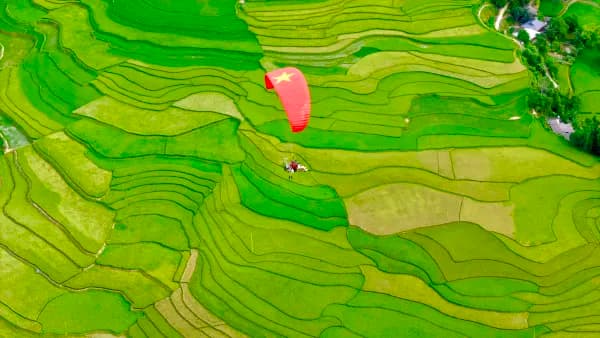
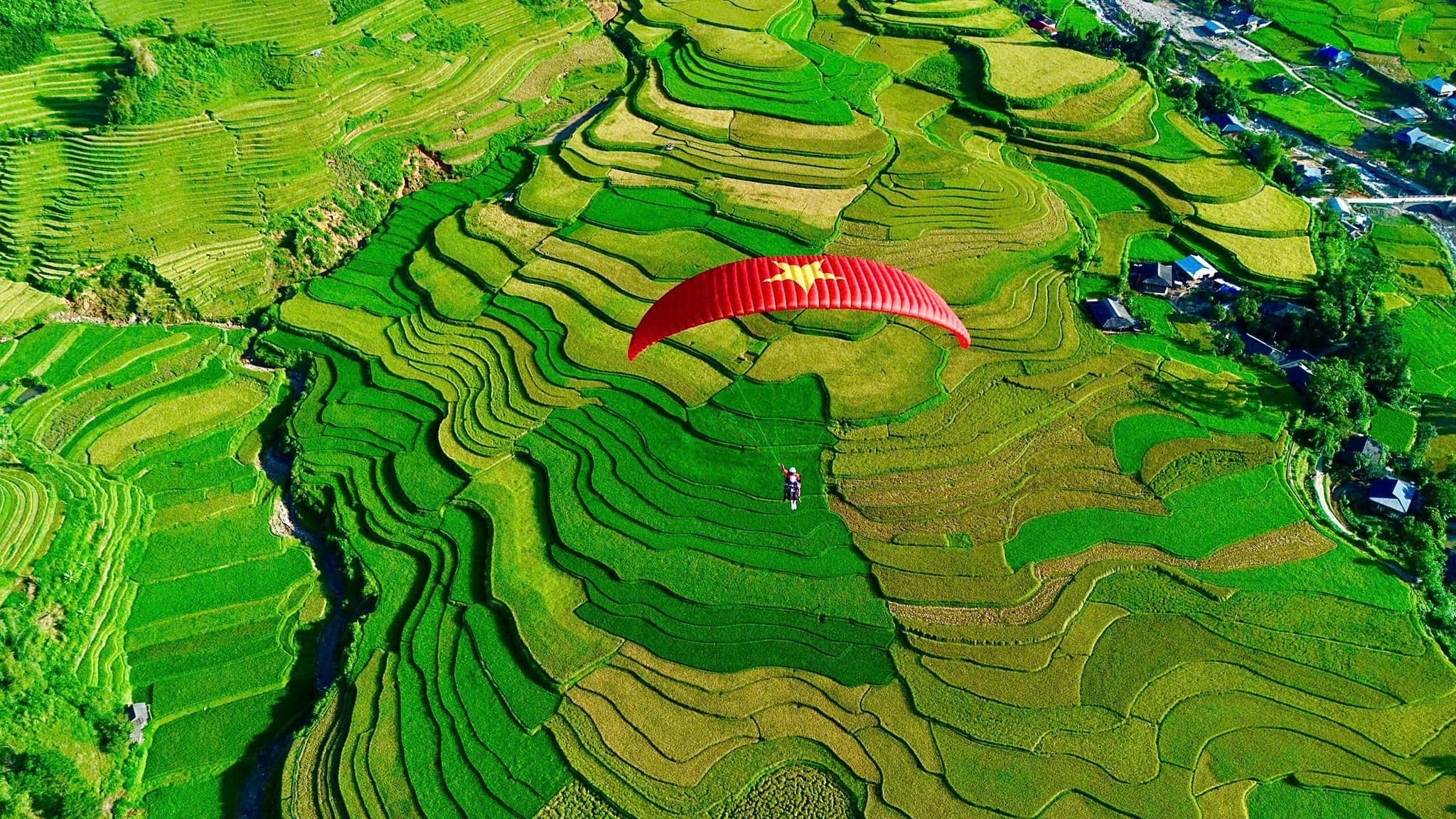
This group flies the majority of tandem flights at the site. Minh Vo — "Steel Eagle" — 14 years of paragliding, more than 6,000 safe tandem flights — One of Vietnam's first five pilots, part of the group that laid the foundations of the sport here — In 2023 he and his team took first place in Accuracy Landing at the MCC competition Nguyen Minh Trung — "Space Warrior" — More than 5,000 safe tandem flights, seven years of experience, more than 1,000 logged hours — Specialises in tandem and cross-country flying — Graduate of an SIV course in Nepal — His wing carries the Vietnamese flag — the most recognisable image to come out of Khau Pha Dinh The Anh — "Cloud Hunter" — More than 5,000 flights and over 1,000 hours of safe airtime — Three-time national champion in accuracy landing — Represented Vietnam in competition in South Korea in 2023 — Has launched in Switzerland, South Korea, the USA, Thailand and Indonesia Chien Thang — "Thang the Thunderbolt" — Seven years flying, more than 4,000 safe tandem flights, more than 1,000 hours — Holds Vietnam's #2 record for the longest solo flight: nine and a half continuous hours — PPG pilot That figure — nine and a half hours aloft on an unpowered wing — is worth unpacking. It means that for nine and a half hours he kept finding and holding lift: a test of reading air that no instrument performs for you. That is precisely the skill that makes your own 15-minute tandem smooth rather than rough. Other Vietnamese pilots have also flown at Khau Pha during competitions and festival seasons, among them Nguyen Van Tien Toan. The pass has long been where the country's paragliding community gathers each harvest season.
Local pilots — Hmong men flying over their own fields
This is the part we are proudest of, and the part no reseller can replicate. A Xieng — "the hard-working village boy" — Four years flying, close to 500 safe tandem flights — One of the first local pilots from Mu Cang Chai — In 2025 he and his team took first place in Accuracy Landing at the MCC competition — on home ground — Trained directly by chief pilot Dang Van My A Mac — "the all-rounder" — PG and PPG pilot, currently flight coordinator at Mu Cang Chai — Three years flying, more than 600 flights plus several hundred PPG flights — The first professional trike pilot in Tu Le – Mu Cang Chai — Assistant instructor on training courses, and able to service the engines himself — Also trained by My A Hung — "the Hmong flute player" and Khang Dung — "sky photographer" are currently trainee pilots working through the programme. The significance of this runs past tourism. The terraces you see from the air are farmed by these pilots' families. When a young Hmong man from Tu Le becomes a certified tandem pilot, the value of those terraces stops being only the rice crop — and that is the most durable way to keep this landscape intact.
What APPI, IPPI and P5 actually mean
Guests hear these letters constantly and rarely get them explained, so here is the short version. IPPI — International Pilot Proficiency Information — is the common conversion scale of the World Air Sports Federation (FAI). It issues no licences; it translates one country's rating into another's, across five ParaPro levels. APPI — Association of Paragliding Pilots and Instructors — is a widely recognised certifying body, with its own tracks for pilots, tandem pilots and instructors. The five ParaPro levels, briefly: — P1 – P2: students, flying simple conditions under an instructor's direct supervision — P3: still a student under IPPI — practising active flying and beginning to fly on their own at familiar sites in mellow conditions — P4: soaring — using lift (ridge soaring, thermalling); completing level 4 is when you are recognised as a pilot — P5: senior pilot — flying many sites in stronger conditions, the basis for cross-country flying and for becoming an instructor A tandem rating is a separate step. IPPI has a level 6 for tandem, open only after IPPI 5; to carry passengers commercially a pilot needs a specific tandem qualification, requiring minimum hours, a number of supervised tandem flights and its own examination. A strong P4 pilot still may not fly you without it. SIV is incident-recovery training — the pilot deliberately collapses, twists and destabilises the wing over a lake with a rescue boat below, and practises the recovery. An SIV instructor is qualified to teach that. The Khau Pha team currently has two SIV instructors: Alish Thapa and Subash Thapa.
How a tandem pilot differs from a solo pilot
People assume a tandem pilot is simply a good pilot with a spare seat. It is not that. — Twice the weight. A tandem wing is bigger, heavier, slower to respond and needs more force to steer. Launching with a passenger who has never run in step with anyone is a discipline of its own. — No room for corrective errors. Flying solo, a pilot can accept a situation and then deal with it. Carrying a passenger, the safety margin has to be far wider — meaning noticeably more conservative flying than the same pilot does alone. — Flying and looking after someone at once. A tandem pilot is simultaneously reassuring someone afraid of heights, filming, framing the shot, and watching whether you are going pale. — Owning the cancellation. A solo pilot who cancels loses an afternoon. A tandem pilot who cancels breaks the plans of a family that just drove 300km. Which is why "4,000 to 6,000 tandem flights" is a far more meaningful number than "many years of experience".
What a PPG pilot needs on top
Flying a powered paraglider (PPG) requires a separate rating; it does not come automatically with a paragliding licence. Three additional skill sets: — Running an engine. Starting, pre-flight checks, fuel management, and knowing exactly what state the engine is in throughout the flight. — Powered launching. Getting off level ground with a motor unit on your back and a passenger in front is a different technique from running down a slope. — Always keeping a glide option. The professional rule: at every moment, stay within gliding range of a safe landing field should the engine stop. At that point the wing is still a complete paraglider and continues to glide normally. At Khau Pha there are fewer engine-rated pilots than tandem pilots — currently Dang Van My, Alish Thapa, Subash Thapa, Chien Thang and A Mac. That is the practical reason PPG slots per day are far more limited and sell out first in peak season. The discipline is covered in detail in powered paragliding in Mu Cang Chai.
From student to tandem pilot: the path at Khau Pha
Khau Pha is the only site in Vietnam that runs commercial flying and pilot training in the same place. That creates a closed loop: people learn here, build hours here, and become pilots here. Step 1 — The basic course. About seven days, one-to-one instruction, on the Lim Mong landing field. Ground handling, canopy control, launching, straight flight, landing. Step 2 — Building hours. The longest stage and the one with no shortcut. Hundreds of solo flights in varied conditions. Step 3 — SIV. Incident recovery over water. Without it, you should not be carrying passengers. Step 4 — The tandem rating. Supervised tandem flights, an examination, and only then real passengers. Step 5 — PPG or acro, if the pilot chooses to specialise. A Xieng and A Mac are exactly this pathway in practice: young men from the village, trained by My, several hundred flights each, and now one is an accuracy-landing champion and the other coordinates flying for the whole site. If you want to take that path: the intensive paragliding course.
What your pilot decides on your flying day
From the moment you arrive until you land, here is what is running through the mind of the person flying with you. Before you arrive — the pilot has already read the forecast, knows today's wind direction, and has a plan for time slots. When you check in — your weight determines the wing size and who flies with you. This is not random allocation: the ratio of total weight to wing area (wing loading) determines whether the wing is fast or slow, stable or responsive. On launch — the pilot fits your harness himself and checks every buckle. That is not delegated to ground staff, because the person carrying the responsibility is the person flying. In the seconds before the run — this is the decision point. The pilot waits for the right cycle. It might be 30 seconds, it might be 10 minutes. If the cycle does not come, the flight waits. In the air — choosing a line based on the lift that is actually there rather than a planned route, keeping separation from other wings, and continuously calculating whether there is still enough height to reach the landing field. On approach — picking the direction from the surface wind, and telling you when to put your legs out. You see none of that chain. You see a smooth flight. That is what a good pilot looks like.
Can you choose your pilot?
The honest answer: you can ask, and we will try, but it cannot always be arranged. Pairing depends on three things, in this order: your weight and the right wing size, each pilot's schedule that day, and the conditions at the moment you reach launch. Safety comes before preference. But if you have a specific reason, say so when you book and the team will do what it can: — An English-speaking pilot — no problem, the team includes several international pilots — The Vietnamese flag wing for your photos — mention it in advance, since it belongs to one specific pilot — Afraid of heights, want a smooth flight with no banked turns — say so, and say it again to your pilot before launch — A PPG flight — must be requested in advance, since engine-rated pilots are limited — Young children or older guests — tell us beforehand so we assign a pilot with the right experience One honest piece of advice: do not pick a pilot by social media following. Every pilot on the roster above holds a tandem rating and flies to the same set of safety rules.
Frequently asked questions about the Khau Pha pilots
What qualifications does my pilot hold? Every tandem pilot at Khau Pha is trained to the international APPI and IPPI standards and holds a separate passenger (tandem) rating. The roster is public at mebayluon.com/pilots. How many pilots are on the Khau Pha team? Sixteen: a chief pilot, two SIV instructors, team pilots, acro pilots, local pilots and trainees. How many hours do the pilots have? It varies. Chief pilot Dang Van My has the most flight hours in Vietnam, with more than 6,000 tandem flights; Subash Thapa has over 4,000 tandem hours; several of the Vietnamese team pilots have 4,000 – 6,000 tandem flights and more than 1,000 hours. Are there foreign pilots? Yes. The team includes several Nepali pilots — from one of the leading paragliding nations in the world — two of whom are APPI and SIV instructors: Alish Thapa and Subash Thapa, who have run four SIV and acro courses in Vietnam between 2022 and 2024. Can I choose my pilot? You can ask when you book. The final pairing depends on weight, wing size, the day's schedule and conditions. Do the pilots speak English? Yes, several do. Mention it when you book. Who decides whether today is flyable? The pilot on launch, not the ticket desk. If conditions are not right the flight is postponed or cancelled, and you reschedule or get a refund at no charge. How is a tandem pilot different from a solo pilot? The tandem rating is a separate qualification to carry passengers, requiring minimum hours, supervised tandem flights and its own examination. A strong solo pilot is not permitted to fly you without it. Is the powered paragliding pilot a different person? Possibly. PPG requires a separate engine rating held by fewer pilots — which is also why there are fewer PPG slots each day. How do I become a paragliding pilot? The basic course runs about seven days, one-to-one, on the Lim Mong landing field. After that comes hour-building, an SIV course, and only then the tandem rating. Are local pilots as experienced as the veterans? They have fewer flights than the senior pilots, but they all meet the passenger standard and they have one advantage of their own: they fly their home terrain every day. A Xieng won the accuracy landing title at the 2025 MCC competition.
International instructors who have worked with Mebayluon
The permanent roster is not the whole story. A flying site only raises its standard when people from outside come in regularly to examine, re-teach and point out what is being done wrong. Four SIV and acro courses run in Vietnam Alish Thapa and Subash Thapa have worked with Mebayluon Paragliding four times to run SIV and acro courses in Vietnam, across 2022, 2023 and 2024: twice at Nui Coc Lake (Thai Nguyen) and twice at Ha Long (Quang Ninh). These are not display events. SIV is incident-recovery training: the pilot deliberately collapses, twists and destabilises the wing at a safe height over water, with a rescue boat below, and practises bringing it back to normal flight. It is the only training that shows a pilot what actually happens when a wing stops behaving — and it cannot be learned from a book. Acro is aerobatic flying, where the pilot pushes the wing into states normal flying never reaches. What this means for a tandem passenger at Khau Pha: pilots who have been through SIV know what a wing will do in a bad situation, because they have created that situation themselves. That is the difference between someone who has read about it and someone who has done it. One of the four is documented here: the second SIV course at Nui Coc Lake.
An instructor from Japan Alongside the Nepali instructors, Mebayluon has also worked with instructor Tono from Japan. Japan matters here for a specific reason: the certification system of the Japan Hang and Paragliding Federation (JHF) is among the most rigorous in Asia, and chief pilot Dang Van My holds a JHF P5 rating — the top level of the ParaPro scale. The value of bringing in foreign instructors is not the flying instruction. The pilots here can already fly. It is that operating procedures and safety standards get audited by outsiders on a regular basis — something a self-contained operation finds very hard to do for itself.
Further reading
— The full pilot roster — Pilot Dang Van My — how he came to paragliding — Paragliding in Mu Cang Chai: prices, seasons and the complete guide — Khau Pha Pass site profile — Powered paragliding in Mu Cang Chai — Is paragliding safe? — The intensive paragliding course