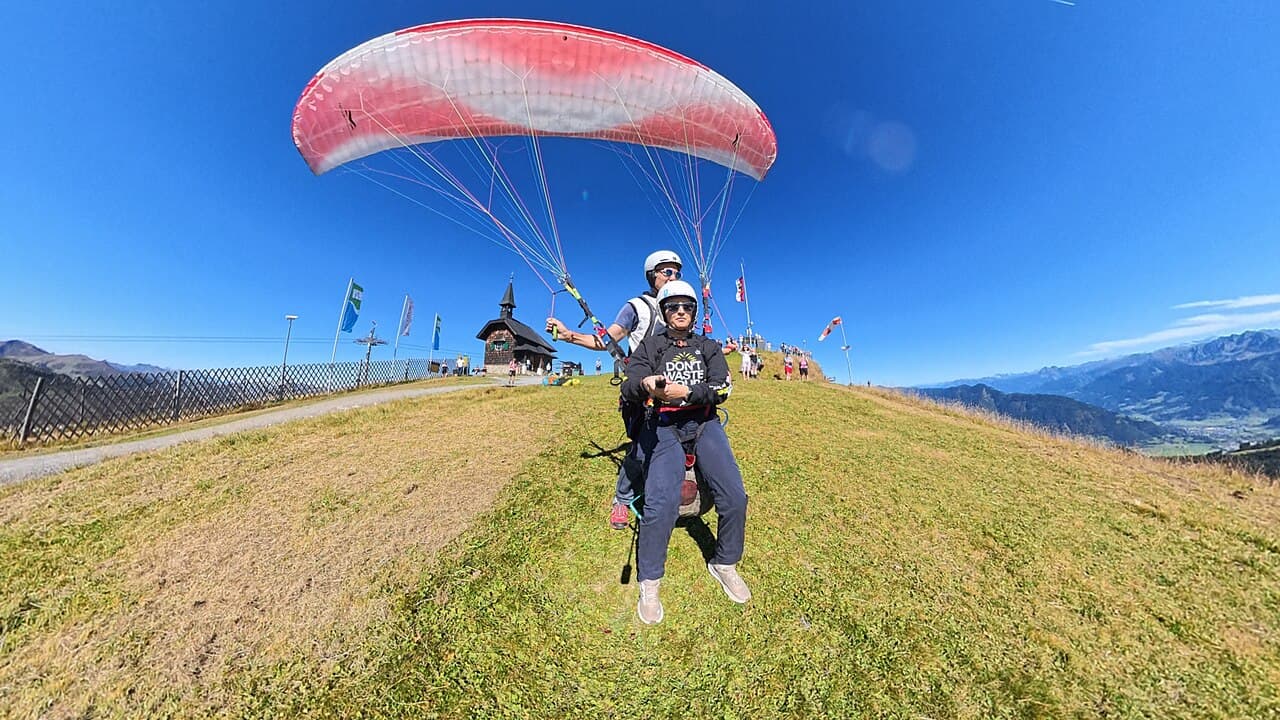
Many pilots still call paragliders "ultralight flying vehicles" – the term used by Decree 36/2008. Since 2025 the legal framework has changed completely: paragliders, powered paragliders (PPG), balloons and similar devices are now grouped as other flying vehicles, managed alongside unmanned aircraft (drones). From 20 July 2026, registration of flying vehicles with the Police begins. This article explains briefly why you must register, whether you need to "report" a flight, which agencies are in charge, and what drone pilots need to do.
The current legal framework
| Document | Main content | In force |
|---|---|---|
| People's Air Defence Law 2024 (No. 49/2024/QH15) | Defines unmanned aircraft and other flying vehicles; the Police register them (Art. 29), the Ministry of National Defence issues flight permits (Art. 30); operator conditions (Art. 31); neutralisation and seizure (Art. 34) | 1 Jul 2025 |
| Decree 288/2025/NĐ-CP | Classification; conditions for registration and operation; flight permit files and deadlines; operator requirements | 5 Nov 2025 |
| Circular 78/2026/TT-BCA | Registration procedure, identification number, electronic tag/device for flight management | 20 Jul 2026 |
| Decision 18/2020/QĐ-TTg | Prohibited and restricted flying areas (under review under the new law) | 2020 |
| Circular 06/2018/TT-BVHTTDL | Facilities, equipment and staff required to run paragliding and powered kite businesses | 15 Apr 2018 |
The Air Defence Law defines other flying vehicles as "balloons, model aircraft, parachute-wings, kites (except folk kites) and other flying devices, with or without an operator, that are not aircraft or unmanned aircraft". Paragliders and powered paragliders fall squarely within this definition.

1. Why a paraglider must be registered, and how
Why
- Identifying the owner. Vietnamese airspace is managed centrally by the Ministry of National Defence. When radar or the public spots something in the air, the authorities must know immediately whose it is and whether it is permitted. The registration number works like a number plate.
- A condition for a flight permit. A permit application requires the vehicle's documents. An unregistered vehicle of unknown origin will not be permitted.
- Handling incidents. A wing that falls, a missing pilot, a collision – the registration number traces the owner, operator and site operator within minutes.
- Preventing misuse. Flying vehicles can be used for surveillance, carrying prohibited items or entering military areas. Registration is the first layer of control.
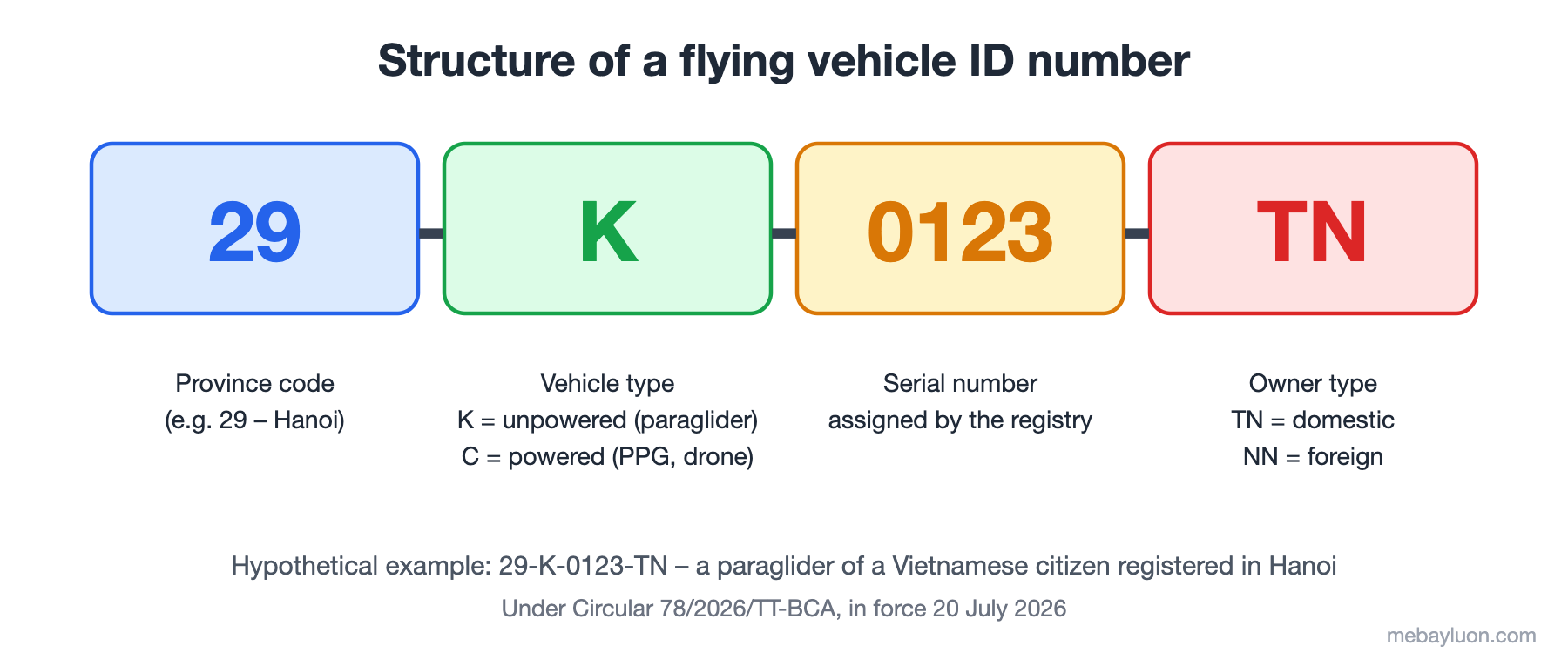
Under Circular 78/2026/TT-BCA every vehicle gets a unique registration number that serves as its identifier, in the form AB-X-NNNN-CD: AB is the province code, X the vehicle type (C – powered, K – unpowered), NNNN a serial number, CD the owner type (TN – domestic, NN – foreign). A paraglider therefore carries a K, a paramotor a C.

Who registers
Under Article 29 of the Air Defence Law, the Police register unmanned aircraft and other flying vehicles (except those of the Ministry of National Defence). Circular 78/2026/TT-BCA assigns:
- Provincial Police: vehicles of Vietnamese citizens, foreigners residing in Vietnam and organisations headquartered in the province – where most pilots and clubs will register.
- Department of Cyber Security and High-Tech Crime Prevention (A05): Police vehicles, diplomatic missions, temporary registrations and some special cases.
- Commune Police: may be assigned vehicles under 2 kg of domestic organisations.
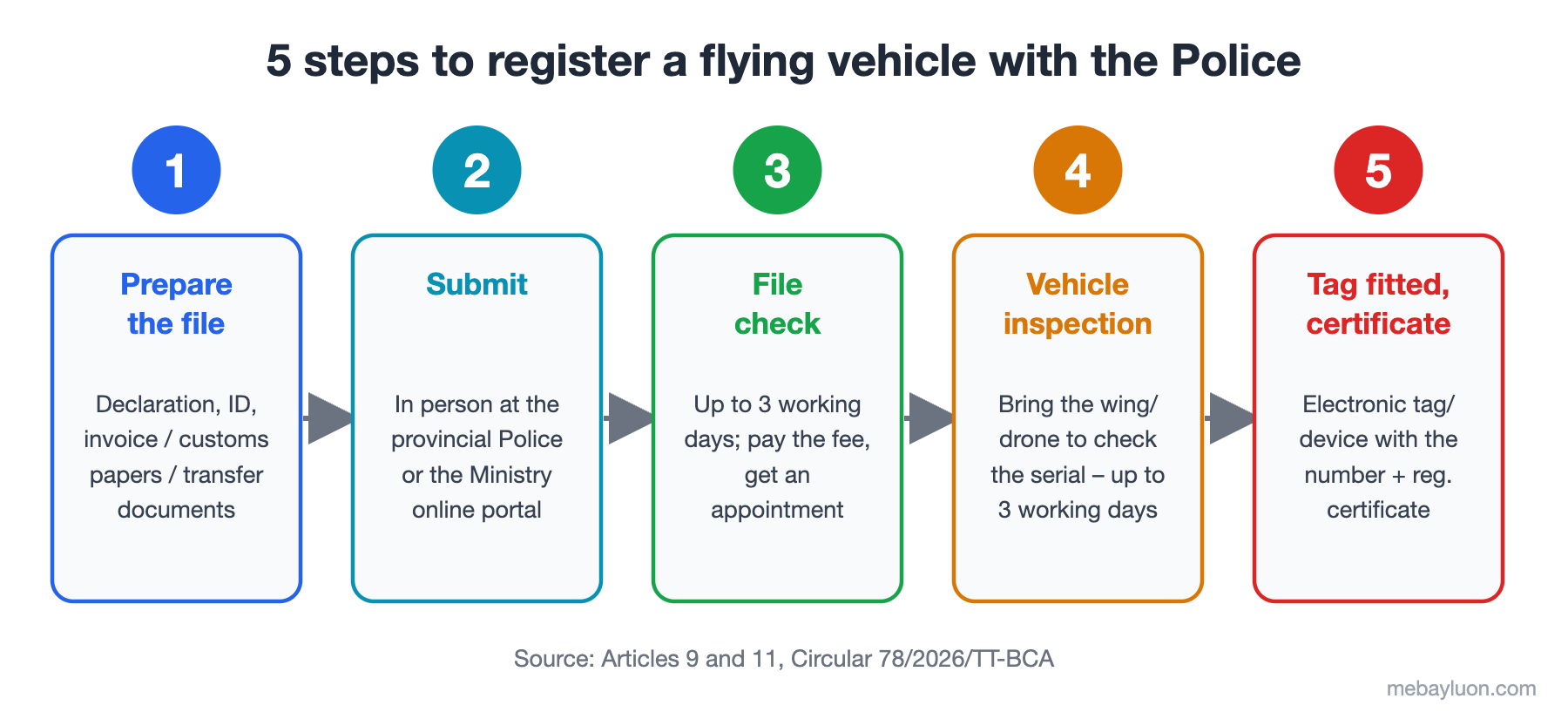
Procedure (Articles 9 and 11, Circular 78/2026/TT-BCA)
- Prepare the file: declaration, ID, proof of lawful ownership (customs declaration and import licence if imported; invoice from a licensed seller; or transfer documents), fee receipt. Self-built vehicles also need a technical certificate or an owner's commitment.
- Submit in person or online via the Ministry of Public Security's public service portal; receive a file number.
- File check – up to 3 working days. If complete, you are told to pay the fee and bring the vehicle; if not, you supplement it.
- Vehicle inspection: bring the wing/vehicle to check the serial number, frame, body, engine and accessories – up to 3 working days for the result.
- An electronic tag or device carrying the registration number is fitted and the registration certificate is issued.
Practical notes for paraglider pilots:
- Keep the invoice and customs papers when you buy a new wing. For a used wing, get transfer documents from the seller.
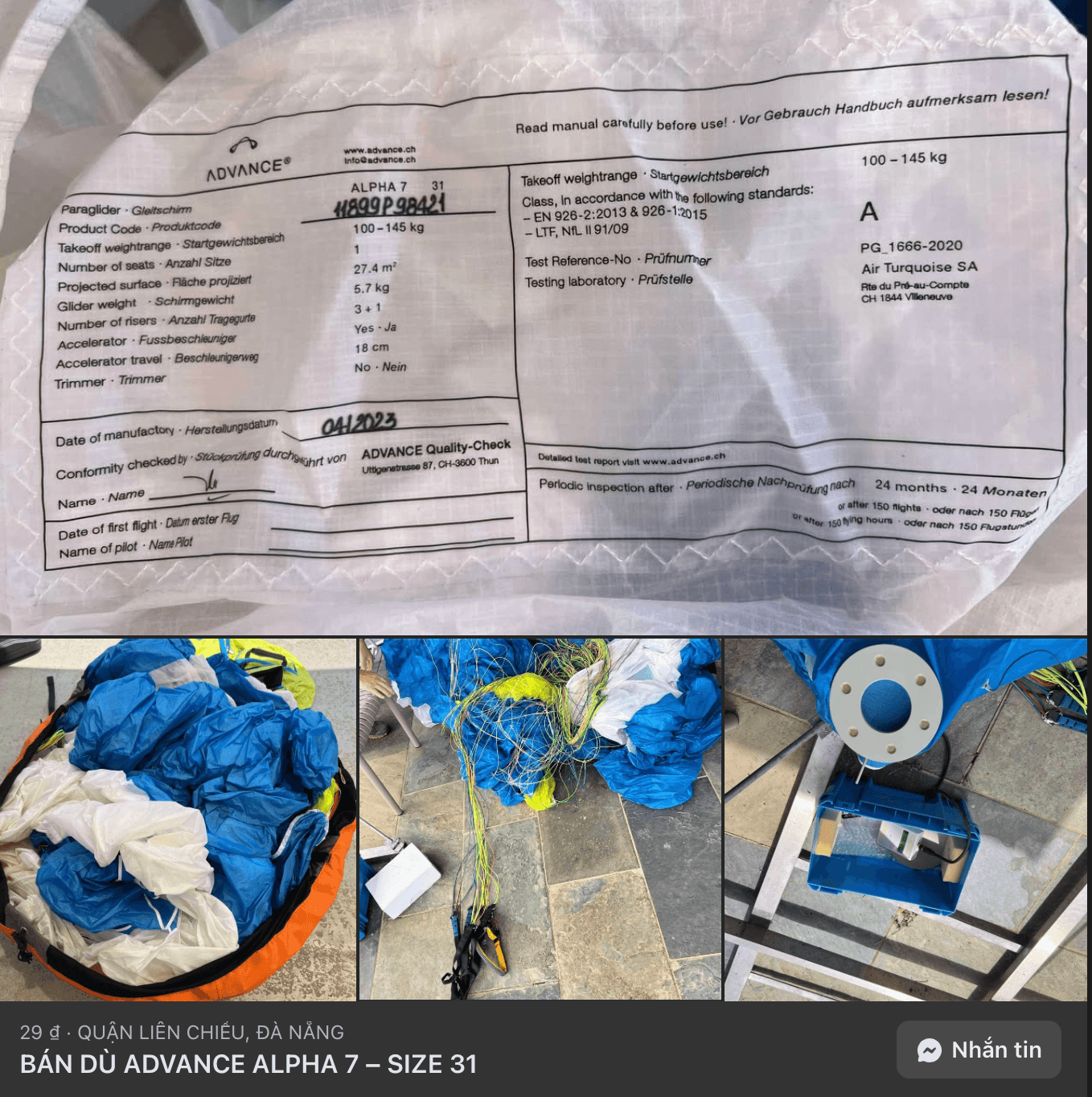
- The serial number on the wing's label (usually on the centre cell near the A-lines) is what gets checked – never cut the label off.
- How tags or devices will be attached to paragliders and paramotors is still new; ask your provincial Police before bringing the wing in.

2. Do you have to "report" a flight? Who is in charge? What if something goes wrong?
Flight permits and flight reporting
Registration is only the vehicle's "birth certificate". Every flying activity also needs a flight permit from the Ministry of National Defence (Art. 30 Air Defence Law; Arts. 21–22 Decree 288/2025/NĐ-CP). Under Decree 288:
- The file includes an application, the relevant legal documents, a diagram of the flying area and approval letters for restricted areas.
- Submit at least 7 days before the flight (12 days if a NOTAM is needed); the authority answers within 5 working days.
- A permit is valid up to 30 days; up to 180 days for state or agricultural missions; up to 360 days for traditional flying areas such as established paragliding sites.
- Where to submit: the Operations Department of the General Staff (1 Nguyen Tri Phuong, Hanoi), military region commands, provincial military commands, or online via the national public service portal.
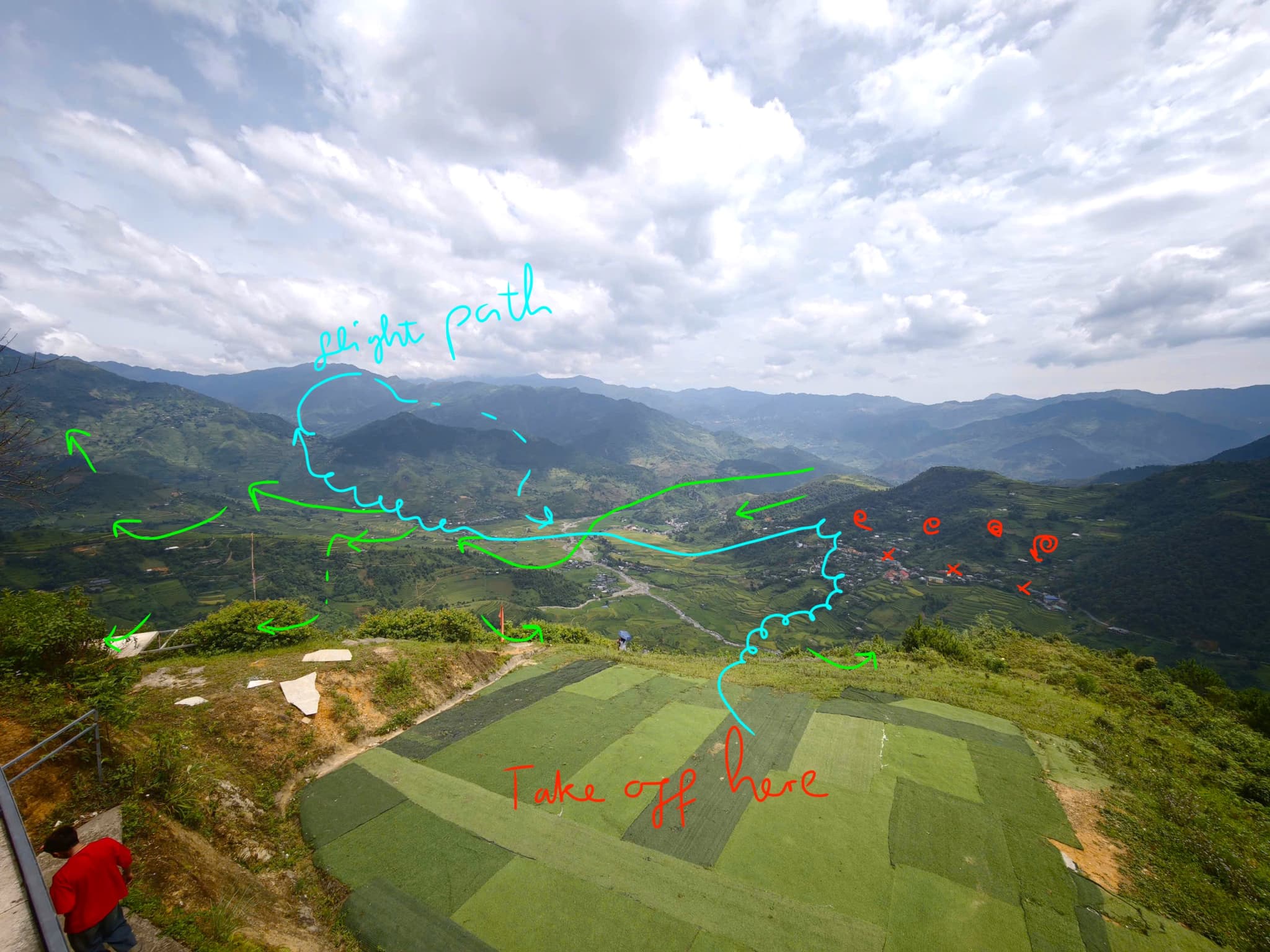
At operating sites (Khau Pha, Sapa, Vien Nam, Son Tra…) the site operator holds the annual permit. Individual pilots do not apply for a permit every day, but must:
- Register with the site operator before flying (name, wing, registration number, rating) to be included in the permitted flying list.
- Fly within the area, hours and ceiling stated in the permit.
- Follow the coordination and notification with local military and authorities required by the permit – usually done daily by the site operator.
Flying outside a permitted site (a new hill, an XC flight leaving the area, turning up at an unknown slope) is flying without a permit, even at a few hundred metres – airspace above 120 m over terrain is already a restricted area.
Who is in charge while you fly
- Ministry of National Defence: manages the airspace, issues and suspends permits; air defence and local military units monitor.
- Police: check registration, handle security and public order violations.
- Site operator: the party directly responsible under the permit, runs launch and landing, stops flying when ordered.
- People's Committees and commune authorities: manage the local area and help in incidents.

When something goes wrong
- Accident, injury, tree landing, water landing: call the site operator (radio, phone), 112 (search and rescue), 115 (ambulance), 113 (police). Commercial paragliding sites must have a safety, search and rescue plan, rescue and medical staff (Circular 06/2018/TT-BVHTTDL).
- Landing outside the permitted area, especially near military sites: stay where you are, contact the site operator, cooperate with local police and military; do not walk away or relaunch.
- Breaching the permit (wrong area, busting the ceiling, flying after a stop order): the whole site's permit can be suspended; the vehicle can be neutralised or seized (Art. 34 Air Defence Law); the pilot faces administrative fines, and criminal liability if the consequences are serious.
- Damage to third parties (landing on houses, cars, people): the owner and operator are liable in civil law – carry third-party liability insurance and accident cover for pilots and tandem passengers.
3. Police, army or local government – who manages paragliding?
The answer: all three, each with its own job.
| Agency | Role for paragliders and other flying vehicles |
|---|---|
| Ministry of National Defence (Operations Department of the General Staff; military regions; provincial military commands) | State management of air defence and airspace; issues, amends and suspends flight permits; technical standards; pilot licences; neutralising illegal flying vehicles |
| Ministry of Public Security (Department A05; provincial and commune Police) | Registration and identification numbers, electronic tags/devices; the flying vehicle database; inspection and enforcement |
| Provincial and commune People's Committees | Local management; approving imports of flying vehicles; rescue and incident coordination |
| Provincial Department of Culture, Sports and Tourism | Certificate of eligibility to run paragliding sport businesses (Circular 06/2018/TT-BVHTTDL): launch at least 15 × 10 m, landing 30 × 30 m, at least 70 m height difference, instructors, rescue and medical staff |
| Civil Aviation Authority of Vietnam | Manages civil aviation (aircraft, airports, airways). A paraglider is not an "aircraft", so it is not registered with the CAAV, but it must stay clear of the airport and airway airspace the CAAV manages |
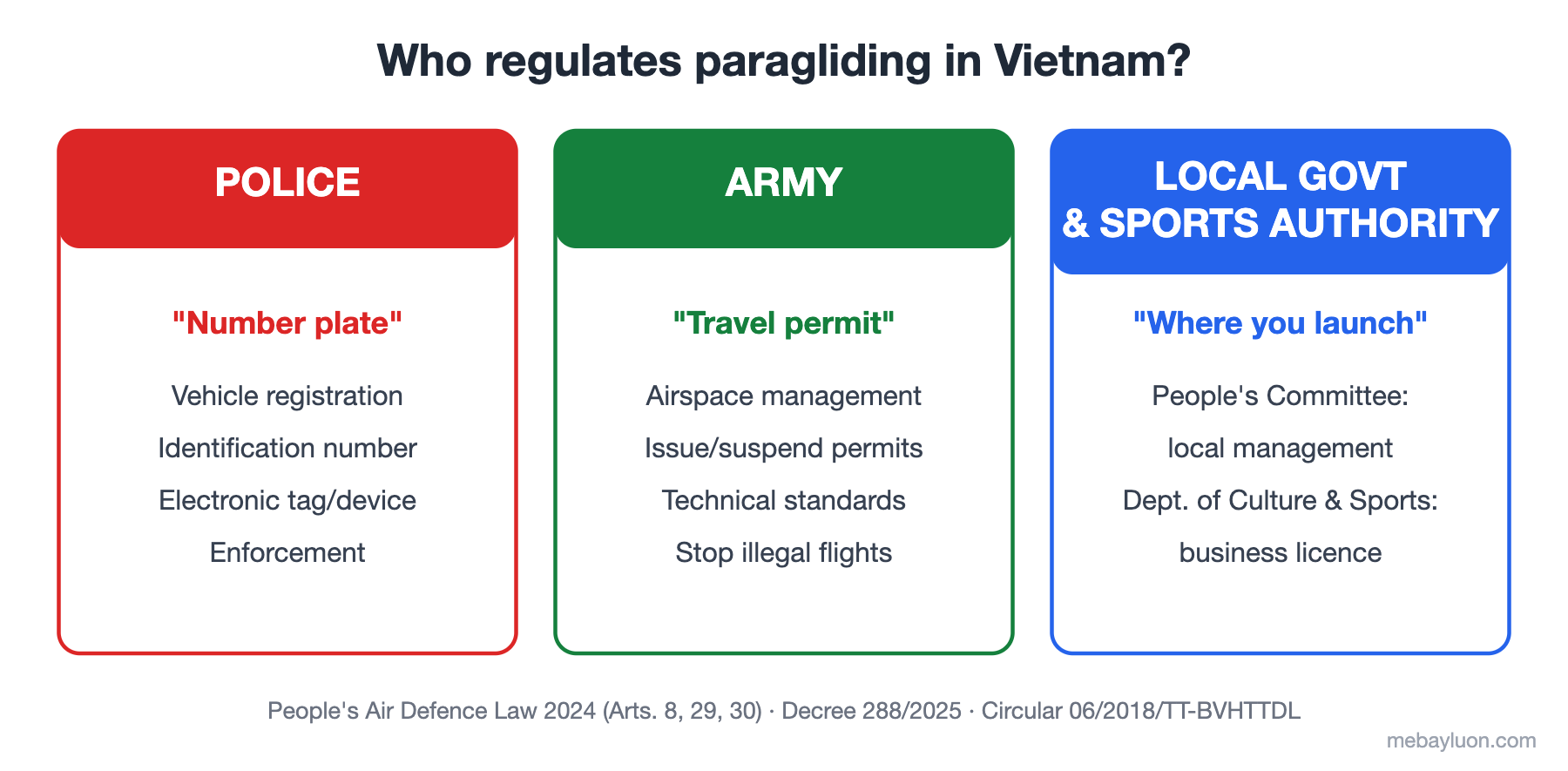
In short: the Police issue the "number plate", the Army issues the "travel permit", and local government and the sports authorities manage the place you launch from.

4. Do drone flights need reporting? How do you register?
Yes, in most cases. A drone is an unmanned aircraft. A DJI Mini (under 250 g) and a DJI Air 3S (about 720 g) are treated very differently.
| Take-off weight | Registration with the Police | Pilot licence | Ministry of National Defence flight permit |
|---|---|---|---|
| Under 0.25 kg (DJI Mini…) | Check with provincial Police under Circular 78/2026/TT-BCA | Not required; the operator may be under 18 | Exempt for recreational, line-of-sight flights outside prohibited and restricted areas |
| 0.25 kg to under 2 kg (Air, Mavic…) | Required | Class A licence (visual line of sight) | Required |
| 2 kg and above, or beyond line of sight, or programmed flight | Required | Licence for flight observed via equipment (class B) | Required |
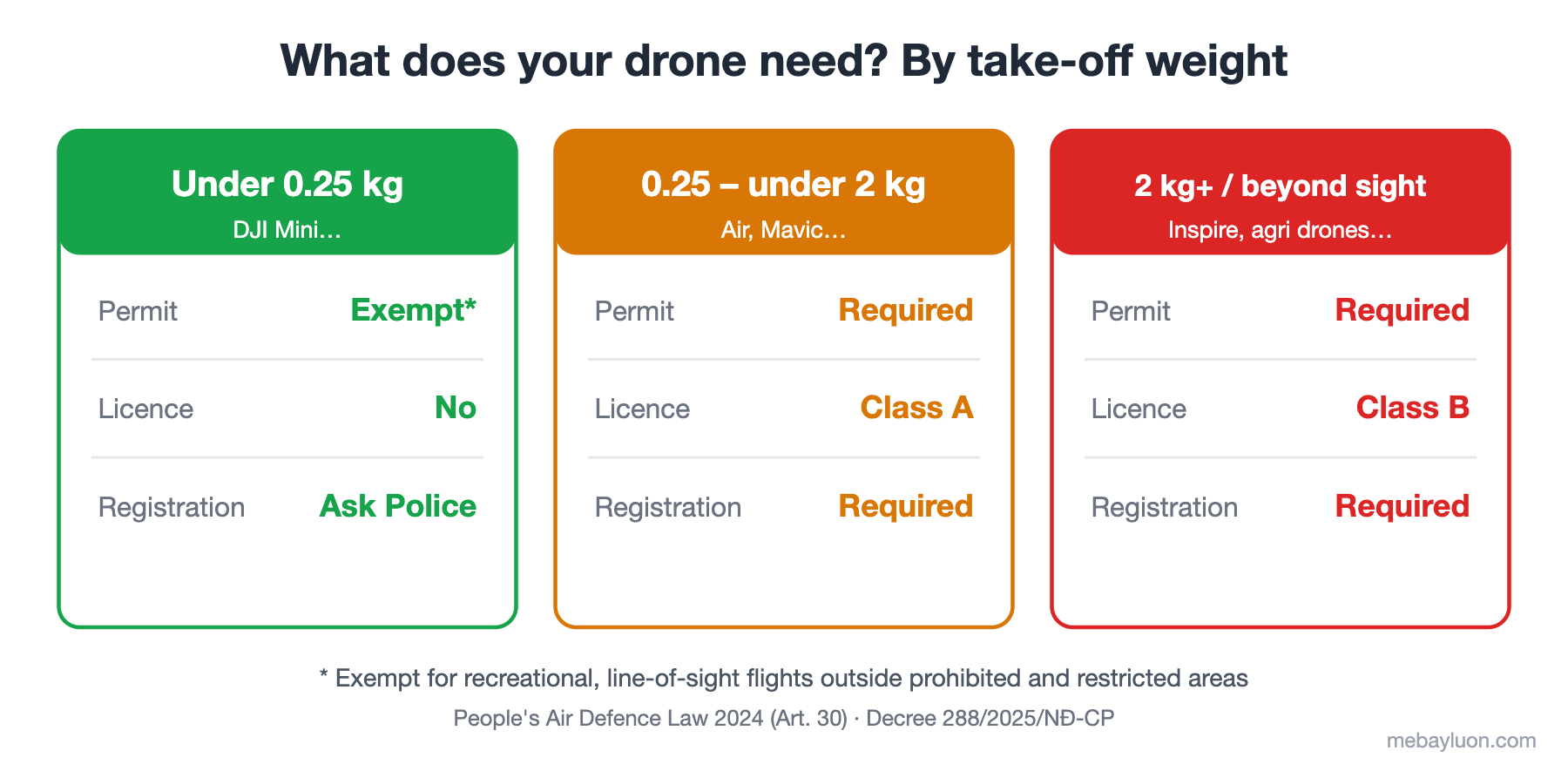

Steps for a 0.25–2 kg drone:
- Register the drone with the provincial Police (or commune Police where delegated) as in section 1, and receive the identification number and electronic tag/device.
- Hold a pilot licence tested and issued by a body of the Ministry of National Defence; the operator must be 18 or over, with no alcohol or drugs in the system.
- Apply for a flight permit for each area and period: submit at least 7 days ahead via the Operations Department, a military region, a provincial military command or the public service portal.
- Check prohibited and restricted areas before take-off (map at cambay.mod.gov.vn); do not fly over crowds, near airports or military barracks.
Fines: according to the Ministry of Public Security, flying a drone without a permit can be fined up to VND 30 million; organisations pay double; the drone can be confiscated.
Drones at paragliding sites: a drone near paragliders is a real collision risk. Even with a drone permit, tell the site operator, keep your distance from wings and stay out of the launch and landing corridors.

Summary for pilots
- Paragliders and PPG are other flying vehicles – no longer the "ultralight" concept of Decree 36/2008.
- Register with the Police (from 20 July 2026) – marked K (unpowered) or C (powered).
- Flight permits come from the Ministry of National Defence; at a permitted site, register with the site operator and fly within its area, hours and ceiling.
- Incidents: tell the site operator, call 112/115/113, stay at the scene, cooperate with the authorities.
- Drones from 250 g: registration + pilot licence + flight permit.
References
- People's Air Defence Law 2024, No. 49/2024/QH15
- Decree 288/2025/NĐ-CP on managing unmanned aircraft and other flying vehicles
- Circular 78/2026/TT-BCA (LuatVietnam)
- Registration procedure for drones and flying vehicles from 20/7/2026 (Thu vien Phap luat)
- Authority, files and procedure for flight permits under Decree 288/2025 (Thu vien Phap luat)
- Lam Dong Provincial Police – Decree 288/2025
- Hung Yen Provincial Police – notes on registering flying vehicles
- Circular 06/2018/TT-BVHTTDL on paragliding and powered kites
- Ministry of Public Security: unpermitted drone use can be fined up to VND 30 million (24h)
Note: this article is a pilot-friendly summary and does not replace the legal texts. Detailed guidance on registration and pilot licences is still being issued; check with the provincial Police, the provincial military command and the site operator before starting any procedure.