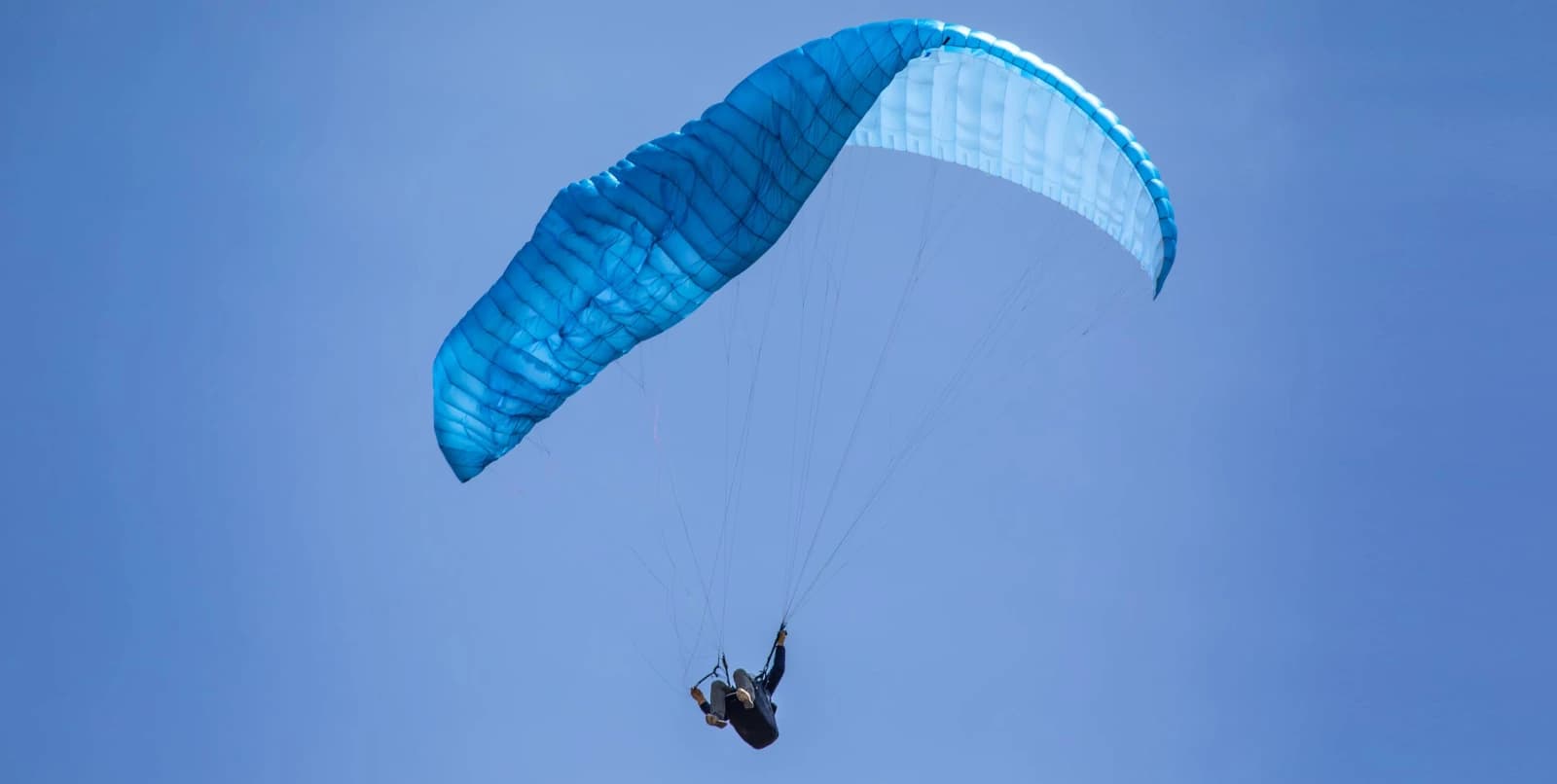
Active flying greatly reduces collapses in paragliding, but they may still occur out of the blue, especially when flying fast. The use of the speed bar reduces the angle of attack and makes the wing easier to collapse when airflow hits it from above. Higher speed also makes the wing react more aggressively once a collapse happens. The main dangers from big collapses are spiral dives, canopy cravats, line twists, high G-force, vertigo, panic.
This is the practical drill: the reactions in the right order when your wing collapses, to review before every season. The theory — why collapses happen, asymmetric versus frontal collapses, their complications and why SIV matters — is in Active Flying Part 3: Handling Asymmetric and Frontal Collapses.
When a big collapse happens unexpectedly:
➊ Release the speed bar immediately, tuck your legs beneath your seat, and lift your body upright to reduce the chance of line twist. Look up at the wing to evaluate the side and the size of the collapse. ➋ The natural instinct to curl into embryo pose when something hits you can be upgraded with grabbing the risers below the pulleys, applying light brakes or no brakes at all. Grabbing the risers also provides you support to lift your body upright and to weight shift. Risers-grabbing technique is not good for beginners or pilots who may panic and freeze. You should be able to work with your hands independently at any moment while your body is being trashed around or your head is dizzy from rotations and g-forces. This requires to suppress some body balancing instincts of your arms. A more conservative approach is to use riser-touching which can proceed toward riser-grabbing and riser-pushing if twist is nearby. The riser-touching also works as a reference for brakes position in the moment of stress and chaos. ➌ If it’s a big asymmetric collapse, push and spread the risers apart to reduce the chance of line twist and help the body follow the wing rotation. ➍ The riser grabbing/touching can be asymmetrical, with the outer riser grabbed about 20 cm lower, applying mild outer brake to reduce potential spiral development without decreasing airspeed too much. This is a conservative reaction doing both during a moment of doubt – shall we stop the turning to prevent a spiral or shall we spread the risers to prevent a line twist? ➎ If the collapse is big and asymmetric, then you fall, but the remaining working part of the wing still creates some lift, which throws your body away and towards the collapsed side. This would lead to a stronger spiral development. Avoid flying a big and lose harness, as your body may slips to the inner side and stay there, constantly applying inner weight shift. There are fatal accidents of pilots subconsciously applying weight shift and maintaining a collapse-induced spiral dive. The surprise of the big collapse makes it difficult to evaluate its development – will it throw you into a spiral, will it spin and twist the lines, will it just fall and recover quickly? It is better to prepare for the worst, so after and during the collapse, throw your body to the opposite side as you do when countering roll motions or small collapses. It is not easy as the remaining lift in the outer wing throws you towards the collapsed side but you can use the outer riser grab to pull yourself for opposite weight shift or at least to minimize the into-the-collapse weight shift. ➏ All the previous reactions – releasing the speed bar, raising the body upright, looking up at the canopy, grabbing the risers, and opposite weigh shift – can be combined in one whole body movement performed in less than a second.
➐ In the next moment, things become clearer regarding the twist. If it still develops despite you spreading the risers, then try to have equally and slightly pulled brakes or no brakes at all before the twist blocks them. Mind your arms not to be trapped by the twist and release the brakes if they’re locked. You must have a free hand at any moment during flight to throw your reserve if needed. Having the brake handles around your wrists is a bad habit, especially if you fly with thick gloves. In case of twist then re-grab the lines beneath or above the twist and push them hard apart to untwist. Quick sideways kicks with legs can help you rotate and untwist. If the twist is combined with a spiral dive, then it is very hard to untwist but not impossible. Also, a spiral with a twist is usually not a stable maneuver and often clears by itself. Give it some time if you have the height. If not, then throw the reserve parachute. ➑ If there is no twist but just a big asymmetric then stop the rotation with a dozed opposite brake – not too much, not too less; but let the wing keep some rotation towards the collapsed side as this feeds it with healthy airspeed and canopy pressure. Big collapses cease lift and first we fall. The airflow from underneath activates the inductive ability of the remaining uncollapsed part of the canopy which shoots you into a spiral. The worst are the 70-80% collapses. It is difficult to stop their aggressive surge with opposite brake or weight shift, so it’s better to follow it, first with hands holding the risers to prevent a twist and then tame the rotation with opposite brake and weight shift. The vertical fall which follows the collapse means that there is about a second delay before the wing dives into a spiral, so there is sufficient time for reaction. Modern shark-nose profiles react slower at “biting the flow” and have a longer fall and less aggressive spiral surge compared to old classic profiles, which produce more aggressive twists, spins and spirals. It might be helpful to have an instant pull and release of the outer brake at the moment of the collapse. This pushes some air from the working side into the collapsed one. The surge of the working side later will recover its pressure quickly. After this initial single impulse, the pilot can grab the outer riser to prevent the line twist but be ready to release the riser grab and work actively with the outer brake according to the situation. The collapsed-side brake cannot do anything so the inner hand continues holding the riser for support until needed. ➒ After taming the spiral, then you can clear the cravat with pumping the brake or pulling the stabilo line. The pumping is quick and moderately deep. Usually, 3-4 pumps are enough to clear most cravats, but some stubborn ones may require deeper pumping up to a stall. During pumps, make sure you have sufficient overall airspeed not to stall or spin the wing. Big collapses are often accompanied by a cravat which creates drag and keeps some rotation. Let it turn as it feeds the wing with airspeed, but don’t allow it to accelerate and enter another spiral. The clearing of the cravat with brake pumps or stabilo line consumes airspeed so it can be done in series with short pauses in between to monitor and recover airspeed. Some really big cravats require series of stalls with both brakes. Of course, there are cravats which cannot be recovered or there is no sufficient height for their recovery. If they’re big and make the wing unstable and close to stall or spin, then it’s best to throw the reserve.
➓ If there is no asymmetry in the collapse, but it’s just a big frontal tuck and fall, then there is no need to grab the risers to prevent a twist, but instantly pull and release the brakes. This folds the trailing edge down and pushes air forward, pressurizing the tucked or still tucking frontal part. Some frontals collapses tuck down and roll the leading edge backwards, and the brake pull reduces this development and helps to unroll the leading edge. When wing tucks during speed bar flying, the fast airflow hits the central part causing a horseshoe shape of the canopy with wingtips going forward. There is high chance for wingtips to collide and one to get stuck inside the lines of the other causing an enormous cravat. An instant and deep pull of brakes reduces the horseshoe development. In case of a long-lasting horseshoe fall you need to pull the brakes symmetrically or individually 3-4 times to stop the wingtips roaming around and tangling with each other or with the central part of the canopy. ⓫ Strong turbulence may not only collapse your wing and make you fall, but can trash your wing in one direction or another. It can spin it and even throw it under you without any warning. This can bring you in a cascade – a series of symmetric or asymmetric surges, collapses, stalls, spins, falls. It is pretty chaotic and difficult to predict what comes next; and then the next comes so quickly that your control inputs are often late and in the wrong moment, destabilizing the situation further. Remember that each fall is followed by a surge, so if you recognize the fall then you have time to stop the surge but don’t forget to release the brake after each input to recover airspeed. Remember the beginner’s mantra – stop the dive, let it fly and keep direction. If you’re not sure with your understanding, timing and reactions then grab the risers with brakes pulled 20-30 cm to shoulder level and hold them firmly for 3-4 seconds. The brakes are not pulled too much to sustain a stall but are pulled enough to create drag for the surges. Once you recognize a moment of symmetry and peace then let the glider dive forward and recover airspeed and normal flight. ⓬ There is a double brake pull technique when things happen quickly and it’s difficult to estimate how much to pull and not to overreact. So, when something hits you then the first instant pull is more conservative, let’s say 20-30 cm, followed by a full release. Meanwhile, you should have gathered enough information to apply properly the second pull and release. Both brake pulls can be done below one second. Often, the release of the second proper pull is slower. One variation of the double brake pull technique is when reacting on big asymmetric collapses. When the collapse hits you pull and release brakes instantly, then touch risers close to pulleys as a zero brake reference and then pull again appropriately. ⓭ The work with the body is pretty active in turbulent air. It looks like the boxer movements when avoiding the opponent punches. In case of big asymmetric collapses, you should throw your body instantly to the opposite and still working side of the wing. Generally, you cannot overreact with the body and do harm as you can do with the brake, where an overreaction can lead to stall or spin due to airspeed loss. ⓮ The collapse recovery greatly depends on in what type of air the collapse happens? If it’s smooth rising air like ridge soaring or vast thermal lift then it will recover quicker. If it’s fragmented, turbulent, or sinking air then it will take much longer time. ⓯ Big collapses rarely come out of nowhere. Usually, small turbulence and shaking precede bad turbulence, so there is plenty of warning and time to release the speed bar. Some pilots on two-line gliders feel improved glide and collapse resistance when flying on half speed bar through mini turbulent air, but you have to be sure that it’s a vast uniform zone, not a warning of something bigger.
Safe fly and happy landing!
— Content shared by pilot Nikolay Yotov, March 2024.