🔍 Porosity and Air Permeability
The porosity of an object is an indicator of the ratio of empty space in a given volume to the building material itself. Woven fabric: Porosity is determined by the ratio of the number of threads in a given area to the distances between them—the so-called “pores.” * The Principle: The more pores there are, the higher the percentage of porosity. The fewer the pores, the denser the material. ►A fabric with 100% porosity does not exist (that’s just empty space). ►A fabric with 0% porosity is essentially a dense polymer, not a fabric. ►The porosity of paragliding fabric is variable. During the aging process, new pores open and existing ones change their size. ⚠️ Key Distinction: In most cases, when we say "measuring porosity," we are actually measuring air permeability—how much air passes through a certain area in a certain amount of time. ►While technically different, "porosity" has established itself as the main industry term. ►For paragliders: Low values = High quality (Low porosity = Low air permeability).
📏 Measuring it: don't just read the seconds
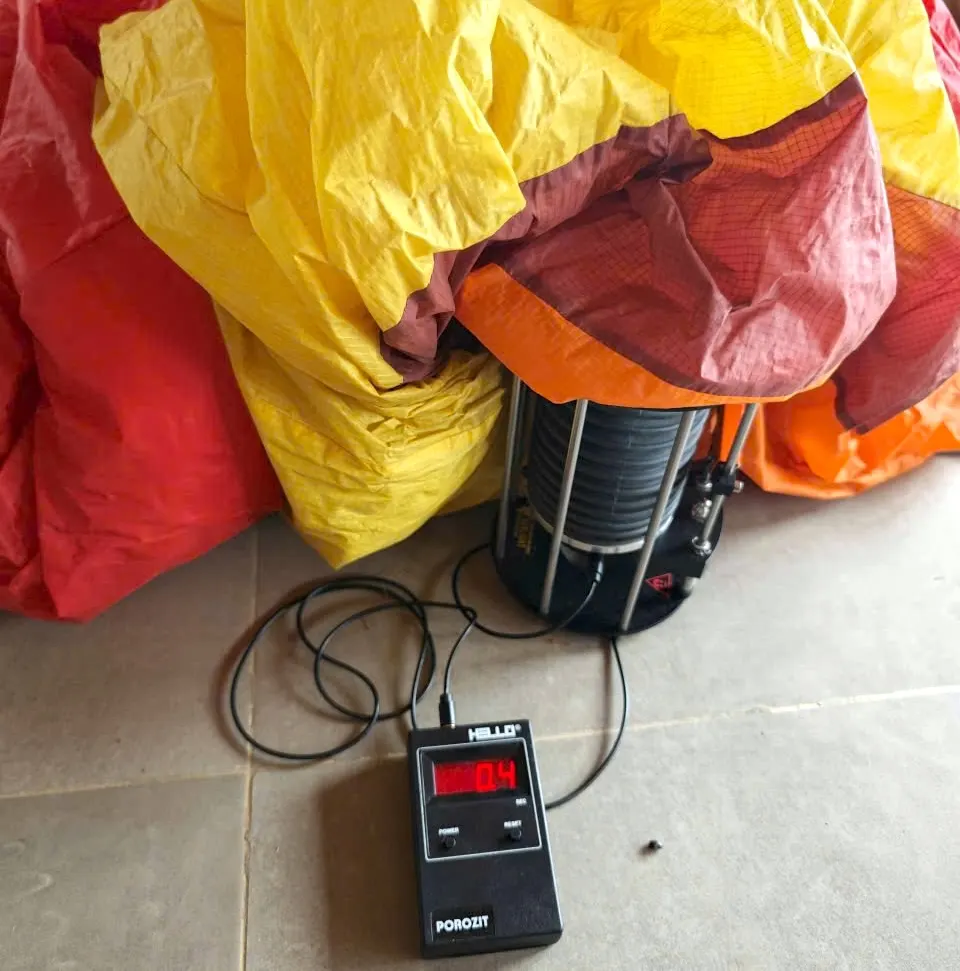
Permeability is measured using devices called porosimeters. These measure how long it takes for a volume of air to pass through the fabric under defined pressure. 👉Higher recorded time: The slower the air passes through → LOWER (better) porosity. ❌ Wrong Practice: Simply giving the time in "seconds." Every brand of porosimeter uses different air volumes and cross-sections. Measured times for the same fabric can vary significantly between different machines. ✅ The Standard: Quality porosimeters are calibrated to calculate permeability in real units: liters/m²/minute. Example: The popular JDC MK1 measures 250 ml of air through 38.5 cm² at 10 mBar. To get the exact measurement, the device coefficient (5400) is divided by the time read in seconds. 💡 Pro Tip: Always request the measurement in universal units (L/m²/min), as seconds can vary wildly between different instruments.
✈️ Why is Fabric Air Permeability Important?
►In paragliders, lift is created by air flowing around the wing at different speeds. ►Pressure Drop: The area of reduced pressure above the upper surface is essential for stability and flight parameters. ►Laminar Flow: The more "stuck" the flow is to the surface, the better the lift.
►When porosity is high, air leaks through the fabric and disrupts the uniformity of the flow on the upper surface. ☝️The Result: The flow cannot "stick" to the surface and is "blown away" by vortices of passing air. ⚠️The Risk: This creates a prerequisite for the paraglider to enter a parachutal stall or full stall, even without pilot input or brake pressure.
🛠️ The coating that protects the cloth
To reduce porosity, manufacturers use two main practices: ➊ Tight Weave: Denser threads let less air through. ➋ Coating: A special polymer coating is applied to fill the pores. ⚠️ In paragliders, the main cause of material aging is the destruction of this coating layer. ⚠️ A Note on "Restoration": Factory coating involves thermal hardening ("baking") in autoclaves. Products claiming to restore porosity at home usually only work for a few flight hours and can sometimes make the fabric worse in the long run.
📉 How a wing ages
When weaving the fabric, unfilled pores remain between the threads of the material – these pores are filled by the coating. After the paraglider is sewn, during the first flights of the wing, a large part of the threads undergo a process of adjustment. The fabric stretches and contracts with different coefficients in different places on the wing. Some of the threads tighten, and others relax – this leads to the destruction of the coating in places where the pores of the fabric become larger as a result of the adjustment.
The porosity of a paraglider changes along a non-linear curve throughout its life: ► First 50 hours: The wing can lose 10-30% of initial porosity as threads adjust and stretch, causing micro-ruptures in the coating. ► Stable Phase: It then levels out and remains relatively stable for most of its life. ► The End of Life: As the coating becomes brittle and separates from fibers, permeability increases exponentially until the wing is unusable.
🚩 Paraglider Deterioration Signs
Paragliders approaching critically low porosity values often show signs of deterioration. ⚠️ The most characteristic signals of increased air permeability are: ▶ Deteriorated glide ratio 🦅 ▶ Increased sink rate 🪂 ▶ Inability to flare during landing 👟 ▶ Difficulty inflating the wing 💨 In practice, the coating ages differently in various parts of the wing or with different colors. 🎨 🔍 BREAKDOWN BY LOCATION: ▶ When the leading edge coating deteriorates: The wing becomes difficult to inflate, but the glide ratio and sink rate do not change significantly. ▶ With reduced values of the main part of the wing (the part behind the leading edge): 📐 The wing has a tendency to go into parachutal stall. 📐 An increased sink rate and correspondingly reduced glide ratio are observed.
🎨 Color and UV Resistance
Different colors have different aging coefficients: ▶Light Colors (White, Light Gray): Reflect light. UV rays pass through the coating twice (entry and reflection), aging the coating faster but potentially sparing the internal fibers. ▶Dark Colors (Black): Absorb UV. The coating lasts longer, but fibers may age faster. 🚩The Winner: Contrary to expectations, Black is often one of the most resistant colors because the coating integrity remains higher for longer.
🛡️ Looking after your wing
To preserve the porosity of our paragliders and to extend their lifespan, we must take into account the factors that can damage the fabric coating and worsen porosity values. Such factors are: ☀️ EXPOSURE TO UV RADIATION ▶ The biggest enemy of the paraglider is UV rays which destroy the structure of the coating and prematurely age it. With the exception of standard sun exposure during flight, we should always aim to reduce excessive exposure. ▶ Note: Don’t leave your paraglider outstretched while waiting for the conditions!
⚙️ MECHANICAL INFLUENCES ▶ Dragging the fabric along the ground, folding in the dust, sand or on abrasive surfaces disrupts the physical integrity of the coating and leads to its rapid destruction. ▶ Folding the glider too tightly, excessive bending or flexing of the fabric, causes ruptures in the micropores of the coating and deterioration of porosity. ▶ Wing overloading – overloads within normal limits above the weight range do not cause significant changes to the fabric and the coating layer. Extreme overloads during aerobatics cause dynamic contractions and stretching of the coating layer and fabric fibers which age the coating prematurely or can cause ruptures of the micro pores of the coating.
💧 HUMIDITY ▶ Moisture itself does not damage the coating. However, storing the glider in a humid environment or folding it in a damp or wet state can lead to the development of mold that literally destroys the coating layer. Always dry a damp glider in the shade before folding. ▶ NEVER fly the paraglider to dry it. Water is not compressible! When flying with a very wet wing, water droplets pass through the pores of the fabric and exert greater than standard pressure on the coating and fabric fibers – this can cause the micro-pores of the coating to rupture and the porosity of the wing to deteriorate. ▶ Saltwater is more aggressive to the coating from a chemical point of view. After drying, the residual layer of sea salt crystals acts as an abrasive that further destroys the coating. ▶ Freezing/icing of the wing in flight causes damage to the coating integrity. Icing creates concentration of pressure in areas of the fabric and can cause rupture of microfibers. 🧪 CHEMICAL ELEMENTS ▶ All types of solvents, petroleum products and aggressive chemicals can corrode the coating layer and cause extreme deterioration of porosity. In Fig. 14. below, you can see traces of destroyed coating on a wing that was spread out over spilled fuel. ▶ NEVER use chemicals to clean the glider.
🌡️ TEMPERATURE ▶ Extreme temperatures can change the structure of the polymer and cause the coating to break down. Extremely low temperatures are rarely a problem (the coating starts to become more brittle at temperatures below -20/-30°C). ▶ Extremely high temperature is easy to reach however. The temperature in a closed car where you have left your wing on a hot summer day can easily reach values above 60 – 70°C. At these temperatures, the polymer molecules begin to change. The coating begins to change its structure, which can shorten its lifespan by over 30%–40%. 🔥 Always protect the wing from direct flame – paragliders burn at around 300 euros per second!
💡 Words of Wisdom
Porosity is the most accurate "health check" for your wing. "Never do to your wing what you wouldn't do to yourself." Take care of your paraglider, and it will take care of you! 🪂✨
Source: Skynomad.com
— By Ivelin Kalushkov