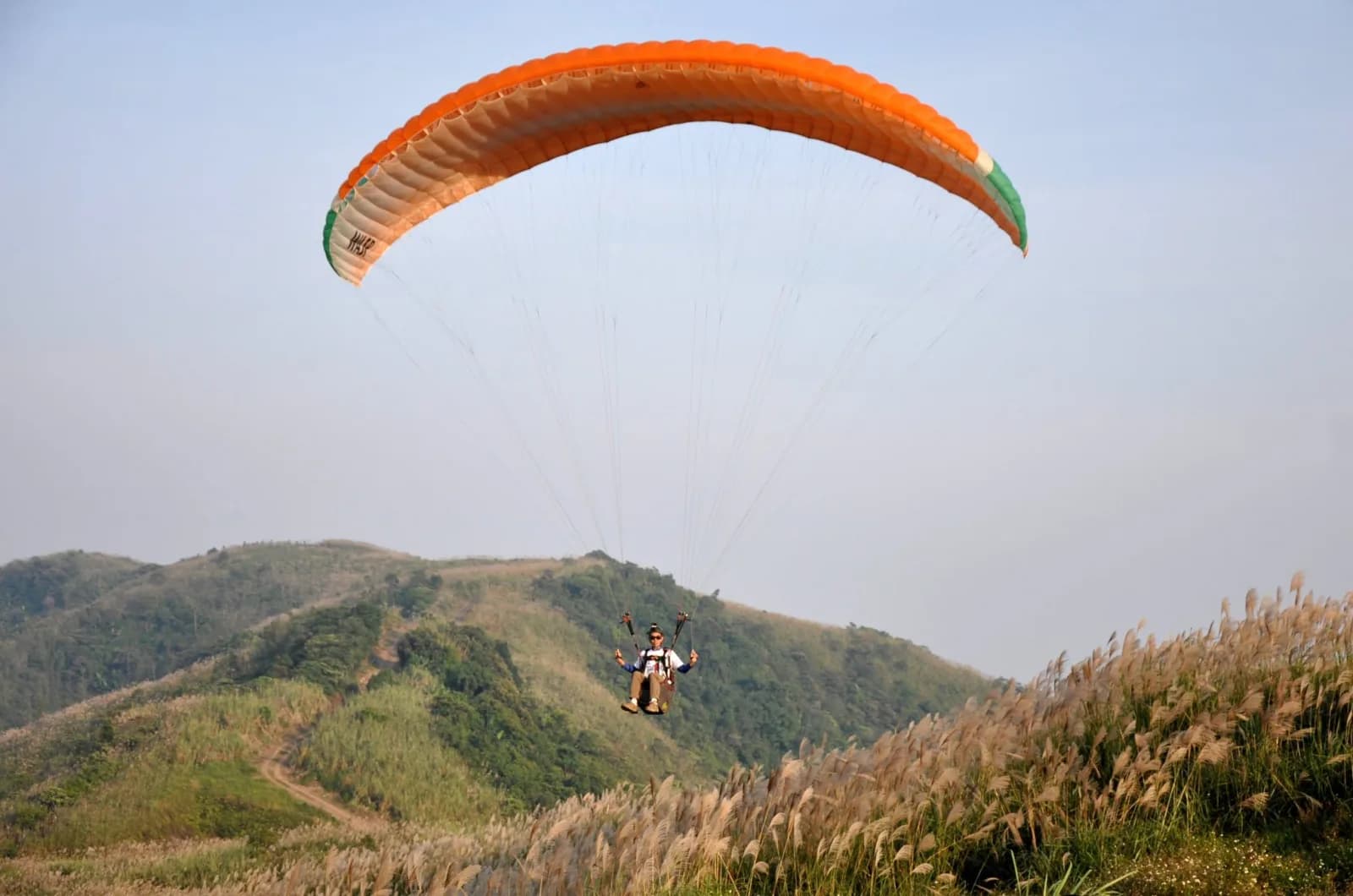
Below are the questions people ask most often about paragliding — from what keeps a wing in the air, to steering and landing, to safety, cost and how long a set of equipment lasts.
Source: flypgs.com
— The structure and flight principle of a paraglider.
What is paragliding?
Paragliding is a form of unpowered flight that works on the same aerodynamic principles as sailplanes and hang gliders. The "engine" here is gravity: it makes the wing sink (at under 1.5 m/s) while also driving it forward (~ 35 km/h). In still air, that lost height converts into roughly 9:1 of glide ratio. A paraglider is essentially a soft wing that lets a person fly without an engine. It consists of an aerofoil-shaped canopy held open by air pressure, a set of thin but very strong suspension lines — typically cored with Dyneema or Kevlar — running down to the risers, and the pilot seated in a harness below. The first paragliders evolved from steerable parachutes, which is why the earliest models looked much like them.
☀️ What makes a paraglider climb?
The answer is the SUN. Solar energy heats the earth's surface and drives the wind, and both produce rising air. In real atmosphere, throughout a glide the pilot keeps running into lift: most commonly thermals (columns of warm air convecting up from sun-heated ground) and ridge lift (air forced upward as it meets a slope). When the air rises faster than the wing sinks, the pilot gains hundreds or even thousands of metres. That is what allows flights of six or seven hours and cross-country distances of several hundred kilometres. Like a bird: not a drop of fuel, no engine noise, just solar energy.
🪂 What are the main parts of a paraglider and how does it fly?
The canopy is made of an upper and a lower sail joined by internal ribs, which divide it into 40–70 cells. The leading edge has open air intakes while the trailing edge is completely closed. In flight, part of the airflow enters those intakes and pressurises the cells — that internal pressure is the only thing holding the aerofoil shape, since a paraglider has no rigid frame at all. The rest of the airflow passes over and under the canopy and generates lift. That lift is what makes the wing glide and lets the pilot touch down softly rather than drop like a stone.
🛫 How does a paraglider take off?
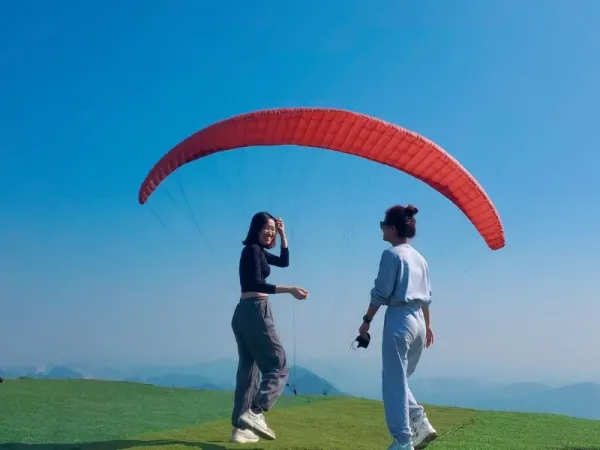
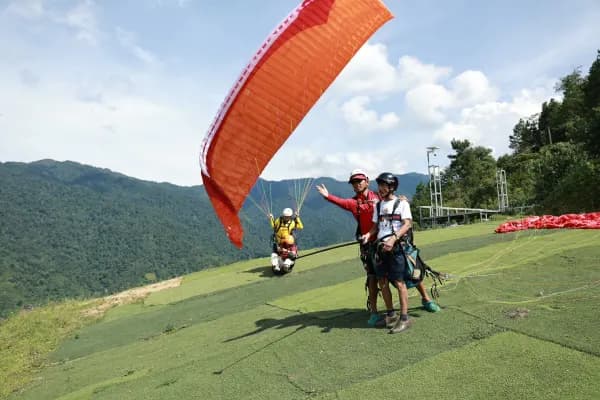
Unlike skydiving from an aircraft or BASE jumping from a cliff, bridge or building, a paraglider pilot launches on foot, standing up. The pilot uses the wind to inflate and raise the canopy overhead, looks up to check that it is evenly pressurised and the lines are clear, then runs a few steps into wind down the slope to leave the ground. On flat terrain the wing can instead be towed up by a winch or a vehicle.
🎮 How do you steer and land a paraglider?
The pilot steers with two brake lines, each acting on one half of the canopy's trailing edge. Pulling one brake slows that half of the wing, creating extra drag so the glider turns that way. To land, the pilot pulls both brakes evenly — a manoeuvre called the flare. The canopy briefly increases lift and then sheds speed, trading most of the wing's forward energy for braking, so the pilot steps down gently on their feet.
🔍 What is the difference between a paraglider and a hang glider?
A hang glider has a rigid frame that holds the wing's shape, and the pilot flies lying face-down. A paraglider keeps its shape from air pressure alone, and the pilot hangs in a seated or reclined position. A paraglider packs away in about five minutes into a bundle the size of a large rucksack and is easy to carry at 10–15 kg. A hang glider, by contrast, is larger (3–6 m), heavier (30–50 kg), needs a vehicle with a roof rack to reach the site, and takes 20–30 minutes to rig and derig. A hang glider does have advantages — higher airspeed, better resistance to turbulence and a higher glide ratio — but a paraglider is far easier to launch, land and learn.
🛡️ Is paragliding safe?
With proper training and equipment, paragliding is one of the safest forms of personal flight. But like any adventure sport it carries real risks, and flying safely means working constantly to reduce them. The most important prerequisites for learning safely are the pilot's attitude, competent instruction and safe equipment. Where those are in place, the paraglider's low speed and inherent stability make for a safe and easy way to fly.
🎓 Is paragliding hard to learn?
A paraglider is the simplest of all aircraft. Most people can learn to launch, turn and land in a few hours of instruction. That is partly because we control the situation, assess the conditions and make the safety decisions for the student. What cannot be taught in that time is everything needed to make those decisions yourself in the air. Doing that safely requires a thorough grasp of aerodynamics, weather, equipment and safety procedures — and above all of collision-avoidance rules and air law. A pilot training programme covers all of this and is the fastest and safest route into the sport, while teaching yourself from scratch takes far longer and is the main cause of most accidents.
💰 How much does a paraglider cost?
Prices vary by manufacturer, by model and above all by the market you buy in. A new canopy costs roughly €1,500–5,000. Beyond the wing you also need a harness (€400–600), a reserve parachute (€400–600) and a helmet (around €100). Gloves, a flight suit, ankle-supporting boots, eye protection, a vario, GPS and a radio are not compulsory but make flying more comfortable and safer. Second-hand gear is far cheaper, but have someone experienced inspect the canopy and lines before you buy.
⏳ How long does a paraglider last?
Ordinary wear on the cloth and lines — most visible along the leading edge — together with UV ageing usually limit a canopy's service life to about two to six years. That figure depends heavily on hours flown and sun exposure: a wing that is packed properly, kept out of prolonged sunlight and porosity-tested regularly will last considerably longer.
🔄 What if I have to cancel, or the weather turns?
No. Every Mebayluon service and flight can be refunded, cancelled or rescheduled free of charge — there is no penalty in any case. We only ask that you let us know a few hours before the departure time if you need to cancel or move your booking, so we can reschedule other guests and reassign pilots and transfers.
We hope this gives you a fuller picture of the sport. If anything is still unclear, message Mebayluon Paragliding and we'll be glad to help.