We have previously introduced the concept of instability and lapse rate. It may be a good idea to review that material at this time. We will build on the basic ideas and gain more insight into the workings of our flying environment as we learn the lift history of thermals.
🌱 How a thermal is born
A thermal is a collection of air rising through the general air mass because it is lighter than its surroundings. Thermals come in a wide variety of shapes, sizes and strength. If we want to be most effective at hitching a ride on these free elevators we must begin our study with their birth. The sun heats the earth's surface on an almost daily basis. This heat is passed directly to the air above the surface as we found out previously. If heating is slow the warm air may rise in a light, continuous plume. In a faster heating process a bubble may form that remains on the ground for a period of time before it releases in a sudden rush. As an illustration of how this works, watch a pan of water coming to a boil. At first the bottom of the water is heated you will see convection currents – plumes – begin to rise. Then, as heating gets more intense bubbles begin to form on the bottom, breaking away to rush to the top surface. As the heating continues larger bubbles form in the hotter areas. A couple other things to notice in our model is the presence of downward moving currents in the early heating process, the general spherical shape of the bubbles and the overall mixing of the water. These features also occur in the air. The figure below shows the effects of surface heating:
- In the first case, light heating causes a slow circulation plume. This may occur in the morning, when a layer of cloud partially obscures the sun or in the evening when warm ground cover slowly releases stored heat.
- The second case shows a warm dome growing on the surface. A dome such as that illustrated will be of limited extent in terrain where the size of the heated area is determined by the size of a field or other surface. Trees and other cooler ground cover often determine how large a heated dome may be.
When this dome grows at a fast rate it expands to move the air above it as shown in the figure below. This fairly rapid expansion and the inertia of the heated air serve to keep it on the ground until some disturbance dislodges it. When the heated dome does release it consolidates into a bubble as we shall see below. This bubble process is the most efficient method nature has devised to carry heat aloft to relieve the imbalance of excess heat at the surface. The limited area of heated air shown in case II occurs most often in greener areas such as Europe and the eastern portion of North America. In desert areas large tracts of undifferentiated surface heat up on an equal basis forming a broad layer of hot air. This potential thermal will rise at distinct trigger points and continuously feed into a tall column of rising air. This is case III on the illustration below.
⚡ Thermal triggering
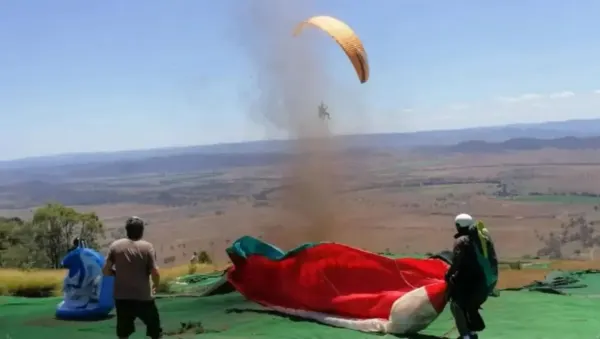
A potential thermal may sit on the ground for many minutes as it is building. Although this is an unstable situation, the warm air must push up through the cooler air and a flow under the thermal must begin. If the warm air is expanding it may remain on the ground until a gust breaks it away or it becomes so large that the expansion slows and the cooler air pushes in from the sides. The sudden release of a thermal is called triggering. Certain wind irregularities can serve as thermal triggers. For instance, a downdraft from a previously released thermal or a gust from a passing car can cause a thermal release. Many a pilot has achieved a low save when their ground crew raced by in a car to release a thermal. One site in Pennsylvania has a train that wends up the valley and releases thermals on schedule. Sailplane pilots have been known to dive at the ground to cause thermal release then zoom up to ride the thermal. This is almost like pulling yourself up by your own bootstraps. A general surface wind serves to release thermals as it swirls around ground obstructions. Such a wind often limits the size of thermals because it triggers them more frequently. In open terrain a wind will blow the heated air along until it meets a hill or other rise which starts vertical motion and serves as a trigger as shown in the figure below. The passing of a cloud over sloping terrain can serve as a triggering mechanism. In extreme cases the ground can cool as much as 50°F (27°C) in several minutes when a cloud shadow stops the solar heating. A quick slug of cool air can form which slides downhill to trigger any potential thermals in its path. When no wind is blowing any terrain irregularity can serve as a thermal trigger. A feature with an upward slope may have an upslope breeze established which will initiate thermal release. The figure below shows how hills, a tree, a pole or a tower with their rising convection currents will trigger thermals. Other irregularities such as buildings, plateaus and tree lines will trigger thermals in undifferentiated terrain.
🏔️ Lee-side thermals
An important terrain effect is the blocking of wind by ground obstructions – hills, buildings and stands of trees. The downwind or lee side of such solid objects will experience very little wind disturbance if the wind is not too strong. Consequently this wind sheltered area will often allow a thermal to grow to considerable proportions before it releases. Lee side thermals have a reputation in the soaring world for being bearers of healthy lift. However, in any significant wind the lee side of a mountain isn't our first choice of places to be. We need to be well above a mountain to exploit a lee side thermal safely. At that point we will most likely be encountering thermals from both sides of the mountain. Lee side thermals are not a dependable source of lift near a mountain because we can't safely spend time on the lee of a mountain searching for lift. However, look for wind sheltered areas on the surface as sources for good thermals.
🎯 Thermal sources
Intimately connected with thermal triggers are thermal sources. A thermal source is a point on the terrain most likely to produce thermals and consists of an area of good heating and triggering. Good surface sources are those areas heated most rapidly by the sun. Bare ground, plowed areas, pavement, dry crops and weed fields are tops on our list. Any place you would feel burning bare feet on a hot summer day is a good thermal generator. Sand is readily heated but the sand particles trap a lot of air so the heat capacity of sand is low and they cool quickly in passing clouds. Stands of corn in autumn are excellent thermal sources since they trap a thick layer of air to be warmed. In a similar manner a town or city heats a deep layer of air due to the reflection from the sides of buildings and the great amount of pavement. Rocky ground is a fine source of thermals if the rocks are small. Larger rock outcroppings have their own peculiarities. They readily conduct heat to their interior so their surface takes quite a long time to heat up. They don't come into their own as thermal sources until early afternoon. In the evening rock surfaces can be primary sources of thermals as they slowly release their vast amount of stored heat. Quarries are also good later thermal sources. However, if they are deep holes the thermals they grow aren't readily triggered.
🏠 House thermals
The terms house thermal and resident thermal refers to a thermal source near a particular flying site that is fairly reliable. This thermal may be a continuous column or more likely a regular succession of bubbles. Many a pilot has dove to a house thermal only to find disappointing sink. Nothing is guaranteed in the air except gravity and the rising cost of equipment. However, a house thermal is the most reliable form of thermal we have. Essentially a house thermal exists over a good source. That it exists so close to a regular flying site is the reason for its reputation. Sometimes a rock outcropping, a quarry or a lone hill will be the source. At a mountain site a particular ravine or bowl may serve to herd thermals to the same place so it appears that they are from one source. No matter how a house thermal arises, it should be visited on a periodic basis if you are in need of a thermal in the area.
📌 How reliable is a thermal?
Good thermal sources tend to be consistent producers of thermals on a periodic basis throughout the day and every day.