🪂 Paraglider Control Mechanisms
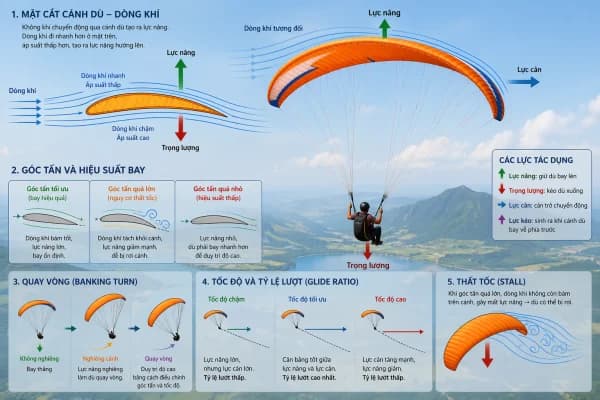
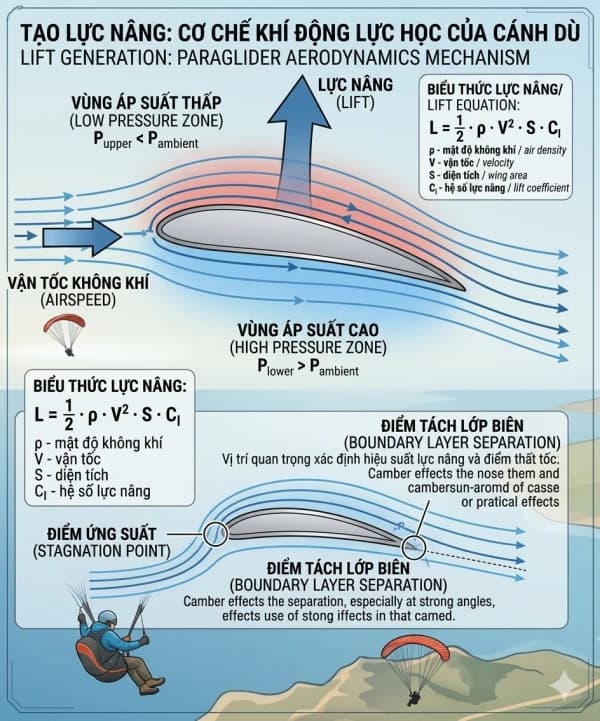
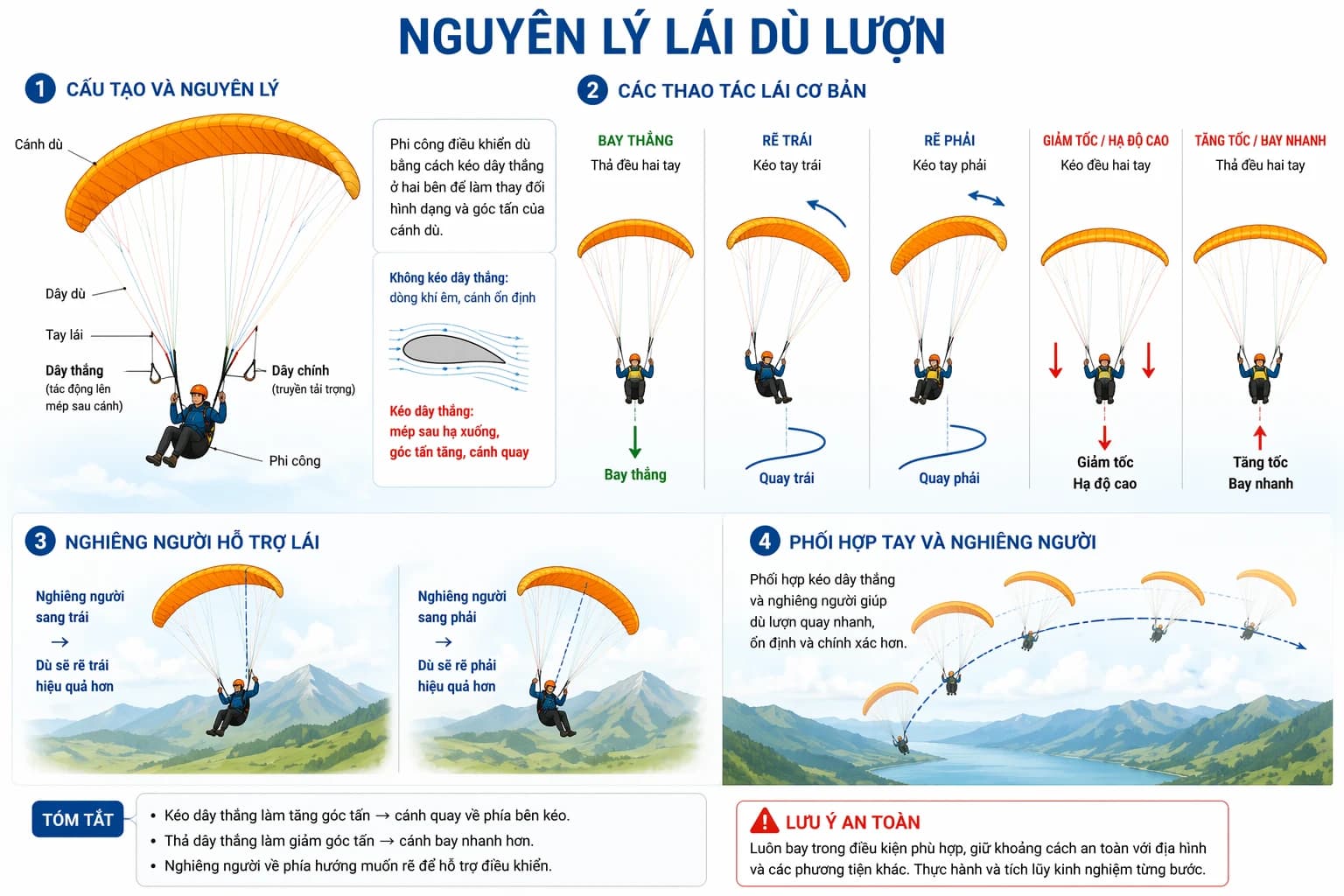
A paraglider is controlled using two fundamental principles: Aerodynamic Control and Balanced Control. ▶ 🌬️ Aerodynamic Control: This is activated by moving or bending specific parts of the wing's surface. By doing so, the pilot changes both the magnitude and the direction of the aerodynamic forces acting on the wing. ▶ ⚖️ Balanced Control: This involves shifting the alignment between the weight force G and the aerodynamic force R until a new equilibrium (flying mode) is established. The aerodynamic force acts on the Centre of Pressure (CP), while the weight G originates from the Centre of Gravity (CG), located near the pilot’s midsection. This control is achieved through weight shifting.
🛑 The Braking System: Mechanics & Applications
The brakes serve as the primary aerodynamic controls. They function as follows: ▶ The Mechanism: Pulling both brakes evenly folds down the trailing edge of the wing, creating additional drag. This slows the wing down relative to the pilot, increasing the Angle of Attack (AoA). While this temporarily boosts lift, it eventually slows the entire aircraft. ▶ New Flight Modes: If the brakes are held in a specific position, the glider stabilizes into a new flight mode characterized by a steeper gliding trajectory, lower airspeed, and a higher angle of attack.
🎯 Usage & Associated Risks:
▶ Precision Landing: Flying at slower speeds with a steeper glide is ideal for landing in tight spots to avoid overshooting. ▶ The Danger Zone: Operating at low speeds brings the glider closer to stall speed. At this point, the wing becomes vulnerable to turbulence and wind gradients. Furthermore, lower airspeed reduces internal canopy pressure, making the wing much more likely to collapse.
🔄 Turning Techniques
1. THE BRAKE TURN ▶ Pulling a single brake folds the trailing edge of that specific half-wing. This side creates more drag and slows down, while the opposite side continues at normal speed. ▶ The paraglider pivots toward the braked side and will continue to turn until the brake is released. Once released, the glider exits the turn tangentially and resumes straight flight.
2. THE WEIGHT-SHIFT TURN ▶ The Mechanism: The pilot leans their body sideways, shifting the Centre of Gravity. This loads one half of the wing more heavily, causing that side to dip and the wing to bank at an angle γ. ▶ The Physics: The total aerodynamic force R tilts along with the wing. A horizontal component (Rsinγ) is created, which pulls the glider into a turn. The steeper the bank angle, the more powerful the turn becomes. ▶ The Technique: Proper weight shifting requires a full lean. Beginner wings (EN A) are designed for stability and are naturally more resistant to weight-shift turns than high-performance wings (EN D).
⚠️ Safety Critical Warnings
▶ 📉 Increased Descent: When a wing banks, the vertical lift component decreases to Rcosγ. This causes a higher sink rate (Vy) and increased horizontal speed (Vx). Never perform steep turns close to the ground, as the extra descent can be fatal. ▶ 🌪️ The Spin (Half-Wing Stall): If a pilot pulls a single brake too aggressively to force a tight turn, the airflow on that side may "tear" or detach, leading to a stall. This causes the wing to spin violently around its vertical axis. Spins are highly dangerous and can lead to line twists or a cravat. ▶ 🌀 The Spiral Dive: A prolonged, deep brake pull can transition a turn into a spiral dive—a high-speed, high-G rotation. While easier to control than a spin, the 3-5 G-forces can cause blackouts or loss of consciousness in untrained pilots. If not exited with enough altitude, the high vertical speed (10−20 m/s) makes ground impact unsurvivable. 👉 Expert Tip: To fly safely and efficiently, always initiate turns with weight shifting first, then gradually apply brake. This coordination ensures a smooth turn with minimum altitude loss and stays far away from dangerous stall angles. By Nikolay Yotov
Reference: www.skynomad.com
— by Nikolay Yotov