💨 Airflow around a wing, aerodynamic force, lift
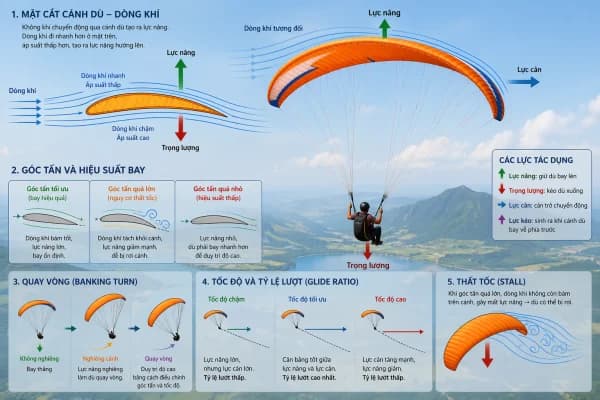
Every object that moves through air interacts with it by creating an aerodynamic force. The speed of movement of a wing through the air is called airspeed (V). Airspeed and aerodynamic force exist, no matter if the wing moves through the air or the air moves around a stationary wing, as in a wind tunnel, for example. Any force can be split into different components based on different coordinate (reference) systems. The aerodynamic force (R) depends on the direction and speed of movement; the direction and speed of air flow around the wing (the vector of airspeed V). The component perpendicular to V is called lift (Ry), and the component opposite to V is called drag (Rx). Furthermore, we’ll continue using these popular names, but we must remember that these are not independent forces but only components of a single force – the full aerodynamic force R.
Lift and drag are convenient for a basic explanation of how a wing works. A wing is more efficient if it produces more lift and less drag. Lift can be created by: ▶ an airflow around a body that is asymmetrically positioned in it; ▶ an airflow around a body that has an asymmetrical shape; ▶ a combination of both above – an airflow flowing around an asymmetrically positioned body with an asymmetrical shape.
When a symmetrical body is placed asymmetrically in airflow, the airflow causes pressure on its exposed surface and creates an aerodynamic force perpendicular to it.
📐 Angle of attack
The angle between the body’s surface and the direction of airflow is called the angle of attack α and is a crucial flight parameter. It determines the direction and magnitude of full aerodynamic force i.e. the magnitude and ratio between its lift (Ry) and drag (Rx) components.
A typical example of an asymmetrically positioned body in airflow is when we put our hand outside the window of a moving car. Then, we can feel the full aerodynamic force by changing the tilt of our palm (the angle of attack). ▶ Even small angles of attack increase lift and push our hand upward. ▶ Higher angles of attack produce more drag and push our arm backward. ▶ A 90 ̊ angle of attack produces maximum drag and no lift at all. ▶ A 0 ̊ angle of attack minimizes drag and allows our hand to cut more easily through the air. ▶ Negative angles of attack produce downward lift, which pushes our arm downward. Negative angles of attack are used in racing car designs, where special spoilers create a downward aerodynamic force, which increase the pressure towards the ground and the friction of the tyres. This allows racing cars to make tighter turns with smaller radii and higher speeds.
🔄 Asymmetrical Shape and Bernoulli’s Principle
Another way to create lift is through the interaction of airflow with an asymmetrically shaped body. It uses the flow conservation law based on the fact that matter and motion don’t appear from nothing and don’t disappear into nothing i.e. the incoming flow is the same as outgoing flow. As a result, where the flow is restricted, it increases its velocity V, and vice versa: ▶ You can increase the flow velocity by restricting the exit of a garden hose with your finger, spraying water further away. ▶ The river flow increases its speed where river banks become narrower and slows down where river banks become wider and further apart. ▶ Wind increases over hills and mountain ridges because flow’s cross-sectional area is restricted from below compared to free-from-obstacles airflow at the same altitude. ▶ You cannot blow a ping pong ball out of a cooking funnel because its greatly widening cross-sectional area rapidly reduces airspeed.
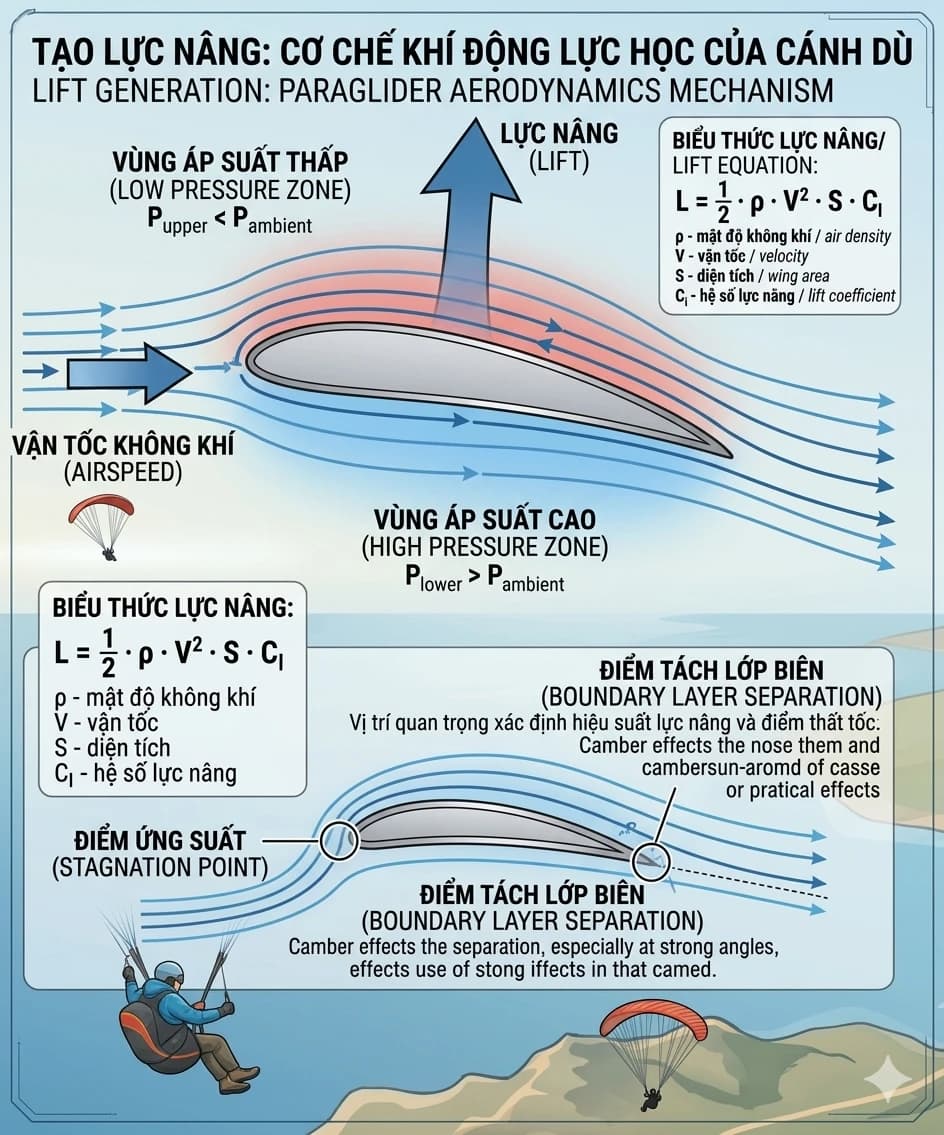
Parallel to the above processes, in areas where the speed of the fluid (V) increases, the surrounding pressure (p) decreases and vice versa. This is known as Bernoulli’s principle.
▶ Airbrush painting devices use fast airflow to suck paint from below. ▶ If you blow air between two sheets of paper, parallel and close to each other, it decreases the static pressure between them, causing them to come closer, pushed by the relatively higher surrounding pressure outside. Because of this effect, two ships on opposite courses shouldn’t pass too close to each other, as increased relative flow speed between them will reduce pressure and can result in suction, potentially crashing them into each other. ▶ The classic wing profiles have a convex upper surface, which acts like an obstacle: it reduces the cross-sectional area of the flow, accelerates it, and creates a zone of reduced pressure, sucking the wing upward.
Usually, the lift creation by airflow around an asymmetric profile is combined with the creation of lift by an asymmetrically positioned body in the flow. The aerodynamic force R and its components lift and drag depend on: ▶ wing’s profile ▶ angle of attack α ▶ square of airspeed V² ▶ wing’s surface area S ▶ air density ρ
⚠️ Stall and Dangers
The increase of the angle of attack directly increases lift production, but beyond a certain angle of attack, the airflow above the top surface tears sharply away from the wing, causing it to lose most of its lift. A stall occurs – the wing no longer flies but falls down fast, creating only drag.
The stall is dangerous, because: ▶ it develops quickly and suddenly ▶ the fall is fast and furious ▶ the chaotic flow around the wing makes it difficult to control
🚫 DO NOT FLY WITH TOO HIGH ANGLE OF ATTACK!
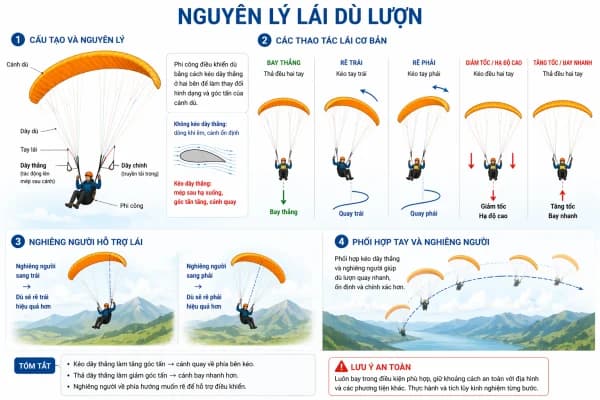
As it’s difficult to observe and measure the angle of attack, to avoid stall, it’s easier to pay attention to the airspeed – the feeling of the wind in your face. Any pull of brakes increases the angle of attack and slows down the paraglider. Thus, if during a gliding flight we: ▶ feel a slowing down (reduced feeling of wind on the face) ▶ see our hands pulling the brakes too much, below our hips ▶ feel the too much resistance from the wing to our brake pull 👉 ...then we’re close to stall and have to restore our airspeed immediately by releasing the brakes – HANDS UP! The stall shouldn’t be confused with a collapse, where the wing reaches a negative angle of attack. The airflow comes from above, deforming and folding the leading edge – the frontal part of the wing. The stall can also deform the wing, but this happens at the trailing edge – the back part of the wing, and the reason is reaching too high angle of attack.