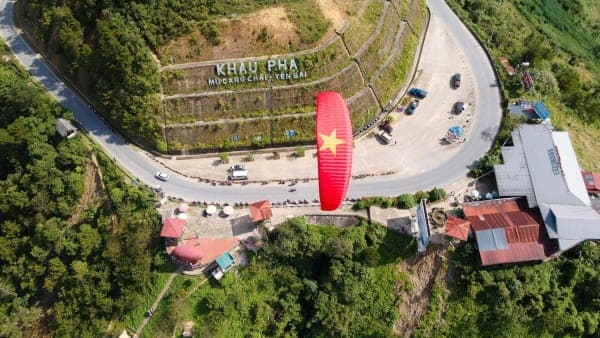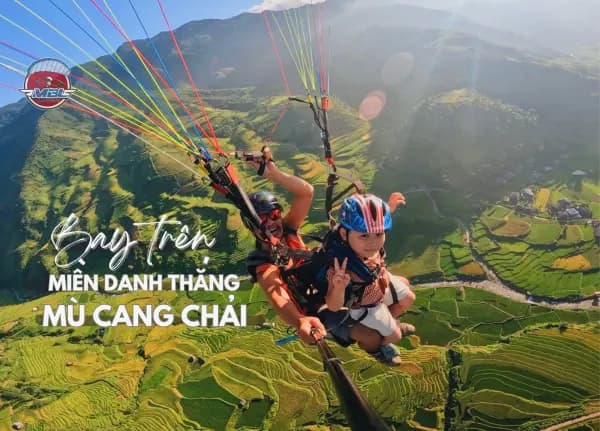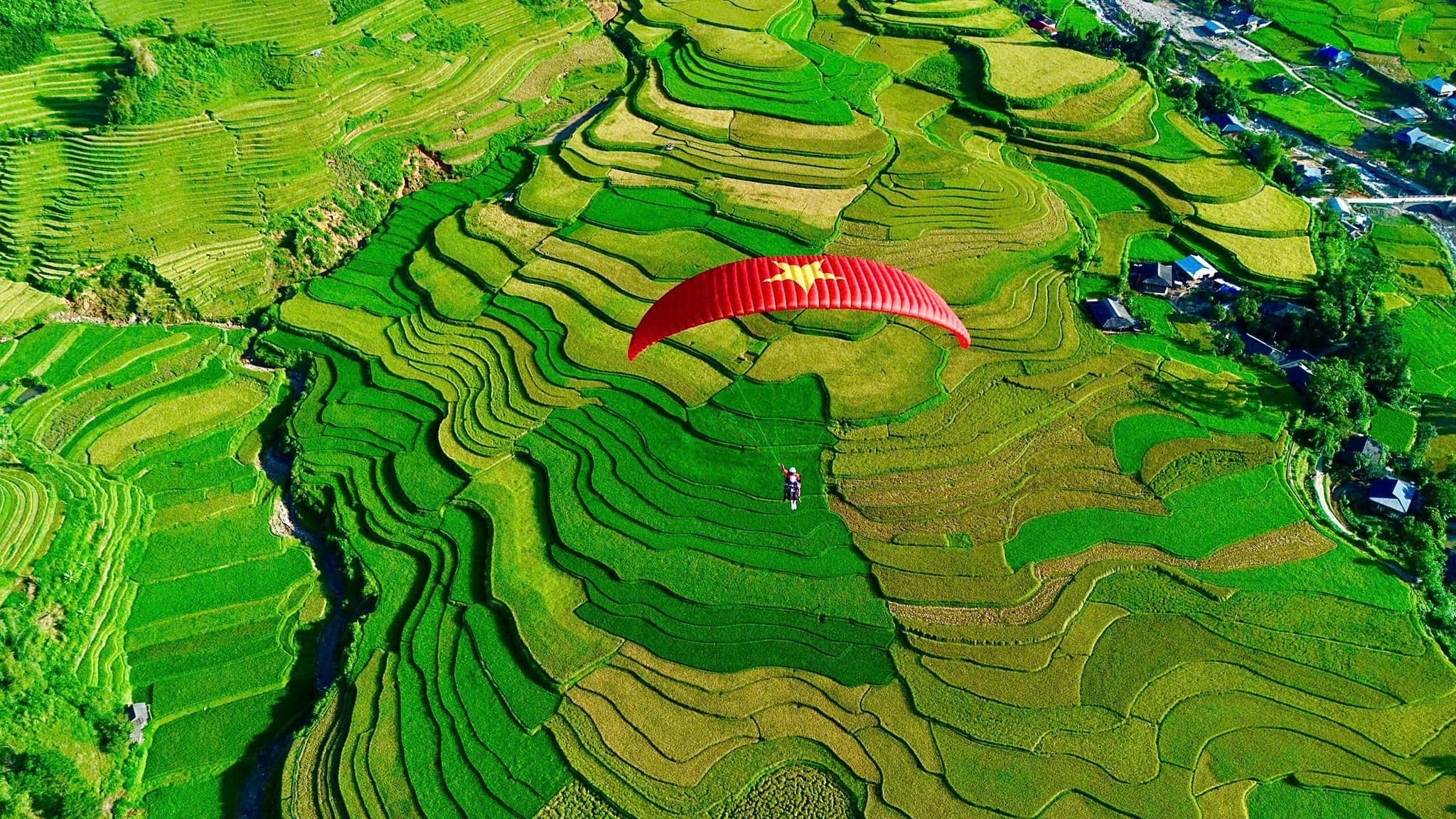
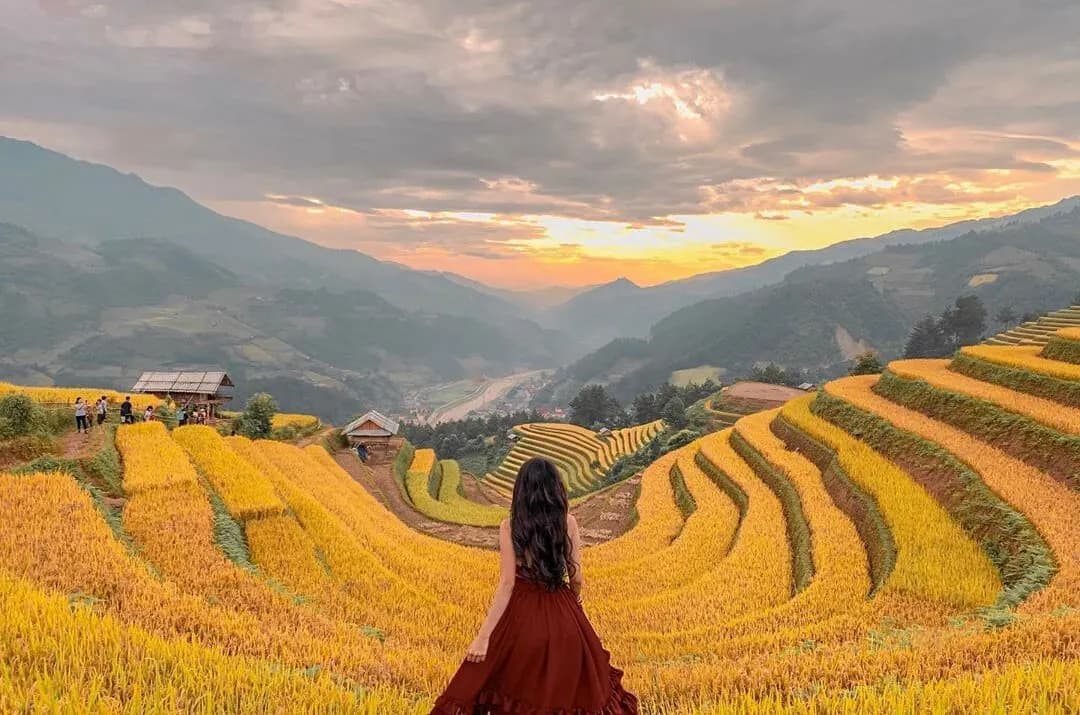
Mu Cang Chai is not just a destination—it is a vast masterpiece woven by both human hands and nature. No matter when you visit, this land always knows how to delight the eyes with its own unique shades and beauty. 👉 The one thing worth doing here is flying. Prices, season and practical tips are in our guide to paragliding in Mu Cang Chai.
🌾 When is the best time to visit Mu Cang Chai?
🎨 The Four-Season Symphony of Mu Cang Chai: Each time you visit, you’ll be treated to a completely different charm: Spring & Summer (February – August): After Lunar New Year, young rice seedlings begin to take root, covering the terraces in a gentle green hue. Notably, from late December to February is the season of wild peach blossoms (To Day) in full bloom, followed by the pure white of Son Tra (wild apple) flowers in late spring. As summer arrives, the entire valley transforms into a vibrant green sea, full of life and vitality.
☀️ Summer (March – April): The Ideal “Heat Escape” Retreat Healing climate: Although daytime can be sunny, the high-mountain terrain keeps the air pleasantly cool and refreshing. In the evening, temperatures drop, creating an especially airy and comfortable atmosphere—perfect for relaxing nights in the midst of the forested mountains. Terraced rice field scenery: Unlike the water-filled season, most terraces at this time are dry, forming artistic, undulating patterns across the landscape. However, in areas with double-cropping, young rice seedlings have already begun to grow, creating vibrant green silk-like strips that stretch across the valleys, bringing a sense of freshness and vitality to the region.
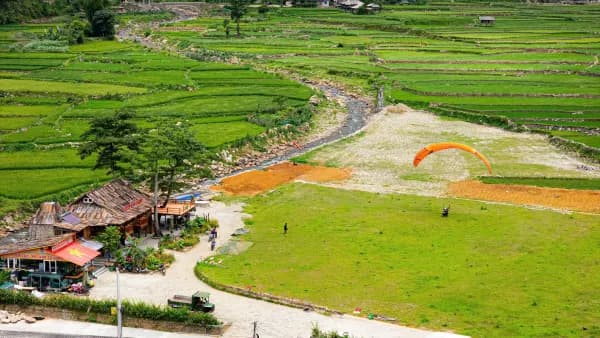
Water-Pouring Season (Late May – Early June): This is when the terraced rice fields enter the transplanting season. Water is channeled into the paddies, covering each terrace and creating a vast “mirror effect” that reflects the sky and clouds of Northwest Vietnam in a truly stunning way. In June, especially, when paragliding at Khau Pha Pass, visitors can still see golden ripe rice around the landing field (Ban It Thai area) due to earlier planting schedules, adding an impressive contrast to the landscape.
Golden Season (September – October): The most glorious time of the year, when the entire mountains and forests are transformed by the shimmering golden color of ripe rice fields. Late August – Early September: This is the best time for paragliding, with clear blue skies and the rice just beginning to ripen across the terraces. October: The ideal period to fully admire the iconic beauty of the “Raspberry Hill” and “Horseshoe Hill,” the signature landscapes of the region.
🎨 Winter (November – January): After the harvest season, Mu Cang Chai becomes quieter and more serene. Landscape: The terraced fields are left with rice stubble and earthy brown tones, often wrapped in mist. This creates a poetic, ink-painting-like scenery full of artistic depth and calmness. Highlight: By late December, wild peach blossoms begin to bloom again in the biting cold, signaling the start of a new cycle of life.
🛣️ How to get to Mu Cang Chai
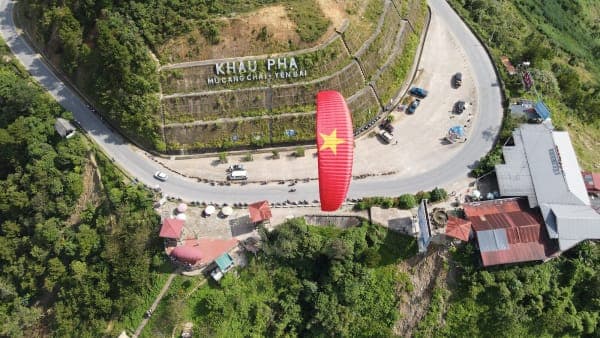
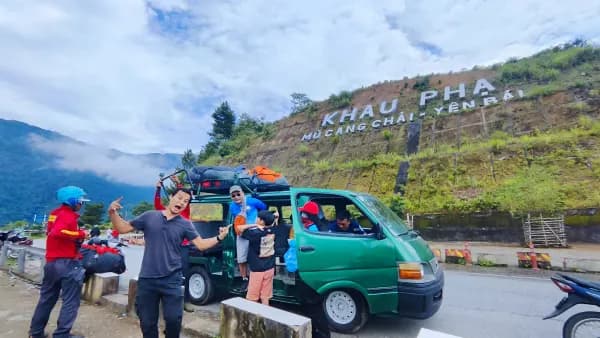
The Mu Cang Chai paragliding site sits on top of Khau Pha Pass, around 250 km from Hanoi; the town of Mu Cang Chai itself is further out, roughly 300 km. Either way the journey is more rewarding than Sapa or Moc Chau, thanks to the passes that cut across the ranges. 📌 Worth knowing before you go: any trip to Mu Cang Chai takes you over Khau Pha Pass. The pass used to be administered as part of Mu Cang Chai; after the recent boundary changes it belongs to Tu Le commune. In terms of landscape and culture, though, it is one continuous stretch — so going to Mu Cang Chai means stopping at Khau Pha and Tu Le too. 📍 Where it is Mu Cang Chai, Tu Le, Tram Tau and Nghia Lo sit side by side in the northwestern mountains. Highway 32 is the main road through the whole area — a legendary route among Vietnamese travellers. 🚌 How to get there 1. Intercity coach (from Hanoi) Coaches leave My Dinh station and follow Highway 32. There are morning, afternoon, evening and overnight departures — the last one around midnight, picking up in the My Dinh area. Shared cars and limousines also run, with one or two early-morning departures a day. Flying into Noi Bai airport? Some coaches run straight to Mu Cang Chai past the flying site: Thanh Anh in the morning, Mai Trang in the evening (pick-up around 8 pm). Some coaches take the Noi Bai – Lao Cai expressway before turning off. This is the safe, economical option. 2. Resort shuttles Resorts such as Le Champ and Garrya run their own shuttle services, so you can travel in the resort's vehicle. 3. Your own vehicle (motorbike or car) Riding or driving the route is a fine experience if you want freedom and the full sweep of the northwestern mountains. Two main routes: 📍 Route 1: the traditional road along Highway 32 The shortest and most scenic, but also the most demanding, with long winding passes. Detail: Hanoi (My Dinh) ➔ Nhon ➔ Son Tay ➔ Trung Ha bridge (Ba Vi) or Dong Quang bridge ➔ Thanh Thuy ➔ Thanh Son (Phu Tho) ➔ Tan Son ➔ Thu Cuc ➔ Ba Khe ➔ Nghia Lo ➔ Tu Le ➔ Khau Pha Pass ➔ Nga Ba Kim ➔ Mu Cang Chai town. Best departure time: leave at 5 am. At a steady pace with breaks, you will reach Nghia Lo or Tu Le right around lunchtime — good timing for a plate of the famous Tu Le sticky rice. Why take it: the road passes a string of scenic spots, above all Khau Pha, one of the four great passes of the north. 📍 Route 2: via the Noi Bai – Lao Cai expressway, exiting at IC14 (recommended) This is the route Mebayluon recommends to guests: shorter and with fewer passes than exiting at IC12 or IC13. Detail: Hanoi ➔ Noi Bai – Lao Cai expressway ➔ exit at IC14 (Mau A, km150) ➔ Nghia Lo ➔ Highway 32 ➔ Tu Le ➔ Khau Pha Pass ➔ Mu Cang Chai. Note: the expressway is always the better choice — faster, safer and considerably smoother. Exiting at IC12 (Nga 3 Mi) or IC13 (Highway 37) still gets you there, but the road is longer and has more passes. 🚧 Coming soon: the IC15 junction (Dong Cuong), linking directly to Highway 32 at Gia Hoi, is expected to open around September 2026. That will cut the run from the expressway to Tu Le from about 120 km to roughly 80 km. Until then, IC14 remains the way to go. 💡 Practical tips Check your vehicle: before setting off, make sure brakes, tyres and lights are in good order — you will be crossing a lot of mountain passes. Flying with us: if you have a paragliding booking with Mebayluon, both routes take you straight over Khau Pha Pass, where the launch site is — very convenient for stopping off. Alternatively get off at the "Lim village junction" (3 km from Tu Le town) to reach the landing field and watch the flying. Navigation: always use Google Maps together with the road signs, as GPS signal can drop out in the mountains.
Summary buses/car going Mu Cang Chai - Tu Le via Khau Pha Pass
⛰️ Khau Pha Pass and Tu Le — the stretch you can't skip
Any trip to Mu Cang Chai takes you over Khau Pha Pass. The pass was formerly part of Mu Cang Chai; after the boundary changes it belongs to Tu Le commune — but in landscape and culture it is one continuous stretch that cannot really be separated. Khau Pha is one of the four great passes of northern Vietnam. From the top, at 1,268 m, you look down over the whole valley of rice terraces — a view many people call the finest in the Northwest. Tu Le brings together things few other places manage at once: ♨️ Natural hot springs, onsen-style bathing in the middle of the mountains. 🏨 Le Champ Tu Le Resort Hot Spring & Spa — a high-end resort, with a zipline as well. 🪂 Paragliding — the only flying site in the whole region, right on Khau Pha Pass. 🏔️ Big mountain scenery, with terraces curving around the slopes. 🧵 Living Thai and Hmong culture: indigo dyeing, green-rice pounding, traditional stilt houses. The people here are welcoming and the place has not been commercialised. In short, Tu Le is not somewhere to drive through. It is worth stopping for at least a night.
🛌 Where to stay in Mu Cang Chai: from budget rooms to resorts
Mu Cang Chai is a land of simplicity, where you can find peace and relaxation in the midst of vast mountains and forests. Accommodation here mainly focuses on local experiences, offering a warm and intimate atmosphere. 1. Traditional stilt-house homestays – Local cultural experience This is the most common and distinctive type of accommodation. If you are traveling in a group or want to learn about the lifestyle of the Thai and Hmong ethnic groups, this is the best choice. Features: Traditional stilt houses with dorm-style rooms (capacity from 10 to 30 people) or private rooms. Food services and small convenience shops are often available on the ground floor of the house. Typical areas: It Thai village (also called Lim Thai), Lim Mong, terraced rice field areas such as La Pan Tan, Che Cu Nha, De Xu Phinh, or Tu Le valley. Suggestions: Clubhouse Mebayluon (It Thai Village), KPF (It Thai Village), Do Gu Homestay (La Pan Tan), A Lu (La Pan Tan), A Su (La Pan Tan), Che Cu Nha. 2. Ecolodge model – eco-friendly retreat For travelers who prefer a quiet, green space with aesthetic design, close to nature while still ensuring privacy. Features: Thoughtfully designed lodges, often located on hillsides with direct views of terraced rice fields. Suggestions: Hello Mu Cang Chai, Mu Cang Chai Eco Lodge (La Pan Tan), etc. 3. Budget hotels – basic comfort If you prioritize privacy and urban-like amenities, staying in the town center is a suitable option. Features: 1–3 star hotels with basic facilities such as TV, refrigerator, private bathroom, and Wi-Fi. Location: Mainly concentrated in Mu Cang Chai Town and Tu Le, convenient for night dining and walking around. 4. Higher-end options Le Champ Tu Le Resort Hot Spring & Spa (hot springs, spa, mountain views) Garrya Mu Cang Chai (luxury resort in nature) 5. Nghia Lo and Tram Tau areas (about 60 km from Khau Pha Pass): These areas offer slightly more upscale hotels and resorts, ideal for resting before or after conquering Khau Pha Pass. 💡 Advice: Book early: During the golden rice season (September–October), accommodations are often fully booked. You should reserve at least 2 weeks to 1 month in advance. Convenient location: If you plan to go paragliding at Khau Pha Pass, staying at Clubhouse Mebayluon or homestays in Tu Le/ Lim Mong will save significant travel time. Experience tip: Don’t miss staying one night in a stilt house to enjoy bamboo rice, grilled chicken, and corn wine with locals – it will likely be the most memorable part of your trip.
🛵 Routes to explore Mu Cang Chai
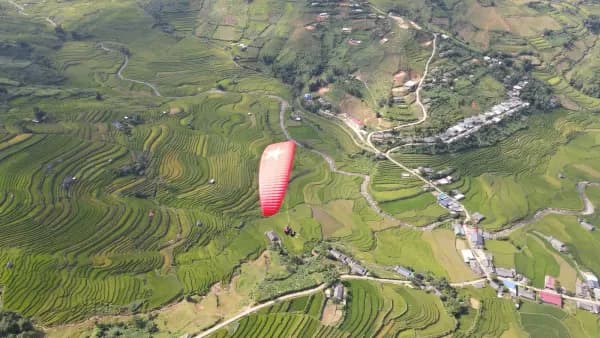
🛵 Exploration Journey The area around Khau Pha Pass and the valley at its foot is not just a destination, but a deeply emotional journey—where you immerse yourself in majestic nature and rich local culture. 1. Conquering the sky at Khau Pha Pass Khau Pha Pass – one of Vietnam’s “Four Great Mountain Passes” – is also the launch site of the annual paragliding festival “Flying over the Golden Season.” Unique experience: From the summit at over 1,200 meters above sea level, you take off with your pilot and slowly glide through the clouds, feeling a thrilling sense of freedom. Million-dollar view: The entire Lim Mong valley appears beneath you like a living painting. Terraced rice fields stretch like golden silk ribbons, while small stilt houses peek through the misty mountain air—creating unforgettable memories. Note: As this activity attracts many visitors, especially during the September–October rice season, it is recommended to book in advance with paragliding operators (such as Mebayluon Paragliding) to secure your slot and receive weather support. 2. The Lim Mong valley and It Thai village: the beauty at the foot of the pass Nestled within the embrace of towering mountains, It Thai and Lim Mong villages are long-standing settlements of the Thai ethnic group, known for their simple and untouched beauty. Village roads: Crossing a charming suspension bridge over a cool stream, you’ll find narrow winding paths climbing the hillsides. In September and October, this journey becomes magical as golden rice fields line both sides of the road, filling the air with a rich harvest scent. Village life experience: Visitors can leisurely ride motorbikes or walk through golden terraces, feeling the rhythm of harvest season and capturing once-in-a-lifetime photos. Cultural interaction: You will meet warm smiles from local children and the hospitality of elderly villagers. Don’t hesitate to talk with them to learn more about local customs and traditions. Relax by the stream: After a day of exploration, stop by a crystal-clear stream and feel the cool water flowing through your hands—a natural form of relaxation from the mountains.
🏛️ National Heritage: The Roads to the Sky The terraced rice fields cover a vast area of more than 2,200 hectares across Mu Cang Chai. Of these, 500 hectares have been officially recognized by the Ministry of Culture, Sports and Tourism as a National Heritage Site. Your journey to admire this heritage should not miss the “golden triangle” of terraced fields: * La Pan Tan: Home to the most graceful curves, especially the famous Raspberry Hill. * Che Cu Nha: Steep, majestic terraces full of dramatic beauty. * De Xu Phinh: A peaceful and poetic blend of nature and village life. 1. Raspberry Hill (La Pan Tan) – The symbol of the golden season Located about 8 km from the town center, Raspberry Hill is an iconic representation of Northwest Vietnam’s abundance, with its golden swirling rice terraces. How to get there: The road is steep and difficult. It is recommended to park at the foot of the hill and hire a local motorbike taxi for safety and convenience. Experience services: * Flower fields (buckwheat flowers) blooming near the hill * Renting ethnic costumes for traditional-style photo shoots Entrance fees (reference): * Entry ticket: 20,000 VND/adult | 10,000 VND/child * Photo platform fee: 5,000 VND/person * Access to rice fields: 10,000 VND/person --- 2. Horseshoe Hill (Sang Nhu) – A photographer’s paradise Just over 2 km from the town center, Horseshoe Hill is famous for its majestic semicircular terraced fields and stunning sunset views. How to get there: Despite its proximity, the road is steep and narrow. A round-trip motorbike taxi usually costs around 60,000–100,000 VND per person. Best time to visit: Late afternoon, when the setting sun lights up the terraces in a glowing golden hue. Entrance fee: 20,000 VND/adult | 10,000 VND/child 3. Na Hang Tua Bamboo Forest – A “Little Jiangnan” in the mountains About 20 km from town, this 60-year-old bamboo forest offers a peaceful, emerald-green escape from the busy world. Features: A cinematic landscape ideal for photography, also a local source of bamboo shoots for the region. Travel note: The road is very challenging, with steep slopes and muddy conditions during rain. Cars cannot reach the site, so visitors usually hike or hire locals on motorbikes. Experience: Enjoy absolute silence, breathe in the scent of bamboo, and take unique, wuxia-style photos. 🍴 Food & evening experience: In the evening, the town becomes livelier with more dining options. Don’t miss the night market, where you can try traditional Thai dishes such as grilled fish (Pa Pinh Top), smoked buffalo meat, and local black pigs.
💚 Tu Le: A stopover filled with the scent of young sticky rice Located just about 3 km from Khau Pha Pass, Tu Le is a refined stop that captivates every traveler. ♨️ Hot spring bathing experience (local experience) Location: Open-air bathing pools located right beside the stream flowing through the village. Experience: Many homestays in Tu Le have even brought natural hot spring water directly into their private bathing areas for guests. Cost: Free or a very small maintenance fee for the village (around 10,000–20,000 VND). 🏨 Premium experience at Le Champ Tu Le Resort For those seeking a more luxurious and professional retreat: Services: Japanese-style Onsen area with hot tubs and infinity pools overlooking the rice terraces of Tu Le valley. Facilities: Outdoor mineral pools, indoor wooden bathtubs, along with high-end spa and massage services. Experience: You can spend a night in Tu Le to enjoy the fresh mountain air before crossing Khau Pha Pass into the “land of terraced rice fields” – Mu Cang Chai.
🍽️ Food and drink in Mu Cang Chai
1. Tu Le sticky rice & Tu Le green rice flakes (Com Tu Le) These are the “soul” of the cuisine in the valley at the foot of Khau Pha Pass. Tu Le sticky rice: The grains are large and round. When cooked, the rice becomes exceptionally sticky, naturally sweet, and richly fragrant. It is often served with grilled local pork or free-range mountain chicken. Tu Le green rice flakes: Made from young rice harvested while still tender and dewy in the morning. The flakes have a natural fresh green color, a soft chewy texture, and a delicate new-rice aroma. You can buy them fresh or enjoy dishes like green rice porridge or green rice sticky rice. 2. Pa Pinh Top (grilled folded stream fish) A signature dish of the Thai ethnic group, prepared with great care. Preparation: Fresh stream fish is split along the back, marinated with local spices such as mac khen, doi seeds, ginger, lemongrass, and forest herbs, then folded and grilled over charcoal. Flavor: The fish is naturally sweet, infused with forest spices, with a slightly crispy skin—very appetizing and perfect with rice. --- 3. Grilled village pork with mac mat leaves The pigs are raised freely, resulting in firm, flavorful, and low-fat meat. Preparation: The pork is cut into bite-sized pieces, marinated, skewered on bamboo sticks, layered with fragrant mac mat leaves, and grilled over charcoal. Experience: Golden, crispy skin and juicy meat combined with the distinctive aroma of mac mat leaves create an irresistible flavor. 4. Mu Cang Chai free-range chicken These chickens roam freely on hillsides, making the meat firm, aromatic, and naturally sweet. Best dishes: Grilled chicken with mac khen or boiled chicken served with salt, pepper, lime, and shredded lime leaves. The golden skin and firm meat pair perfectly with Tu Le sticky rice. --- 5. Wild honeybee larvae A rare mountain delicacy, usually available only from April to August. Preparation: Larvae are stir-fried with sour bamboo shoots or lime leaves. Flavor: Rich, creamy taste combined with the sourness of bamboo shoots or citrus aroma of lime leaves creates a unique and adventurous dish. 6. Bamboo shoots & wild vegetables Don’t miss the simple but fresh mountain vegetables: Bamboo shoots: Small, crunchy, often stir-fried or boiled and served with shrimp paste. Forest greens (such as wild fern and Hmong mustard greens): Slightly bitter at first taste but sweet afterward, and very healthy. 💡 Dining tips In Mu Cang Chai town: There are many local restaurants ranging from casual eateries to ethnic-style dining spots. In the evening, you can visit the night market to try street foods. At homestays: Most offer traditional home-cooked meals. Dining with locals in a stilt house while sipping corn wine is one of the most authentic cultural experiences. Souvenirs: Besides Tu Le green rice flakes, you can buy smoked buffalo meat, pure forest honey, or fresh/dried wild mountain apples (tao meo) as gifts. Evening food scene: The town becomes livelier at night. Don’t miss grilled fish (Pa Pinh Top), smoked buffalo meat, and local pork dishes at the night market.
🎡 Things to do around the Khau Pha site
♨️ Tu Le hot springs — natural mineral water, onsen-style bathing, about 5 km from the paragliding landing field. 🛝 Zipline at Le Champ Tu Le Resort — roughly ten minutes by car from the landing field. 🐟 Huy Thanh salmon restaurant — the largest sturgeon and salmon farm in the province, sitting between the launch and landing sites. 🍲 Pho Nui and Suoi Tien restaurants in Tu Le town — known for local ethnic dishes. 🏍️ Motorbike hire: 150,000–200,000 VND a day, 100,000–120,000 for half a day. 🧵 Culture: watch Thai indigo dyeing, try pounding green rice with the villagers. 🎁 What to take home: • Tu Le com — fresh green rice, fragrant and chewy, known across northern Vietnam thanks to the local sticky rice variety. • Tu Le sticky rice — large, soft, fragrant grains that steam beautifully. • Com sticky-rice cakes — made from hand-pounded green rice, soft with the scent of young grain. • Khau hang — this is the one you will struggle to find elsewhere: mature green rice, harvested later than ordinary com and then steamed. The grain is firmer, the flavour deeper and quite distinctive. If you only take one thing home, many people pick this. • Sen cu rice — another local speciality variety.
🎪 Festivals and events through the year
🌾 The Tu Le green rice festival — held at the end of August, this year for the second time. Tu Le com is known across northern Vietnam for the fragrant sticky rice grown here. 🏃 The Trail & Chill Khau Pha run — registration on 22 August, race on 23 August, with 10 km, 20 km and 30 km courses. The route crosses the rice terraces and is widely rated the most beautiful trail in the Northwest. Sign up at weyo.vn/trailchillkhaupha. 🪂 Flying season — best during the golden harvest in September and October, and the water-pouring season in May and June. Every Mebayluon flight can be refunded, cancelled or rescheduled free of charge; just let us know a few hours before departure.
Please act responsibly: do not litter. Avoid crowding or pushing when taking photos, and do not give money or candy to children along the roadside. The weather in Mu Cang Chai can be unpredictable—hot and sunny during the day, but cool and chilly at night. Visitors should bring a light jacket to avoid catching a cold.
🪂 Book a flight over the rice terraces
🏞️ What's at the Khau Pha launch and landing field?